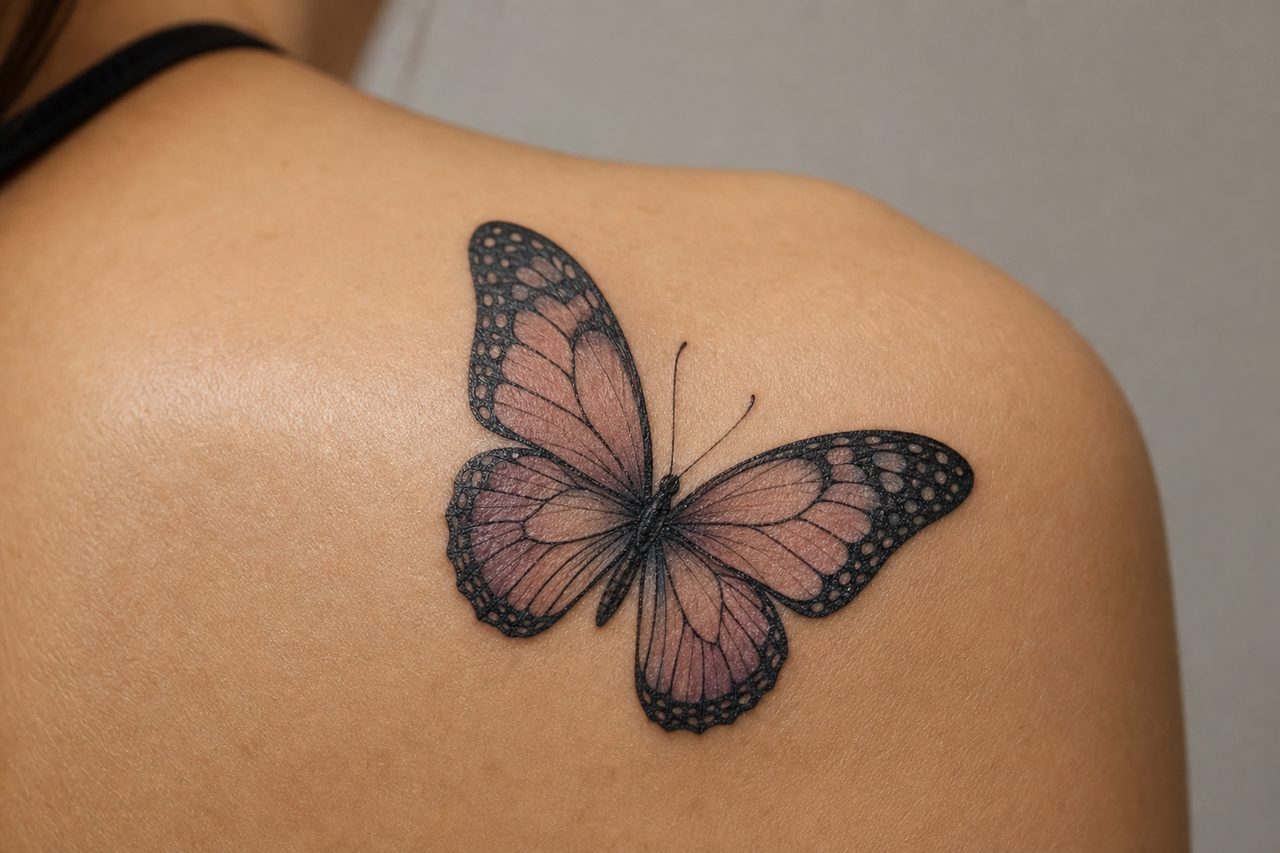
The butterfly tattoo most commonly signals transformation, personal growth, survival through hardship, or a major life change. Beyond that single reading, it carries threads of freedom, the soul’s passage, feminine energy, and the Japanese concept of living beauty that vanishes. The meaning tightens or loosens depending on species chosen, color palette, whether the wings spread or fold, and what accompanies the image.
Mythology & Folklore
Butterflies flutter through global folklore with surprising consistency, though the specifics shift dramatically by region.
European and Celtic Threads
In Irish tradition, butterflies were often linked to the soul, sometimes specifically the souls of the dead, sometimes of the living who traveled in dreams. The word for butterfly in old Irish, dealan-dhe, carries ghostly associations. This soul-connection traveled to the Americas with immigrants and persists in memorial tattoos, particularly white or pale butterflies placed near dates of passing.
Less commonly known: in some Scottish Highland stories, a golden butterfly near a home foretold a visitor, while a dark one warned of bad news. These color distinctions still influence modern choices, gold butterflies for welcome change, black for mourning or mystery.
East Asian Traditions
Chinese lore often links the butterfly to young love and conjugal happiness, most famously through the Zhu Yingtai legend where lovers transform into paired butterflies after death. A pair of butterflies in tattoo work still carries this romantic charge, distinct from the single butterfly’s focus on individual transformation.
Japanese monshirocho (the cabbage white butterfly) appears in samurai imagery as a symbol of the soul, particularly the souls of warriors. The connection between brief life and beautiful death resonated with bushido aesthetics. Japanese-style butterfly tattoos often incorporate this martial undertone, pairing the insect with skulls, swords, or falling cherry blossoms.
Mesoamerican cultures, particularly the Aztec, associated butterflies with fallen warriors and women who died in childbirth, both considered sacred deaths that fed the sun. The goddess Itzpapalotl, the Obsidian Butterfly, was a fearsome skeletal figure with butterfly wings, complicating any simple reading of the symbol as purely gentle.
Similar & Related Symbols
The butterfly shares symbolic territory with several images that tattoo collectors often consider alongside or in combination with it.
- Moth: The butterfly’s nocturnal counterpart carries darker associations, attraction to flame, self-destruction, the unseen. Luna moths specifically suggest fleeting beauty and the search for light. Where butterflies signal accomplished transformation, moths often represent ongoing struggle or dangerous obsession.
- Dragonfly: Another winged insect of transformation, but with sharper edges, water associations, adaptability, the ability to move in six directions. Dragonflies read as more aggressive, more ancient, less delicate.
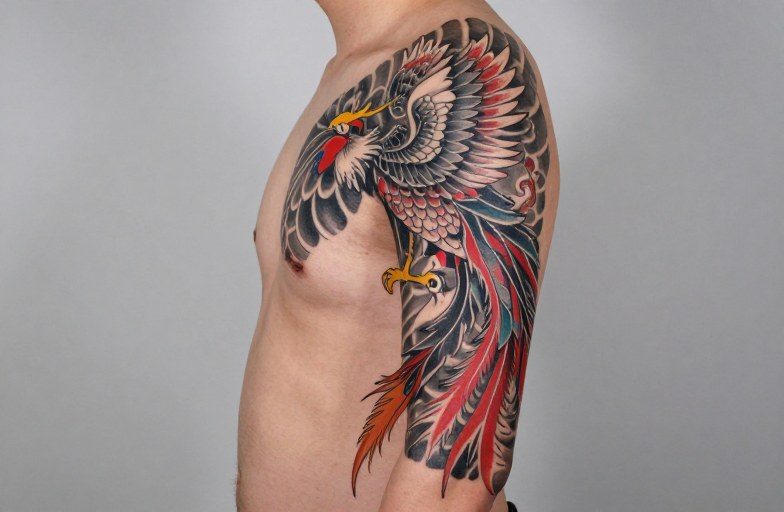
- Phoenix: The fire-bird’s cycle of death and rebirth parallels the butterfly’s metamorphosis, but operates on a grander, more violent scale. Phoenix tattoos suit dramatic life-overcoming narratives; butterflies handle quieter, more internal shifts.
- Caterpillar: Occasionally tattooed as the “before” state, sometimes with the butterfly as “after.” This pairing risks being too literal, but works when rendered with genuine artistic vision rather than clip-art obviousness.
- Flower pairings: Roses with butterflies create a garden-gothic mood; cherry blossoms align the butterfly’s brief life with the Japanese mono no aware aesthetic; milkweed specifically references monarch migration and ecological consciousness.
Design Tips & Pairings
Meaning in butterfly tattoos lives in the execution details, not just the symbol itself.
Species Selection
Monarchs dominate for good reason, their orange-and-black pattern reads instantly, and their actual migration cycle (Mexico to Canada and back, spanning multiple generations) layers genuine natural symbolism onto personal transformation narratives. However, this popularity means monarchs can feel generic unless handled with distinctive technique.
Swallowtails offer more visual drama with their tailed hindwings and varied coloration (black and yellow, or the iridescent blue of the pipevine species). Blue morphos provide electric color that photographs dramatically but fades faster, something to discuss with your artist about long-term expectations.
Choosing a less recognizable species (the mourning cloak, the question mark, the comma, named for punctuation-mark wing shapes) signals deeper knowledge and creates conversation. These also allow more interpretive, less literal rendering by the artist.
Line Work vs. Shading Approaches
Butterflies suit multiple technical approaches, each carrying different weight. Fine single-needle line work captures the insect’s fragility and works well at smaller sizes, but requires extremely skilled execution, wobbly lines on wing veins destroy the effect. Bold traditional American styling with thick outlines and limited color palette reads as vintage and confident, less delicate.
Watercolor technique (no black outlines, color bleeding at edges) mimics actual butterfly wing structure, scales that create color through light refraction rather than pigment. This approach ages unpredictably; the bleeding that looks intentional at year one can become muddy by year five. Black-and-grey realism with careful stippling for texture often outlasts trendier color approaches.
Common pairing strategies include: butterflies emerging from objects (broken clocks, cracked eggs, open books); geometric frames containing organic wing shapes; negative-space butterflies where the insect is the un-inked skin surrounded by dark background.
Religious & Spiritual Angles
Christian tradition has an uneasy relationship with butterfly imagery. The resurrection parallel is obvious and often cited, caterpillar entombed, butterfly risen. Early Christian art used butterflies on tombstones, particularly in the catacombs. Yet the symbol never achieved the institutional centrality of the fish or cross, leaving it available for personal, non-dogmatic spiritual expression.
Buddhist and Hindu contexts emphasize the butterfly’s impermanence, its brief adult life, often just weeks, embodies anicca (the Pali term for impermanence). This isn’t depressing in those frameworks; it’s accurate. A butterfly tattoo can function as a daily reminder against attachment, against clinging to states that must change.
New Age and contemporary spiritual circles have layered additional meanings: butterflies as signs from deceased loved ones, as indicators of spiritual “upgrade” or dimensional shift. These interpretations are recent and culturally specific, not ancient wisdom. They matter because clients bring them, not because they carry historical weight.
Common Variations & Styles
Visual approaches to butterfly tattoos have shifted across decades and continue evolving.
- Traditional American: Heavy black outlines, limited color palette (red, yellow, green, blue), stylized rather than anatomically accurate. Associated with Sailor Jerry-era work and its direct descendants. Reads as confident, timeless, slightly masculine in a symbol often coded feminine.
- Japanese (Irezumi): Butterflies as part of larger compositions, often with peonies, cherry blossoms, or wind bars. Larger scale, more flowing movement, skin showing through as part of the design. Requires commitment to the full aesthetic system.
- Biomechanical: Wings revealing gears, circuitry, or mechanical structures beneath. Popular in the 1990s and early 2000s, now less common but still requested by specific collectors. Suggests transformation through technology or the body as machine.
- Minimalist/single-line: One continuous line forming the butterfly shape. Extremely dependent on precise execution; errors have nowhere to hide. Ages poorly if too thin, holds up at moderate weight.
- 3D/hyperrealism: Butterflies appearing to rest on skin, cast shadows, wings overlapping actual body contours. Technically demanding, impressive when fresh, vulnerable to aging as the illusion depends on fine detail that blurs.
- Abstract/deconstructed: Wing patterns separated from body, scattered across a larger area, or reduced to essential shapes. Allows personal symbolism to dominate over literal representation.
Best Placements
Butterfly anatomy dictates certain placements more naturally than others. The bilateral symmetry of actual butterflies means they work best where the body’s own symmetry supports them, upper back center, chest center, sternum, lower abdomen. Off-center placements require deliberate asymmetry in the design to avoid looking accidentally misplaced.
Wrist and ankle placements remain popular for visibility and the “released” gesture, butterfly about to fly away. These areas move constantly, which accelerates aging. Small butterflies here often need refreshing within five years. The shoulder blade offers flat, stable skin that shows the wing shape clearly and allows for larger, more detailed work.
Behind the ear and on the neck have gained popularity; the butterfly’s compact shape suits these intimate locations. However, neck visibility affects employment options in ways that shouldn’t be dismissed. The rib cage and side accommodate larger, more spread-wing compositions but hurt significantly more due to proximity to bone and thinner skin.
Hand and finger butterflies trend periodically. These placements blur fastest due to constant use and sun exposure, and the butterfly’s delicate detail rarely holds up. Consider bolder, simplified versions for these areas if committed.
Final Word
The butterfly tattoo endures because it operates on multiple registers simultaneously, personal transformation, natural beauty, spiritual passage, aesthetic pleasure. Its flexibility is its strength and its trap. The symbol can absorb almost any meaning, which means the specific choices you make, species, style, placement, accompaniments, must carry the weight. Generic butterfly imagery without these decisions reads as decoration without intention. Work with an artist who pushes past the obvious, and the result can be genuinely yours rather than a borrowed symbol wearing your skin.
Frequently Asked Questions
Does a butterfly tattoo always mean someone went through trauma?
No. While transformation symbolism attracts people who’ve survived difficulty, many choose butterflies for pure aesthetic appeal, spiritual reasons, or cultural connections. The meaning isn’t automatic, ask the person, or let your own reasons stand independently.
Why do monarch butterflies specifically show up in so many tattoos?
Monarchs have the most visually recognizable pattern, strong migration symbolism that mirrors personal journey narratives, and cultural significance in Mexican Día de los Muertos traditions. Their orange-and-black contrast also photographs well and holds up in ink.
Will a colorful butterfly tattoo fade to looking bad?
All color fades, but yellows and oranges (common in butterflies) actually hold up reasonably well compared to lighter blues and purples. Black linework underneath preserves structure even as color softens. Sun protection matters enormously for longevity, tattoos on frequently exposed skin without SPF application degrade faster regardless of color.
What’s the difference between a butterfly and moth tattoo in meaning?
Butterflies generally carry lighter associations, day, transformation achieved, visible beauty. Moths suggest night, ongoing struggle, attraction to destruction, hidden or dangerous beauty. The moth’s symbolism is less universally positive, which appeals to collectors wanting complexity or darker personal narratives.