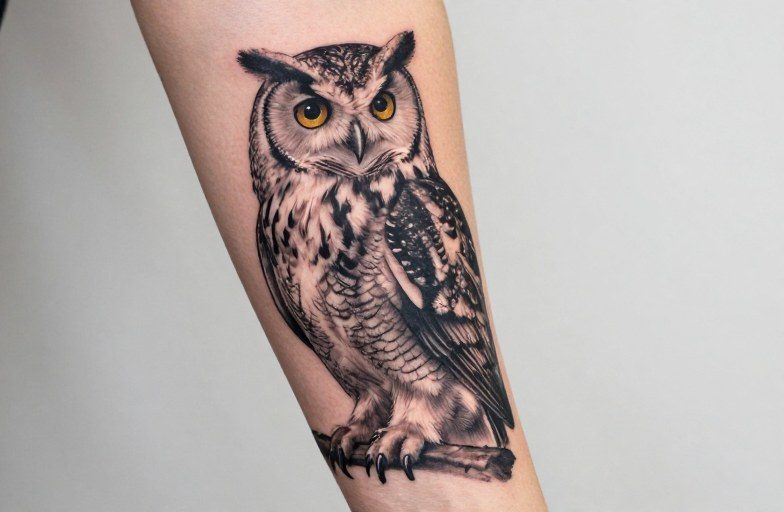
The guardian owl tattoo carries a core meaning of vigilant protection paired with deep, quiet wisdom. Unlike aggressive guardian symbols, the owl watches from darkness without threat, seeing what others miss. It represents someone who protects through awareness rather than force, keeping loved ones safe, guarding secrets, or standing watch over personal boundaries.
Symbolism & Core Meaning
The Watchful Eye
Owls possess extraordinary night vision and a neck that rotates nearly 270 degrees, biological facts that translate naturally into tattoo symbolism. The guardian owl becomes a symbol of total awareness, nothing escapes notice. In tattoo form, this often shows in the rendering of the eyes: large, forward-facing, frequently done with heavier black fill or detailed iris work to catch light. Some designs emphasize asymmetry, one eye catching moonlight, the other shadowed, suggesting the ability to see in both conditions.
Silent Guardian vs. Active Protector
There’s a meaningful distinction here. A wolf or bear guardian tattoo implies confrontation, teeth, defense through strength. The owl guardian protects through presence and perception. This appeals to people who see their protective role as preventive, spotting danger early, reading rooms, knowing who’s trustworthy. The owl doesn’t need to fight because it already knows where the threat is.
- Large eyes: awareness, intuition, seeing hidden motives
- Perch or branch: stability, chosen vantage point, patience
- Moon or night sky: comfort operating in uncertainty, emotional darkness
- Feather detail: quiet movement, leaving no trace, discretion
- Claws gripping: readiness, latent capability, held strength
Personal & Modern Meanings
Family and Relationship Guardians
Parents sometimes choose this design after children arrive, not as a cute “mom/dad tattoo” but as a shift in self-concept. The owl acknowledges changed sleep patterns, literally being awake at night, and a new psychological state of permanent alertness. Placement matters here: chest pieces over the heart, or upper back where the wearer can’t see it but knows it’s there. Some pair the owl with specific elements, a key, a name in script, a date in Roman numerals worked into the branch texture.
Recovery and Self-Protection
For those who’ve left toxic relationships or survived situations where perception failed them, the guardian owl marks a reclaimed vigilance. Wearers who pair protection with freedom sometimes also look at the horse tattoo for its complementary meaning of unbreakable spirit. Not paranoia, but earned caution. The tattoo functions as a self-reminder: trust what you notice. Common placements include the forearm (visible, a conscious choice to display boundaries) or ribs (private, personal armor). Line-heavy designs without heavy shading age cleaner here, since these placements see movement and sun exposure.
Religious & Spiritual Angles
Christian Symbolism
Christian art occasionally placed owls in manuscripts as symbols of solitude and darkness-before-dawn, though the bird’s nocturnal nature also earned it negative associations in some medieval contexts. Modern Christian wearers often reclaim this, emphasizing the owl’s watchfulness as analogous to spiritual alertness, “watch and pray,” the Gospel injunction. Designs might incorporate subtle crosses formed from branch structures, or olive branches rather than bare wood, shifting the tone from isolation to peace.
Contemporary Spiritual Practice
Among those who don’t identify with organized religion, the owl frequently represents spirit guide or totem concepts. This isn’t traditional Native practice (see below) but a widespread modern spirituality where animals carry personal significance. The guardian owl here becomes a claimed ally, someone to call on for discernment, for knowing whether a person or situation is safe. Tattoo designs in this vein often include more mystical elements: geometric mandala backgrounds, third-eye imagery, or aurora-like color work that wouldn’t appear in more traditional renderings.
History & Cultural Roots
Attributing specific meanings to owl imagery requires care, as different cultures treated the bird with dramatically varied significance.
Ancient Greek and Roman Associations
The owl accompanied Athena/Minerva, goddess of wisdom and strategic warfare, not brute combat, but planned defense. This ancient link between owl and protective intelligence persists in Western symbolism. Athena’s owl appeared on Athenian coinage, a civic guardian watching over the city-state. Roman soldiers reportedly feared hearing owls before battle, a superstition that reveals the bird’s liminal status, protective to some, ominous to others.
Native American and Indigenous Contexts
Various Indigenous nations hold specific owl traditions, often linked to death, transition, or spirit messengers rather than guardianship in the modern tattoo sense. Some Plains nations associated owls with protective medicine; others viewed them as carriers of supernatural warning. The diversity matters, there is no single “Native American owl meaning.” Non-Native wearers should avoid claiming tribal significance without specific cultural connection, and artists should steer clear of combining owl imagery with generic “tribal” patterning that collapses distinct nations into visual shorthand.
Japanese and East Asian Traditions
In Japanese, “owl” (fukurou) shares sounds with “luck” and “protection from hardship,” making it a popular motif in netsuke and contemporary design. It sits alongside other Japanese tattoo imagery like the koi carp in the broader tradition of protective and auspicious animal symbols. This linguistic association, rather than mythological narrative, drives much of the guardian connotation in Japanese-influenced tattooing. The owl appears in some forms of fukairi (protective) imagery, though less commonly than tigers or certain deities.
Who Chooses This Tattoo
Professions of Observation
Security workers, investigators, therapists, journalists, people whose work demands reading situations accurately, sometimes gravitate toward guardian owl designs. The tattoo acknowledges a professional identity that bleeds into personal self-concept. These wearers often prefer realistic or neo-traditional styles over cartoonish or overly stylized renderings, seeking gravitas that matches their self-image.
Transitions and Threshold Moments
Major life changes that involve new responsibility frequently precede this choice: first home purchase, ending a period of instability, becoming primary caregiver for an aging parent. The owl marks a self-recognized shift into a more watchful, less self-centered phase. These tattoos sometimes incorporate timestamps, moon phases, specific constellations, or seasonal elements, that ground the guardian symbolism in a particular moment of commitment.
Similar & Related Symbols
The guardian owl occupies a specific niche among protective tattoo imagery. Understanding adjacent symbols helps clarify whether the owl fits a given wearer’s intent.
- Raven/crow: Also nocturnally associated and intelligent, but more commonly linked to transformation, memory, or trickster energy. The raven guards secrets; the owl guards people. For more on that contrast, the crow tattoo symbolism guide breaks down how these dark birds diverge in meaning.
- Wolf: Pack-oriented, communal protection, active defense. Where the wolf fights, the owl observes and warns.
- Hawk/eagle: Daytime vision, solar, overt power. The owl’s darkness association creates a more covert, interior guardian symbolism.
- Gargoyle: Architectural guardian, grotesque, warding through intimidation. The owl protects through knowledge rather than fright.
- Eye of Providence: Divine watchfulness, often religious. The owl substitutes personal, animal vigilance for institutional or divine oversight.
Some designs combine owl with other guardian elements, an owl wearing a wolf’s pelt in stylized form, or an owl with key and lock motifs, to create hybrid symbolism. These work best when the combination serves a specific personal narrative rather than accumulating protective clichés.
Final Thoughts
The guardian owl tattoo endures because it fills a precise symbolic gap: protective without aggressive, wise without elderly, watchful without paranoid. Its visual adaptability, renderable in delicate single-needle work or bold traditional, perched or flying, realistic or geometric, lets it carry this meaning across aesthetic preferences.
What separates meaningful guardian owl tattoos from generic ones is usually specificity of detail. The branch species, the moon phase, the feather position, the eye direction, these choices transform a stock image into a personal symbol. An owl looking left versus right, above versus below, changes the narrative. Working with an artist who asks why you’re choosing this symbol, not just what style you want, typically produces something that actually functions as the guardian it’s meant to be.
As with any tattoo carrying protective meaning, the commitment matters more than the imagery. The owl doesn’t watch by itself. You become it, or it becomes you, and the distinction stops mattering after the first few years.
Frequently Asked Questions
What’s the best placement for a guardian owl tattoo to emphasize its protective meaning?
The upper back and chest work well for guardian symbolism, placing the watchful eyes where you can’t see them but know they’re present. Forearms make the protection visible to others, while ribs keep it private. Consider how much you want to display versus personally carry the symbol.
Do guardian owl tattoos work for men and women equally?
Yes, though style choices often differ. Women frequently choose more detailed, illustrative styles with softer linework, while men often gravitate toward bolder traditional or neo-traditional renderings. The core symbolism transcends gender, and unisex appeal is one reason for its lasting popularity.
How well do owl eye details hold up over time in tattooing?
Intricate iris work with multiple colors tends to blur and fade faster than simpler approaches. For longevity, many experienced artists recommend heavier black outlines around the eyes, limited color palette, and avoiding extremely fine detail in pupils. Touch-ups every 5-10 years keep eye definition crisp.
Can a guardian owl tattoo include color, or should it stay black and grey?
Both work. Black and grey emphasizes the nocturnal, serious quality of the guardian concept. Color, particularly amber or gold eyes, blue moonlight backgrounds, or autumn branch tones, adds warmth and specificity. The choice depends on whether you want the symbol to feel more mysterious or more alive.
Leave a Reply