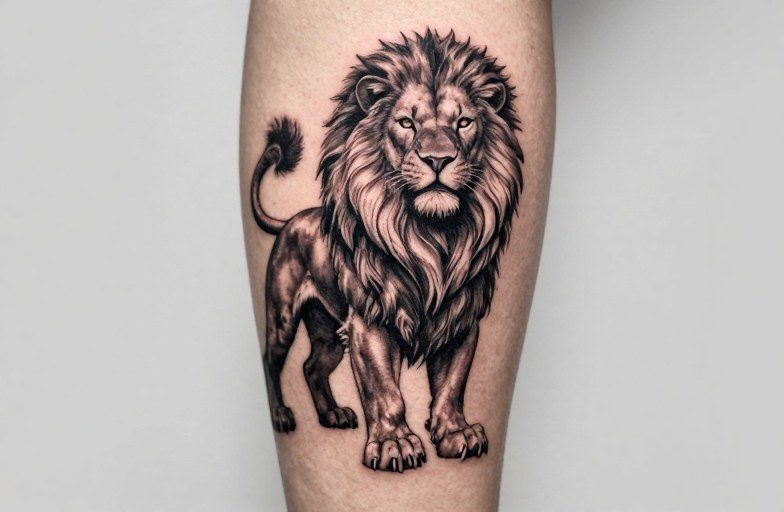
The iron lion ri tattoo fuses three symbols into one image: iron as unyielding strength, the lion as courage and sovereignty, and “ri” as shorthand for Rastafari identity rooted in Ethiopian heritage. Together, they suggest spiritual resilience, African pride, and survival under oppression. Most people drawn to this design connect it to reggae culture, Haile Selassie I, or personal battles they have survived.
What Each Element Carries
The Iron: Tested and Unbroken
Iron in this design means more than toughness. It is often linked to the metal that forged slavery’s chains and the will required to break them. The material suggests something fired and hardened, resistant to bending or corrosion. In tattoo form, iron appears as armor plating, mechanical elements, or darkened, rust-toned texture set against living flesh. Line work matters enormously here. Too clean, and it reads as stainless steel. Too loose, and it dissolves into grey mush. The strongest iron lion pieces use heavy, deliberate outlining with selective whip shading to create that cast-metal density.
Your artist needs to understand how iron catches light differently than skin or fur. Polished surfaces show sharp highlights and deep shadows. Forged or pitted iron reads through texture variation. Discuss reference images of actual wrought iron, aged machinery, or historical armor rather than relying on other tattoo flash.
Related reading: lion neck tattoo symbolism | Japan lion tattoo designs | Chinese lion tattoo meaning | lion tattoo symbolism
The Lion: Judah and Selassie
The lion connects to the Lion of Judah, a title claimed by Ethiopian Emperor Haile Selassie I, whom Rastafarians recognize as divine. This is not generic lion imagery. The mane often incorporates dreadlock-like flows. The eyes frequently carry a human, watchful quality. Some artists render the lion’s face merging with Selassie’s portrait, a technically demanding approach that requires strong photo reference and solid portrait fundamentals. The lion here represents sovereignty, African dignity, and spiritual kingship, not merely animal ferocity.
The specific facial structure matters. A Rastafarian lion typically shows broader, more humanoid features than a wildlife piece. The expression tends toward calm authority rather than snarling aggression. Your artist should study Ethiopian iconography and reggae album art from the 1970s, not just lion photographs.
“Ri”: The Cultural Anchor
The “ri” suffix functions as linguistic shorthand, connecting the wearer to Rastafari culture specifically rather than general lion symbolism. It appears in names, chants, and expressions throughout reggae and dancehall traditions. In tattoo form, “ri” might be lettered across a banner, integrated into the mane’s negative space, or placed as a small counterweight to the main image. Script choice carries weight. Angular, aggressive lettering reads differently than rounded, roots-oriented forms. Many artists hand-draw this element rather than using standard fonts, since the letterforms need to feel organic to the overall composition.
Consider whether you want the text immediately legible or subtly embedded. Some wearers prefer the symbol to speak first, with the text discovered on closer viewing. Others want the cultural declaration upfront.
Religious and Spiritual Dimensions
Within Rastafarian Practice
For practicing Rastafarians, this tattoo operates as sacred imagery, not decoration. The faith centers on African redemption, repatriation, and the divinity of Haile Selassie. The iron lion becomes a visual prayer, a permanent alignment with these commitments. Some wearers incorporate additional symbols: the Ethiopian flag’s green, gold, and red; the Star of David; or Psalm references in Ge’ez script. Not every bearer practices the faith, but the design’s religious origins remain inescapable. Appropriation concerns exist here. This is not a design to choose casually because it looks fierce.
If you do not hold Rastafarian belief or African heritage, consider whether another lion treatment might serve your purposes without borrowing loaded cultural weight. A Nordic lion, a purely wildlife piece, or an abstract strength symbol could express similar personal meaning without crossing into territory that does not belong to you.
Beyond Formal Practice
Outside strict Rastafari, the iron lion attracts people drawn to ancestral strength, survival through hardship, and spiritual endurance. The iron suggests persistence through suffering; the lion, the nobility of maintaining dignity regardless. Some trace the lion motif to broader African diaspora traditions, where it appears across Caribbean and Black American spiritual practices. The design can function as a memorial to elders, a marker of cultural reconnection, or a personal emblem of surviving systemic violence while remaining whole.
Your personal story matters, but it does not erase the symbol’s origins. The strongest pieces acknowledge both: the cultural root and the individual branch.
Personal Stories and Modern Use
Recovery and Transformation
Contemporary wearers often layer personal significance onto the traditional framework. The iron lion has become a marker of recovery from addiction, incarceration, or profound loss. Iron represents the hardness of that passage. The lion represents the life reclaimed afterward. Some veterans and frontline workers adopt the imagery, drawn to its connotations of standing guard and protecting community.
These meanings can coexist with the design’s cultural roots. A piece that honors both your survival and the symbol’s origin tends to feel more grounded than one that strips away context.
The Tension of Secular Use
Modern interpretations sometimes de-emphasize religious specifics while keeping the visual language. This creates tension. The design reads clearly as Rastafarian to knowledgeable viewers regardless of the wearer’s intent. The mane’s dreadlock styling, the color palette, and the lion’s specific facial structure all signal cultural origin. Someone seeking purely generic strength symbolism might be better served by a different lion treatment.
Social media has accelerated the design’s spread, sometimes flattening its meaning into aesthetic category. The strongest contemporary pieces maintain connection to the symbol’s roots while making space for individual narrative. This balance shows in details: a lion’s eyes reflecting specific geography, iron elements shaped like actual tools from your trade, or mane flows that echo family members’ hair textures.
Designing Your Piece
Elements That Work Together
Successful iron lion tattoos incorporate supporting imagery that reinforces rather than competes. Consider these approaches:
- Broken chains integrated into the mane or trailing from the jaw, referencing both slavery’s legacy and liberation
- Ethiopian crosses or Ge’ez script placed as background texture or foreground accent
- Roots or tree forms merging with iron elements, suggesting groundedness and growth through difficulty
- Sound waves or speaker imagery for those connected to reggae and dub music specifically
- Portrait elements of elders or ancestors, requiring an artist with strong likeness skills
Each addition should earn its place. A cluttered composition weakens the central symbol’s impact. Discuss with your artist which elements serve your specific story and which merely fill space.
Technical Execution
This design demands specific technical decisions. The iron portions require dense black packing and smooth grey transitions. Any inconsistency reads as unintentional. The lion’s face needs contrast and clarity. Too much dark surrounding it, and the expression disappears. Many artists work the piece in two sessions: first pass establishing the iron structure and lion outline, second pass building fur texture and refining metal sheen.
Skin tone significantly affects how iron textures read. Darker skin often requires bolder highlights and more deliberate negative space to achieve the metallic effect. Lighter skin allows subtler grey gradation but risks the iron looking washed out. Your artist should adjust their approach based on your specific complexion, not apply a one-size-fits-all formula.
Color and Black and Grey
The Rastafarian Palette
Rastafarian color symbolism offers natural integration: green for land and vegetation, gold for wealth and sun, red for blood and struggle. A full-color iron lion can succeed, but color placement requires discipline. The Ethiopian tricolor works best as background atmosphere, banner elements, or subtle mane tinting rather than overwhelming the central figure. Over-saturated green against black iron creates vibration that fatigues the eye. Muted, earthier versions integrate more smoothly.
Consider whether color serves the piece or merely decorates it. Some of the most powerful iron lion tattoos use color sparingly: a single red accent, a gold eye, green in the negative space behind the figure.
Black and Grey Approaches
Black and grey execution emphasizes the iron’s weight and the lion’s sculptural form. This approach ages more predictably, especially on larger pieces where color saturation might spot or fade unevenly. The challenge lies in preventing muddiness. Without color temperature variation, the iron and lion fur can collapse into similar grey values. Strong artists solve this through texture contrast: smooth polished metal against rough, directional fur strokes, and strategic use of pure black anchors. White ink highlights on the iron elements can suggest reflected light, though white’s tendency to yellow or disappear should be discussed frankly with your artist.
Ask to see healed photos of your artist’s black and grey work, not just fresh tattoos. Iron textures that look crisp on day one often soften substantially over time.
Where to Place It
Scale Requirements
The iron lion requires room to develop. The face detail and iron texture both suffer at small sizes. Minimum comfortable scale for a legible face with recognizable iron elements sits around palm-sized; ideally larger. Common strong placements include:
- Upper arm and shoulder: classic canvas with natural muscular framing for the lion’s mane
- Thigh: ample flat space for detail, easily concealed or revealed
- Back: allows for full mane expansion and background elements like Ethiopian landscape or script
- Chest: the heart placement resonates with the symbol’s spiritual weight, though curvature challenges face symmetry
- Forearm: visible daily reminder, but limits scale and requires careful flow around the cylindrical form
Direction and Flow
The lion’s face has inherent directionality. It is looking somewhere. Placement should respect this. A chest piece with the gaze directed inward toward the sternum reads as self-contained and contemplative. The same face turned outward toward the shoulder reads as watchful, protective. The iron elements have their own visual weight, typically heavier and more static, which anchors the composition. Your artist should map how the piece moves with your body, not just how it sits in a stencil on flat skin.
Consider your professional and social contexts. The forearm’s visibility carries different weight than the thigh’s concealability. The iron lion’s cultural specificity means it will be read by others, accurately or not. Choose placement that aligns with how publicly you want to carry that conversation.
Before You Decide
The iron lion ri tattoo holds genuine power because its symbols have been tested by history, faith, and personal struggle. It is not a design to choose quickly or wear lightly. The best pieces result from honest conversation with your artist about your connection to the imagery, your respect for its origins, and your specific technical needs. Bring reference that matters to you: family photographs, Ethiopian art, reggae album covers, textures from your own life. The tattoo should feel earned, not applied.
Take time finding an artist who understands both the technical demands and the cultural weight. Portfolio review should include healed black and grey work, portraiture if you want Selassie’s likeness, and lettering if you include the “ri” element. Ask about their experience with similar pieces and their approach to cultural symbols generally. The right artist will welcome these questions rather than rush past them.
This design lasts. Make sure the meaning behind it does too.
Frequently Asked Questions
What does ‘ri’ specifically mean in the iron lion ri tattoo?
It functions as shorthand for Rastafari, the spiritual and cultural movement that emerged in Jamaica in the 1930s. The suffix appears in names, chants, and expressions throughout reggae and dancehall traditions. In tattoo form, it connects the design to that specific cultural and religious context rather than general lion symbolism.
Can anyone get an iron lion ri tattoo, or is it culturally restricted?
There is no formal restriction, but the design carries deep meaning within Rastafarian practice and African heritage. If you lack connection to these traditions, consider whether another lion treatment might express your intentions without borrowing loaded cultural weight. The symbol will be read as Rastafarian by knowledgeable viewers regardless of your personal intent.
How large does an iron lion ri tattoo need to be?
Palm-sized is the practical minimum for the face detail and iron texture to read clearly. Larger is generally better. The iron elements require dense black work that needs space to develop proper contrast, and the lion’s facial features lose impact when compressed.
Leave a Reply