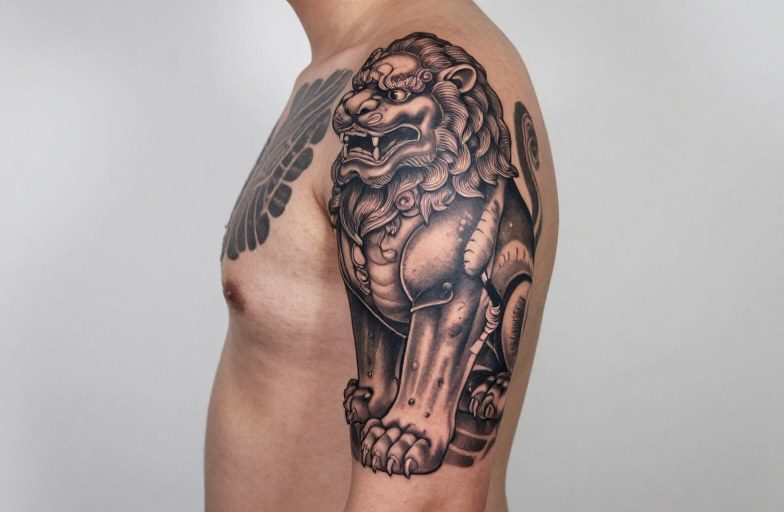
A Japanese lion tattoo, properly called shishi or karajishi (literally “Chinese lion”), carries a meaning built on centuries of guardian tradition. These creatures don’t represent actual lions but rather mythical beasts tasked with protection. The core symbolism centers on fierce courage, the warding off of evil spirits, and unwavering vigilance over what matters most to the wearer.
History & Cultural Roots
The shishi arrived in Japan through Chinese and Korean cultural exchange, likely during the Asuka and Nara periods. Temples and shrines began placing stone or bronze lion-dog pairs at entrances as protective sentinels. The left-hand figure typically keeps its mouth closed to seal in good spirits; the right opens its mouth to roar away evil.
From Architecture to Skin
Translating three-dimensional guardian sculptures into two-dimensional tattoo art required adaptation. Early Japanese tattooists simplified the musculature and exaggerated the mane into flowing, flame-like shapes that read clearly on curved human anatomy. The traditional color palette settled into specific conventions:
- Red or orange manes symbolize fire and active protection
- Green or blue bodies connect to Buddhist guardian figures
- Gold accents reference temple ornamentation and sacred status
Edo Period Tattoo Culture
By the Edo period, shishi imagery had embedded itself in irezumi tradition. The motif often anchored larger back pieces or served as chest panels framing central figures like dragons or Fudo Myoo. Placement mattered: shishi protected the torso’s vital organs and faced outward to guard the wearer’s spirit.
Religious & Spiritual Angles
Buddhism shaped the shishi’s protective role most directly. The beast serves as a vehicle or attendant for various deities, particularly Manjushri, who rides a lion symbolizing the taming of the mind. This association adds layers of spiritual discipline to the tattoo’s meaning.
Shinto Connections
Shinto shrine guardians called komainu are often conflated with shishi in popular understanding, though scholars distinguish them. Both function as spiritual bouncers. A tattooed shishi can reference this shrine-guardian function without requiring explicit religious commitment from the wearer; the symbolism of standing watch translates across belief systems.
Protection Without Aggression
Unlike Western lion imagery that often emphasizes dominance and conquest, the Japanese lion guardian protects through presence rather than attack. The shishi’s value lies in vigilance: it notices danger before harm arrives. This distinction matters for wearers who want strength without hostility.
Best Placements
Shishi tattoos demand space. The traditional mane alone requires significant surface area to render properly, and cramped placement muddles the protective stance that defines the figure.
Back and Chest
The full back remains the classic canvas for a traditional shishi. The spine provides a natural centerline; the creature’s body can follow the back’s musculature while the mane explodes across shoulder blades. Chest pieces work similarly, with the lion’s face centered over the sternum and paws extending toward the shoulders. Both placements allow the open-mouthed guardian to face outward, literally watching the wearer’s back or front.
Thigh and Upper Arm
Thigh placements suit shishi in crouching or pouncing poses, wrapping around the leg’s cylinder. The upper arm (half or full sleeve) accommodates smaller compositions but sacrifices some mane detail. Forearms generally prove too narrow for traditional execution unless the design abstracts significantly.
Scale Considerations
Minimum workable size for a readable shishi head with mane detail: approximately 5-6 inches in any direction. Below this threshold, line weight becomes problematic and shading blends into murk. Traditional Japanese tattooing (tebori or machine) relies on bold, confident lines that simply don’t survive extreme miniaturization.
Mythology & Folklore
Shishi folklore emphasizes parental devotion. The most common story involves a shishi pushing its cub off a cliff to test resilience; only those who climb back survive. This narrative adds layers of toughness, familial love through challenge, and self-improvement through adversity to the tattoo’s meaning.
The Peony Connection
Shishi and peonies appear together so consistently in Japanese tattoo art that the pairing has become almost standard. The flower represents wealth and honor, but the folklore explanation runs deeper: shishi supposedly use peony thickets as sleeping places, their heavy heads nodding in drugged slumber from the flower’s scent. A tattoo combining both suggests power that can be gentle, vigilance that allows rest.
Stone and Living Forms
Some depictions show shishi emerging from or perched on rock formations, referencing their origin as stone temple guardians. This “awakening” motif suggests dormant strength becoming active when needed. The rock base also provides compositional stability in tattoo design, grounding the dynamic mane and claws.
How It Ages on Skin
Shishi tattoos age distinctively based on their structural elements. The swirling mane lines that look magnificent fresh can blur into indistinct gray masses over a decade if executed too finely or placed where skin moves excessively.
Line Weight and Manes
Traditional Japanese tattooing uses heavier outlines than many contemporary styles precisely for longevity. A shishi mane drawn with confident 5-7 needle groupings holds definition where single-needle whisps disappear. The negative space between mane tendrils matters as much as the inked lines; without adequate spacing, the entire head becomes a dark blob.
Color Fading Patterns
Red and orange pigments in the mane typically fade faster than black or dark green body tones. This differential aging can actually enhance the design if planned for: the body remains solid while the mane softens into a fiery halo. Poor planning, however, yields a muddy body with a washed-out mane and no contrast between them.
Skin Movement Zones
Inner biceps, sides of the torso, and throat areas experience constant flex and stretch. Shishi tattoos in these locations require simplified mane structures with fewer fine details. The chest and back, by contrast, offer relatively stable surfaces where complex traditional work survives better.
Common Variations & Styles
Contemporary tattooing has produced several distinct shishi approaches beyond strict traditional irezumi.
Neo-Japanese and Illustrative
These styles maintain the recognizable shishi structure but introduce non-traditional color palettes, varied line weights, or background elements from outside Japanese canon. Purple manes, geometric pattern fills, or watercolor-style splashes behind the figure fall into this category. The core symbolism remains intact while the visual language updates.
Black and Grey Adaptations
Strict black and grey shishi sacrifice some traditional impact; the original color coding carries specific meaning. However, skilled execution can compensate through dramatic contrast and texture variation. The mane becomes a study in gray wash gradation rather than color temperature.
Minimalist and Single-Element
Some wearers choose isolated shishi heads without body or background, functioning as iconographic badges rather than narrative scenes. These work best at smaller scales than full traditional pieces but require extremely clean design to avoid generic “lion tattoo” appearance. The stylized features, bulging eyes, curled nose, flame-shaped mane, must remain distinct.
Final Word
A Japanese lion tattoo carries weight beyond its visual impact. The shishi tradition offers protection symbolism with genuine historical depth, not empty aesthetic borrowing. Whether rendered in full traditional color or adapted to contemporary approaches, the figure demands technical respect: this is not a motif that forgives sloppy drawing or cramped placement. Work with an artist who understands the difference between a generic lion and a guardian with specific cultural lineage. The result should stand watch for decades, not merely decorate.
Frequently Asked Questions
What’s the difference between a shishi and a foo dog tattoo?
Shishi refers specifically to Japanese guardian lion tradition, while foo dog is a Western misnomer for Chinese guardian lions. Japanese tattoo art follows distinct stylistic conventions including flame-shaped manes and specific color symbolism that differ from Chinese or mixed Asian approaches.
Can a shishi tattoo face any direction, or does placement matter?
Traditional composition places the open-mouthed guardian facing outward from the body’s centerline to symbolize warding away evil. However, contemporary designs sometimes break this convention for aesthetic reasons without losing personal meaning.
Does a shishi tattoo require color to be authentic?
Color carries traditional significance but isn’t mandatory for personal meaning. Black and grey execution works when the artist maintains strong contrast and the distinctive stylized features remain readable.
How long does a full traditional shishi back piece typically take?
Completion time varies enormously based on artist speed, detail level, and session frequency. Large traditional Japanese work often spans multiple years of regular appointments rather than weeks or months.