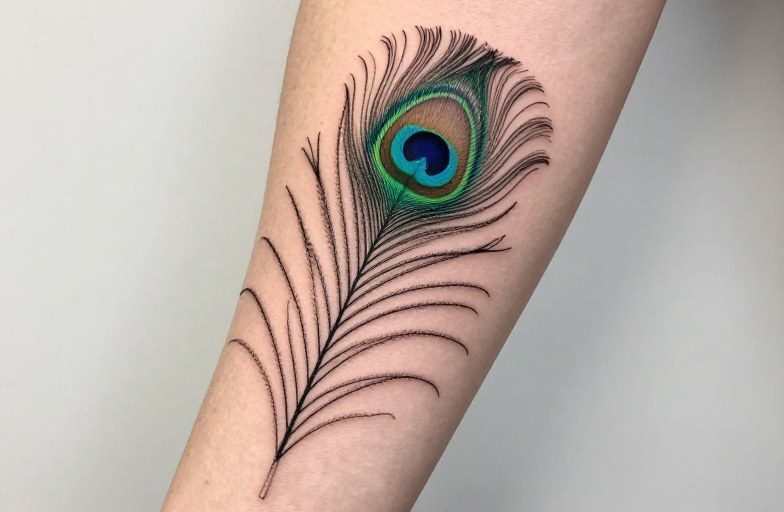
A peacock feather tattoo carries layered symbolism rooted in centuries of cultural association. Most commonly, it represents beauty, pride, renewal, and spiritual watchfulness. The “eyes” on the feather suggest awareness and protection. The meaning shifts depending on whether you emphasize the full eye pattern, the delicate barbs, or the feather as a standalone image versus part of a larger composition.
Mythology and Folklore
Peacock feathers carry weight across several traditions, though their significance varies dramatically. Understanding these roots helps ground your design choice in something more durable than trend.
Hindu and Buddhist Associations
In Hindu tradition, the peacock is often linked to Saraswati and Lakshmi, deities of wisdom and fortune. The feather specifically, rather than the whole bird, became a symbol of patience and benevolence. Some trace it to Krishna, who is commonly depicted wearing a peacock feather in his crown. Buddhist iconography sometimes uses the peacock to represent wisdom that transforms poison into beauty, a reference to the bird’s diet of toxic plants and snakes without harm. These associations are often linked to medieval and early modern texts rather than fixed ancient doctrine.
Related reading: guardian owl tattoo meaning | nite owl tattoo meaning | Philippine eagle tattoo meaning | blue bird tattoo meaning
Western and Mediterranean Lore
Greek mythology connects the peacock to Hera, whose hundred-eyed servant Argus was transformed into the bird’s tail, explaining the distinctive eye patterns. Early Christian art adopted the feather as a symbol of resurrection and immortality, with the “eyes” representing the all-seeing church. In medieval Europe, peacock feathers were sometimes linked to vanity, a cautionary association that still colors how some people read the tattoo today.
Placement and Flow
The feather’s natural shape, elongated, asymmetrical, detailed at one end, makes it surprisingly versatile but also placement-sensitive. Get it wrong and the detail blurs. Get it right and the body’s curves complement the form.
Vertical Flow: Spine, Forearm, Calf
Running a peacock feather vertically along the spine, outer forearm, or calf follows the natural line of the design. The spine placement works best for larger pieces where the eye sits between shoulder blades and the tip trails toward the lower back. Forearm placement favors the outer or inner surface where the feather’s curve can wrap slightly with the muscle. Calf offers similar vertical space with less bone interference.
Curved Adaptations: Ribs, Shoulder, Hip
The feather can bend to follow body contours, though this requires a skilled artist to adjust the barb spacing so it does not look stretched. Ribs demand this adaptation, with the feather often tilting diagonally, the eye near the sternum and the tip pointing toward the hip. Shoulder cap placements work when the eye sits on the deltoid and the barbs fan slightly across the upper arm.
- Small feathers (under 4 inches): wrist, ankle, behind ear. Detail will soften faster.
- Medium (4-8 inches): forearm, upper arm, calf. Best balance of detail and longevity.
- Large (8+ inches): thigh, back, torso. Allows full color gradation and multiple eyes.
Color versus Black and Grey
This choice fundamentally changes what the tattoo communicates and how it behaves over time.
The Case for Color
Actual peacock feathers shift between iridescent blues, greens, and golds. Color tattooing can approximate this through saturated teals, emerald greens, and deep cobalt, often with bronze or gold accents. The eye pattern especially benefits from color contrast. The dark center, blue ring, and outer gold create natural focal points. However, these bright pigments fade toward blue-grey over time, and lighter greens sometimes disappear into the skin entirely. Expect touch-ups at 5-7 years for color work to maintain its intensity.
Black and Grey Realism
Stripped of color, the feather becomes more about form and texture. Fine line work can render the hair-like barbs with precision, and the eye pattern reads as graphic contrast rather than naturalistic mimicry. Black and grey ages more predictably. There is no green turning muddy, no gold becoming mustard. For those drawn to the symbolism but not the flamboyance, this approach feels quieter, more architectural.
Core Symbolism and Personal Meaning
Beyond cultural backstory, the peacock feather communicates several personal themes that explain its persistent popularity.
Renewal and Impermanence
Peacocks molt annually, dropping their elaborate tails and regrowing them. The single feather, detached from the bird, becomes a memento of this cycle, beautiful even in separation, destined to be replaced. This resonates for people marking recovery, transition, or survival through change. The tattoo functions as a private marker of ongoing transformation rather than a single achieved state.
Watchfulness and Protection
The multiple “eyes” along the feather create an uncanny effect, something looking back at the viewer. This has served protective functions in various traditions, with the eyes supposedly warding off harm. In tattoo form, it can represent self-awareness, the examined life, or vigilance about one’s surroundings. Placed on the back, it suggests protection from unseen threats. On the forearm, outward-facing awareness.
Beauty Without Apology
The peacock is unabashedly ornamental. Its feather makes no pretense of utility. As a tattoo, this appeals to people reclaiming visibility after periods of hiding, or simply refusing to minimize their presence. The meaning here is straightforward: the right to be seen, to take up space, to display without shame.
Common Variations and Styles
The basic feather adapts across tattoo genres, each carrying different connotations.
Traditional and Neo-Traditional
American traditional renders the feather bold and graphic, with thick black outlines, limited color palette, and the eye simplified to concentric circles. It reads as vintage, straightforward, slightly masculine. Neo-traditional softens this with more organic line weight and expanded color range, often adding decorative elements like beads, banners, or floral surrounds.
Fine Line and Illustrative
Contemporary fine line work attempts photographic delicacy, each barb distinct, the eye rendered with dotwork gradients. This looks stunning fresh but requires excellent skin and aftercare. The tiny lines blur faster than bolder work. Illustrative styles split the difference, using confident linework with selective detail rather than attempting full realism.
- Watercolor background: feather rendered in solid technique, color splashes behind
- Geometric deconstruction: feather broken into triangles or mandala segments
- Single needle: extreme detail, highest risk of aging poorly
- Jeweled or pearl additions: the eye replaced by a gemstone, barbs becoming chain or filigree
Design Tips and Pairings
What you surround the feather with, or how you isolate it, changes the tattoo’s register significantly.
Effective Pairings
Peacock feathers pair naturally with other symbols of transformation: snakes, butterflies, phoenix imagery. Combining too many can feel like a symbolic pile-up. More restrained combinations include a single feather with scattered dots suggesting shed particles, the feather incorporated into a dreamcatcher structure, or paired with a skull or hourglass to emphasize mortality against beauty. Floral elements, particularly lotus or roses, extend the organic, decorative quality without competing for attention.
Composition Considerations
The feather’s eye demands placement where it will not distort. Avoid joints where flexing will warp the circle. Negative space around the feather lets it breathe. Crowding it against other dense tattoos reduces impact. If you want text, place it parallel to the shaft rather than curving with the barbs, which looks forced. Consider the feather’s direction: pointing upward suggests aspiration, downward release or grounding, horizontal movement or transition.
Line weight matters enormously. The central shaft should carry the heaviest line. Barb lines can taper from medium to hairline. The eye needs solid dark center contrast or it will read as an empty circle within five years. For color pieces, the blue-green transition is where most artists struggle. Request to see healed examples of their color work, not just fresh photos.
Before You Decide
A peacock feather tattoo works best when the symbolism genuinely connects to your experience rather than defaulting to generic beauty or pride. The design’s strength is its adaptability: quiet in black and grey, declarative in color, protective in placement, powerful in context. Choose placement based on how much detail you want preserved and how visible you intend the piece to be. Work with an artist who has healed examples in their portfolio, not just fresh photographs under perfect lighting. The feather is a common motif, but a successful one is built on specificity: your particular shade of blue, your chosen direction, your private reason for wearing an eye that looks outward while it faces your skin.
Frequently Asked Questions
Do peacock feather tattoos have a specific meaning in Christianity?
Early Christian art sometimes used the peacock feather as a symbol of resurrection and immortality, with the eye patterns representing the all-seeing church. This association is less common in modern tattooing than Hindu or Buddhist connections, but it remains part of the symbol’s layered history.
How well do peacock feather tattoos age over time?
Black and grey versions age more predictably than color. Bright greens and golds tend to fade toward blue-grey or disappear entirely, typically needing touch-ups every 5 to 7 years. Fine line details blur faster than bolder work, so consider line weight carefully with your artist.
What is the best placement for a small peacock feather tattoo?
Wrist, ankle, and behind the ear are common choices, but detail softens faster at small sizes. For better longevity, medium placements like the forearm or calf allow crisper barb rendering while still keeping the piece relatively discreet.
Can a peacock feather tattoo be protective?
The eye patterns have been interpreted as protective in various traditions, and some people choose placement on the back or shoulder with this intention. Whether you experience this as spiritual protection or symbolic self-awareness depends on your personal relationship to the image.
Leave a Reply