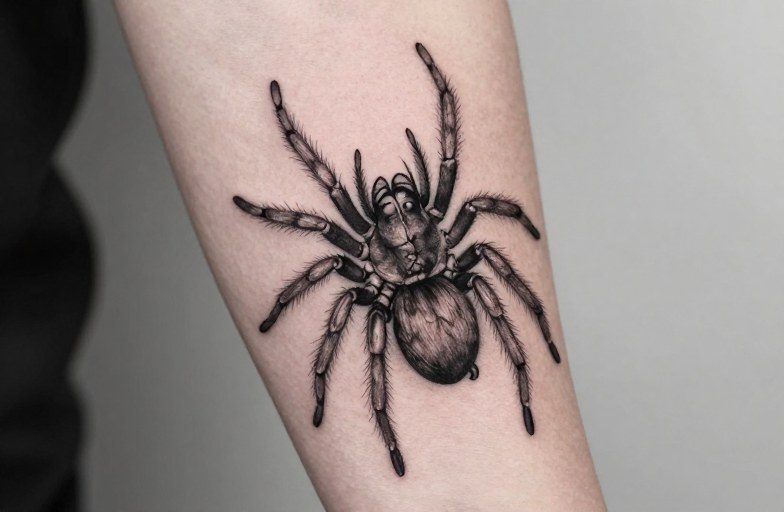
A realistic spider tattoo lives or dies on whether the spider looks like it belongs there. Not cute. Not stylized. Actually sitting on your skin with weight and intention. When it works, the effect is unsettling in the best way: a creature that could begin moving. That immediacy shapes everything else about the meaning.
What the Spider Actually Symbolizes
The Web as Creative Power
Spiders manufacture silk from their own bodies and build architecture from nothing. That biological fact underpins most positive associations: self-sufficiency, the ability to generate structure from internal resources, creative output that does not require external tools. A realistic rendering emphasizes this by showing the actual mechanics, the spinnerets, the segmented abdomen, the precise leg joints that make construction possible. You are looking at a creature that builds its own world.
Patience and Predation
The spider waits motionless for hours. Then strikes without warning. This duality shows up in placement choices. Someone drawn to the patience aspect might choose a location they see daily, a reminder to hold still. Someone drawn to the predatory side might hide the tattoo, or place it where others discover it unexpectedly. Realism matters here because a stylized or cute spider undercuts both qualities equally. The subject needs to read as capable of either behavior.
Related reading: black widow spider tattoo meaning | scorpion tattoo representation | snake and dagger tattoo meaning | wolf and dreamcatcher tattoo
Power and Threat Combined
The black widow archetype, feminine power paired with genuine danger, resonates across cultures. A realistic rendering of a venomous species does not soften this. The hourglass reads as warning, not decoration. Some people choose this specifically to reclaim threat: the small creature that commands respect, that cannot be handled carelessly.
- Construction and creativity (web-building as active making)
- Patience as strategy, not passivity
- Fate, entrapment, and inescapable consequence
- Adaptation, spiders occupy every terrestrial environment
- Reclaimed threat or survival after predatory experience
Color Versus Black and Grey
When Color Adds Specificity
A realistic black widow with actual red hourglass reads differently than a greyscale version. The red announces danger specifically; without it, the threat becomes general, more atmospheric. Color realism for spiders demands serious technical skill. The iridescence of a jumping spider’s eyes, the subtle browns and tans of a wolf spider, require saturation control that not every artist manages. Poor color work on a realistic spider ages into muddy confusion, especially on smaller scales. You are asking the artist to paint within a narrow range and make it hold.
Black and Grey for Texture
Hair. That is the advantage. Spiders are hairy, and black and grey shading with whip-shading or fine-line texture work can render this convincingly. The technique also suits the subject’s natural palette: most spiders people actually want tattooed (tarantulas, recluses, widows, orb-weavers) read as dark shapes in nature. Black and grey ages cleaner on spider tattoos because the subject matter already lacks bright color in most cases; there is less visual information to lose to sun and time. If you want the tattoo to look good in fifteen years without constant maintenance, this is the safer path.
Placement: Where Realism Works and Fails
Spider tattoos work almost anywhere, but realism imposes constraints. The legs need room to read as separate elements, not a blur. Minimum size thresholds vary by placement, and ignoring them is the most common regret.
High-Detail Zones
The forearm, outer calf, and shoulder cap give enough flat real estate for leg spread and body detail. These areas also let the spider sit naturally, curved around the muscle, not fighting the form. A realistic spider on a shoulder looks like it could be resting there; on a ribcage, the curvature distorts the anatomy unless the artist designs for the body shape specifically. That requires a consultation where the artist maps the pose to your specific curvature, not just transfers a flat reference.
Small but Compromised
Behind the ear, the side of a finger, the wrist bone. These work only with simplified realism: still recognizable species, but fewer hairs, less leg segmentation, broader strokes. The tradeoff is immediate impact from placement shock value, but the tattoo will not hold detail for decades. Ink spreads in thin skin; spider legs become threads, then smudges. If you choose this, accept it as a ten-year tattoo, not a lifetime piece.
- Forearm: best for medium-sized hunting spiders with leg spread
- Shoulder/collarbone: natural perching placement
- Thigh: large tarantulas, space for color and texture
- Hand: high visibility, fast fading, needs bold simplified lines
- Neck: socially loud, technically demanding for realism
History and Cultural Roots
Indigenous North American Traditions
The spider appears across numerous tribal traditions, most famously as Grandmother Spider in Pueblo and other Southwest cultures, a figure who brought light, fire, or weaving to humanity. These associations predate European contact and continue in contemporary Native tattooing. Realistic depiction of spiders in this context is less common than stylized or symbolic representation, but the underlying meaning (creation, protection, storytelling) informs modern choices. If you are drawing on this tradition, do so with awareness of its living context, not as borrowed mystique.
African and Diaspora Connections
Anansi, the spider trickster, originates in Akan folklore and traveled to the Caribbean and Americas through the slave trade. The character represents survival through wit, not force. A realistic spider tattoo in this lineage might carry that specific resonance: intelligence, verbal dexterity, the small overcoming the large through cunning. This differs from the web-as-fate symbolism more common in European traditions. The distinction matters if you are choosing the tattoo for personal meaning rather than general aesthetic.
Japanese and European Threads
Japanese tattoo history includes spiders less prominently than some other motifs, but the tsuchigumo (earth spider) appears in warrior folklore as a monstrous opponent, sometimes a metaphor for bandits or rebels. Realistic rendering in Japanese-influenced work tends toward the horrific rather than the delicate. The Arachne myth, often linked to Greek origin, involves transformation through craft: the mortal weaver who rivals Athena and becomes the first spider. Roman sources preserve the tale; Ovid’s version is the most familiar. A realistic spider tattoo in this context might carry subtle reference to the weaving competition or the hanging transformation itself. The Norns, female figures who weave fate, share functional territory with spider symbolism without being directly spider-identified. Some regional traditions tenuously connect spiders to household protection, but these threads are thin and speculative.
Who Actually Gets This Tattoo
The Technical Collector
Realism collectors specifically. A spider offers the tattoo artist a chance to demonstrate multiple skills: hair texture, reflective eyes, translucent leg segments, the interaction of light on curved surfaces. The subject is challenging without being as common as a portrait or a big cat. Some people choose it because they saw a stunning example and wanted that technical achievement on their own skin. This is a valid reason. You are commissioning a small sculpture.
The Personal Connection
Actual spider keepers, arachnologists, tarantula hobbyists, pest control professionals sometimes get the specific species they work with. A Brazilian salmon pink birdeater on a forearm carries different weight than a generic black widow. The realism here serves identification, almost scientific illustration. You are marking yourself as someone who knows the difference.
The Symbolic Claim
People who work in creative fields, writers, designers, programmers, sometimes gravitate toward the web-as-construction metaphor. Those who have survived predatory situations may claim the spider as a reclaimed symbol of threat turned inward. The reasoning diverges widely, which is the point: the spider accommodates multiple authentic readings without requiring a single one.
What to Remember
A realistic spider tattoo succeeds or fails on technical execution first. The symbolism supports multiple interpretations, creative power, patience, danger, fate, but the realism must convince the eye before any of that registers. Black and grey offers durability and texture; color demands more maintenance but can specify species and threat level. Placement should account for leg spread minimums and how the body curves around the design. The cultural history is genuinely layered, not a single coherent tradition, which gives you room to assign personal meaning without claiming false ancient authority.
Find an artist who has done realistic spiders before, or at least realistic insects or arachnids. The anatomy is unforgiving: eight legs with correct joint segmentation, cephalothorax proportions, eye arrangement that varies by species. A wrong detail destroys the illusion. Ask to see healed photos, not just fresh work. Hair detail and fine leg lines blur faster than bold work; you want evidence the artist understands how their lines settle. Bring reference photos of the specific species, but trust the artist to adapt the pose to your body. A spider transferred flat from a photograph will look wrong on a curved surface. The best realistic spider tattoos look like the creature chose to be there.
Frequently Asked Questions
How small can a realistic spider tattoo be before it loses detail?
Generally no smaller than two inches in any dimension for the body alone, with leg spread adding another inch minimum. Below that, leg segments blur together and hair texture disappears within a few years. Simplified realism can go smaller, but you are trading accuracy for longevity.
Do realistic spider tattoos fade faster than other realistic subjects?
Not inherently, but they often contain more fine-line detail than average. Hair strokes and thin leg segments are vulnerable to sun and skin aging. Black and grey ages better than color for this subject. Plan for touch-ups every five to seven years if you want the detail to hold.
Is there a meaning difference between a web and a spider alone?
Yes. The web emphasizes connection, construction, fate, and entrapment. The spider alone emphasizes the creature itself: patience, predation, survival, specific species identification. Some people choose both for the full symbolic range, others prefer the spider alone for its immediate physical presence.

Leave a Reply