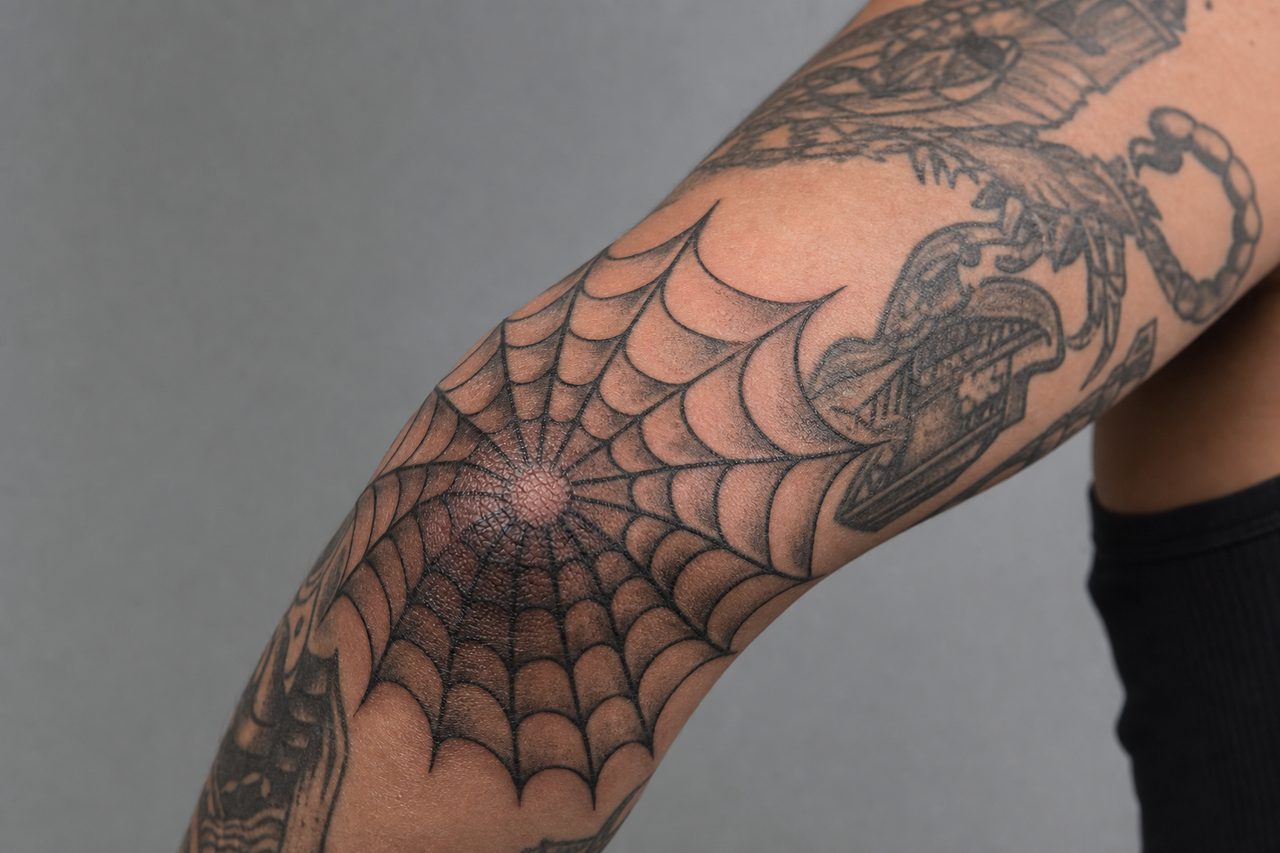
The spider web elbow tattoo most commonly signals time served, struggle, or feeling caught in a system, though modern wearers often choose it for gothic aesthetics, punk identity, or personal battles with addiction or mental health. The elbow placement matters: it’s painful to tattoo, highly visible, and the web’s radial shape conforms naturally to the joint’s circular structure. Meaning depends heavily on era, context, and who’s wearing it.
Symbolism & Core Meaning
The Prison Connection
Most trace the spider web elbow to mid-20th century American prison and naval culture, where it often marked time incarcerated, each ring of the web supposedly representing a year inside. On the West Coast, it sometimes indicated a murder conviction. These weren’t universal rules; different prisons and eras attached different codes. The tattoo’s visibility on the elbow made it hard to hide, functioning as both personal tally and public warning.
Outside prison walls, the symbol migrated through biker and street cultures through the 1960s-80s, carrying connotations of outsider status, anti-authoritarianism, and survival through hardship. The web’s entrapment imagery translated easily: caught by the system, caught by addiction, caught by circumstance.
Entrapment and Stagnation
Beyond institutional origins, the core visual metaphor remains powerful. A spider web catches prey, holds it immobile, consumes it slowly. Applied to human experience, this maps onto depression, addiction cycles, dead-end situations, or relationships that drain without nourishing. The elbow’s constant flexing and bending, never fully at rest, mirrors the restless stuckness of someone wanting to move but held in place.
Mythology & Folklore
Cross-Cultural Spider Symbolism
Spiders and their webs carry radically different weight across cultures. In some West African traditions, Anansi the spider is trickster, storyteller, and culture hero. Navajo weaving traditions honor Spider Woman as teacher of loom-craft. Ancient Greek myth makes Arachne a cautionary figure of mortal hubris, transformed by Athena into the first spider, eternally weaving, never resting.
European folklore trends darker: spiders associated with witches, poison, and entrapment. The nursery rhyme “Along came a spider” encodes genuine medieval fear. These contradictory traditions, creator and destroyer, patient artist and deadly trapper, give the spider web tattoo unusual symbolic density. Wearers can draw on whichever thread resonates.
The Web as Cosmic Map
Some trace the radial web pattern to older symbolic systems: the medicine wheel, the dreamcatcher’s hoop, Buddhist mandalas. The web’s geometry, center point, radiating lines, connecting threads, mirrors how many cultures visualize cosmic order. This gives the tattoo potential spiritual readings entirely separate from prison or punk associations: the web as connection, as pattern underlying apparent chaos, as the individual’s place within larger structure.
Color vs Black and Grey
Color spider web elbow tattoos remain relatively rare, and that rarity carries meaning. Traditional black and grey webs read as harder, more rooted in prison and street origins. The limited palette emphasizes line work, lets the web’s geometry dominate, and ages cleaner on an area that sees constant sun exposure and friction from clothing.
When color does appear, it’s usually strategic: a single red hourglass on a black widow, drops of color suggesting blood or poison, or a blue-black spider against grey webbing. These touches shift the tattoo toward horror aesthetics, comic book influence, or personal symbolism without abandoning the core image’s gravity. Full-color webs with rainbow backgrounds or pastel spiders exist but read as deliberate subversion, reclaiming a dark symbol through playful contrast, or simply prioritizing visual impact over traditional meaning.
Healing reality on elbows: this placement moves constantly, skin stretches and compresses, and sun hits it directly. Black and grey holds sharper lines longer here. Color fades faster, especially yellows and light greens, requiring more frequent touch-ups if saturation matters.
Who Chooses This Tattoo
Demographics and Subcultures
The spider web elbow maintains strong presence in punk, hardcore, metal, and gothic scenes, subcultures that deliberately embrace dark imagery and outsider positioning. It’s common among people with actual incarceration history who want to mark survival without explicit text. Some veterans choose it, drawing on naval traditions where the web indicated time deployed or battles survived.
Age patterns have shifted. Where once this was primarily a 30+ tattoo with lived experience behind it, younger people increasingly choose it for aesthetic reasons, sometimes unaware of prison associations. This generational split creates occasional friction: older wearers who earned the mark through hardship, younger wearers who found the image on Instagram. Both perspectives are valid, but the context gap is real.
Gender and Placement Variation
Traditionally male-dominated, the spider web elbow has grown more gender-neutral, especially as women have claimed space in punk and metal scenes. Some women choose the web on the knee instead, similar joint placement, similar pain, slightly less loaded history. Others pair the elbow web with adjacent imagery: roses, moths, barbed wire, creating narrative compositions that complicate the web’s meaning.
Similar & Related Symbols
The spider web elbow sits within a family of joint tattoos that mark time or struggle. The teardrop under the eye, the clock without hands, the three dots by the eye or hand, all share the function of visible, hard-to-hide markers of experience. The web differs in being more abstract, more visually complex, and more adaptable to non-prison meanings.
Close visual cousins include:
- Dreamcatchers: Similar hoop-and-web structure, opposite connotation (protection rather than entrapment). Some wearers deliberately blur the line, choosing web imagery that evokes dreamcatcher aesthetics without the explicit cultural borrowing.
- Barbed wire: Another elbow classic, also marking time (each barb supposedly a year), simpler to execute, less geometrically interesting.
- Mandala patterns: Radial symmetry like the web, but without the dark associations; spiritual rather than survival-oriented.
- Broken chains or cracked walls: Opposite narrative, escape rather than entrapment, sometimes chosen by people who’ve moved past the web’s stuckness.
Personal & Modern Meanings
Beyond the Prison Narrative
Contemporary wearers increasingly detach the spider web from institutional origins. Common personal readings include: recovery from addiction (the web as what held you, now marked as past), chronic illness (caught in a body that fails), creative obsession (the web as what you build obsessively, beautiful and consuming), or simply aesthetic affinity for dark, organic geometry.
The tattoo’s visibility becomes part of its function. On the elbow, it’s always partially visible, short sleeves reveal it, gestures draw attention. For some, this is accountability: a permanent marker of a phase survived, not to be hidden or denied. For others, it’s confrontation: making others see what they’d prefer to ignore about incarceration rates, addiction prevalence, or mental health struggle.
Reclamation and Subversion
Some wearers deliberately choose the spider web precisely because of its loaded history, wanting to complicate or reclaim it. A person with no incarceration history might choose it to stand solidarity with those who do, or to challenge the assumption that visible struggle marks belong only to the “deserving.” The web’s ambiguity, Is it prison? Goth aesthetic? Personal metaphor?, becomes feature rather than bug, forcing conversation where simpler tattoos pass unnoticed.
Final Word
The spider web elbow tattoo carries weight it didn’t ask for. Born in prison ink, propagated through outsider cultures, now floating free in mainstream visibility, it means different things on different bodies in different eras. What persists is the core image’s power: the web as something built, something that catches, something that can hold you still or hold you together depending on angle of view. If you’re considering it, know the history, know your own reason, and know that elbows hurt, fade, and show. The web you choose, or the web that chooses you, will be there a long time.
Frequently Asked Questions
Does a spider web elbow tattoo always mean prison time?
Not anymore. While the design originated in prison and naval culture, many people today choose it for gothic aesthetics, punk identity, or personal struggles with addiction or mental health. Context and the wearer’s background matter more than the image itself.
How painful is getting a tattoo on the elbow?
The elbow ranks among the most painful placements due to thin skin directly over bone and constant movement during the process. The inner elbow ( ditch) is especially sensitive, while the outer point is more tolerable but still sharp.
Do spider web elbow tattoos age badly?
Elbow tattoos face sun exposure, friction from clothing, and skin stretching from joint movement. Fine line details may blur over time, but bold black and grey webs with solid ink saturation tend to hold up better than delicate or color-heavy designs.
Can I get a spider web elbow tattoo if I haven’t been to prison?
Yes, though some people within prison-affected communities view the tattoo as earned through lived experience. Being honest about your reasons, whether aesthetic, personal struggle, or solidarity, matters more than pretending to a history you don’t have.