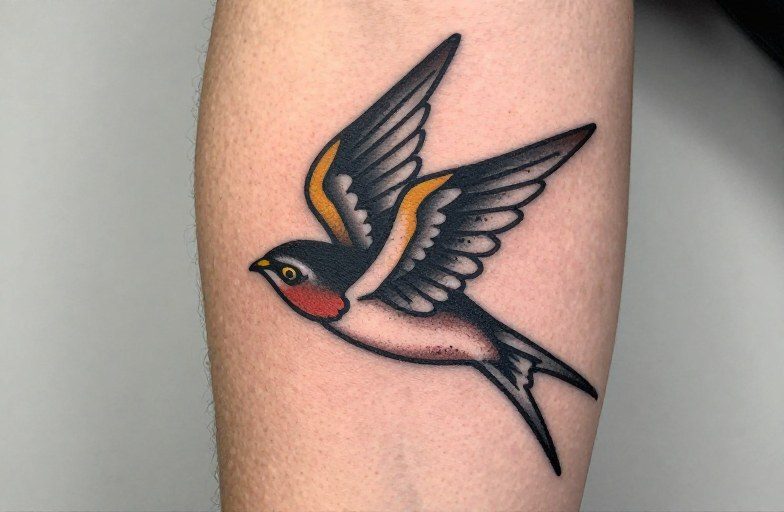
The American traditional swallow tattoo is a specific, instantly recognizable piece of flash art: a fork-tailed bird in profile, wings spread, rendered with thick black outlines, saturated color blocks, and minimal shading. Born from early 20th-century sailor culture, the design follows strict conventions. There is a right way to do it, and many wrong ways. This guide breaks down what separates a solid traditional swallow from a generic bird with a banner slapped underneath it.
Key Characteristics and Motifs
The Bird Itself
Traditional swallows are not realistic. The beak is small and pointed, the eye a simple black dot or tiny circle, the wings long and curved with distinct feather groupings rendered as solid color shapes rather than individual plumes. The tail splits in two; this fork distinguishes it from sparrows, which some shops used as cheaper flash alternatives. Chest placement is classic: one swallow on each pectoral, flying toward the center line or away from it. Hands, necks, and forearms came later as social acceptance grew.
Common Pairings
- Banners and scrolls: Usually below the bird, sometimes above, carrying a name, date, or single word. The banner folds have their own rules. Too many loops looks busy; too few looks flat.
- Daggers and hearts: The swallow piercing or hovering near a heart adds narrative weight without abandoning the style’s graphic simplicity.
- Roses and nautical stars: These fill background space or sit opposite the bird on a larger composition. They share the same visual language: bold outline, flat color, no soft gradients.
Meaning and History
The meaning is baked into the imagery. Sailors got swallows after sailing specific distances, often linked to 5,000 nautical miles for one bird and 10,000 for a second, though these numbers are popularly claimed rather than strictly documented. The bird also promised safe return, since swallows always come home. These associations persist even among people who have never been on a boat.
Related reading: navy swallow tattoo meaning | sailor jerry swallow tattoo | white dove tattoo meaning | tree and bird tattoo meaning
Choosing the Right Artist
Flash versus Custom
Not every artist who does traditional work actually understands the swallow’s specific proportions. You should ask to see healed photos, not just fresh work. A strong traditional portfolio shows consistent line weight, confident color packing, and designs that read clearly from across a room. Artists who offer to make it unique by adding realistic feather detail or soft watercolor backgrounds are offering a different tattoo entirely.
Shop Culture
Traditional American work thrives in shops that still trade in flash sheets and walk-in appointments. The design language was built for quick, repeatable execution. An artist who only books months out for large custom pieces may technically execute the lines, but the energy often differs: too precious, too slow. The best swallow tattoos carry a certain efficiency, a confidence that comes from having done the design enough times that muscle memory guides the hand.
Who It Suits
Placement and Visibility
Placement dictates visibility, and visibility carries social weight. The classic chest pair reads as committed. This is someone who chose a permanent, symmetrical statement. Single swallows on the hand or neck emerged from punk and working-class traditions, signaling affiliation with specific subcultures. Forearm or upper arm placements offer compromise: visible when you want, coverable when needed.
Skin Tone and Color Adaptation
Skin tone affects color choices significantly. The classic red, blue, and yellow palette pops on lighter skin but can mute or shift on darker complexions. A knowledgeable artist adjusts: deeper crimsons instead of bright reds, more teal than sky blue, heavier black reliance to maintain contrast. The swallow’s graphic structure survives these adaptations because the outline does the heavy lifting.
Scale
Scale matters too. Too small, under two inches, and the beak and eye become muddy blurs within a decade. Too large, and the flat color blocks look empty, like a poster blown up beyond its resolution. Three to four inches tall hits the sweet spot for most placements.
Linework and Technique
Outline First, Always
The black outline is the skeleton. In traditional swallows, it runs consistently thick, typically with round liners or small mags for longer wing curves. The line sits at a specific depth: too shallow and it heals gray; too deep and it blows out, creating a fuzzy halo that destroys the crisp graphic quality. A proper traditional line has slight weight variation, thicker on the body contour, thinner on interior details, but never approaches the whisper-fine lines of single-needle realism.
Color Packing
Color goes in after the outline heals, traditionally, though many artists now work wet-on-wet for efficiency. The pigment sits in distinct, unblended blocks: red on the throat, blue or green on the back and wing tops, yellow or cream on the belly. There is no smooth transition between them. The artist packs color with small circular motions, building density until the skin takes no more. Patchy color reads as amateur work; overworked skin scars.
Color versus Black and Grey
The Classic Palette
Red, green, yellow, black. Sometimes blue replaces green; sometimes brown appears on the wings. These pigments were originally limited by what was available and what held: iron oxides, cadmiums, carbon. Modern inks offer more options, but purists stick to the restricted set. The limitation is the point: the swallow reads as traditional because it refuses naturalistic color.
Black and Grey Adaptations
Black and grey swallows exist, often for clients who cannot heal color well or prefer the aesthetic. The challenge is maintaining readability without hue contrast. A skilled artist uses whip shading, soft gradients of black wash, to suggest the color blocks without defining them explicitly. The result is quieter, more graphic, sometimes closer to prison tattoo aesthetics than sailor flash. It works, but it is a different statement.
Healed black and grey tends to hold up longer in some ways: no color fading to muddy versions of themselves. But without the red throat and blue back, the design loses immediate recognizability. Viewers register “bird” before “swallow.”
Aftercare and Aging
First Two Weeks
Traditional swallows heal like any bold-line, color-packed tattoo, but the density matters. The chest, a common placement, moves constantly with breathing and arm motion, making scabbing more likely than on a static limb. Keep it clean, keep it slightly moist with unscented lotion, and do not let it dry out completely. Thick scabs pull color out when they detach.
- Avoid tight shirts that rub the chest; the friction lifts scabs prematurely.
- Sleep on your back if possible; chest tattoos stick to sheets and tear.
- Skip the gym for a week. Sweat and strain open the wound.
Long-Term Aging
These tattoos age well if done right. The bold outline prevents the color blur that destroys finer work. Over decades, the red may pinken, the blue may gray slightly, but the structure remains readable. Sun is the enemy; UV breaks down pigment and damages the skin holding it. A chest swallow under a shirt survives longer than a hand swallow exposed daily.
Touch-ups are straightforward: the design’s simplicity makes matching original work easier than with photorealistic pieces. Many artists offer them free or cheap within the first year, since the original application was quick to begin with.
What to Remember
The American traditional swallow tattoo works because it refuses to be subtle. Every element, the thick black outline, the flat color blocks, the specific forked tail silhouette, serves immediate recognition and long-term durability. It is not a design that asks for interpretation; it is a design that states its presence. Choose an artist who understands the grammar of this specific style, not just someone who can draw a bird. Place it where the symmetry flatters the body and the aging respects the density. Heal it carefully, protect it from sun, and it will remain as clear in thirty years as the day it was done.
Frequently Asked Questions
What’s the difference between a swallow and a sparrow in traditional tattooing?
The swallow has a forked tail and more streamlined body; sparrows are stockier with rounded tails. Sailor tradition specifically valued swallows for their homing behavior, while sparrows sometimes appeared as cheaper, less meaningful flash alternatives.
Can a traditional swallow tattoo work on darker skin tones?
Absolutely, but the artist should adjust the classic palette. Deeper reds and teals replace bright primaries, and heavier black outlines maintain the graphic structure that makes the design readable. The key is contrast, not the specific colors themselves.
How big should a traditional swallow tattoo be?
Three to four inches tall is the practical minimum for most placements. Smaller than two inches risks the beak and eye blurring into unrecognizable shapes over time. Much larger than five inches and the flat color blocks can look empty unless paired with additional elements like banners or roses.
Do traditional swallow tattoos have to be in color?
No. Black and grey adaptations exist and can age well, though they sacrifice some immediate recognizability. The red throat and blue back are so associated with the design that viewers may see “bird” before “swallow” without them. A skilled artist can compensate with stronger outline weight and strategic whip shading.
Leave a Reply