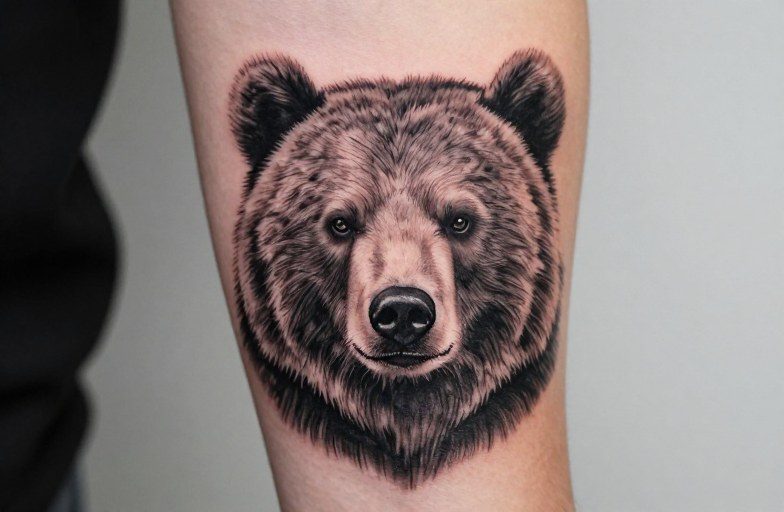
A bear face tattoo typically channels raw power tempered by quiet intelligence. The image lands somewhere between guardian and lone wanderer, an animal that hibernates in darkness, then emerges with renewed force. Most people choosing this motif aren’t after cute; they want the weight of something ancient staring back from their skin.
Symbolism & Core Meaning
The bear’s symbolic vocabulary runs deep and fairly universal. Unlike more culturally specific imagery, the bear face communicates across boundaries with minimal explanation needed.
Power Without Aggression
A bear face, cropped close, emphasizes presence over action. You see the eyes, the bulk of the muzzle, the suggestion of force held in reserve. This reads differently than a full-body bear in mid-roar or mid-swat. The face says: I contain this. It’s controlled strength, the capacity for violence that chooses not to deploy it. For people who’ve done recovery work, survived violence, or rebuilt themselves after collapse, this registers as earned symbolism rather than posturing.
Solitude and Self-Sufficiency
Bears are solitary animals. The face, especially when rendered front-facing or in profile with eyes closed, speaks to comfortable aloneness, not loneliness, but the ability to self-regulate, to disappear into winter and return. This resonates with introverts, with people who’ve learned to mother themselves, with anyone who values their own counsel above crowd noise.
Protective Instinct
Female bears with cubs are legendary for ferocity. A bear face can mark parental devotion, the willingness to become dangerous when boundaries are crossed. Many fathers and mothers choose this specifically, sometimes with subtle cub imagery integrated, paw prints, a small silhouette in the background, or simply the intensity of the gaze itself.
Common Variations & Styles
The bear face adapts to nearly every technical approach, but some treatments consistently outperform others.
- Realistic black and grey: Heavy on texture, fur direction, wet nose highlights, eye reflection. Thrives on large scale: chest pieces, upper thighs, outer arms. Requires an artist comfortable with animal portraiture specifically; human portrait skills don’t automatically transfer to getting the muzzle proportions right.
- Neo-traditional: Bold outlines, limited but saturated color palette, stylized fur tufts. The bear’s natural mass lends itself to this weighty, graphic approach. Greens, deep reds, and mustard yellows sit well against black.
- Geometric/dotwork: The bear’s angular facial structure, triangular ears, blocky muzzle, translates cleanly into geometric breakdowns. Dotwork shading creates fur texture without literal linework. Often chosen for forearms and calves where the shape needs to read at smaller scales.
- Minimalist/line-only: Single needle or fine line, just the essential silhouette. Surprisingly effective for the bear because the profile is so recognizable. Ages faster than heavier work; expect softening around the muzzle edge within five to seven years.
- Native American influenced: Feather accents, dreamcatcher integration, or Pacific Northwest formline styling. Requires cultural sensitivity, formline specifically belongs to Tlingit, Haida, and Tsimshian traditions and shouldn’t be borrowed casually.
How It Ages on Skin
Bear faces present specific aging challenges depending on treatment.
Line-Heavy vs. Shaded Approaches
Line-only bear faces, especially those relying on fine fur texture lines, blur predictably. The individual hairs become indistinct; by year ten you may have a fuzzy shape rather than defined fur. Shaded approaches with solid black areas and negative-space highlights age more gracefully, the contrast holds, the form remains readable even as details soften. For longevity, prioritize solid blacks in the eyes and nose, with mid-tone greys for fur suggestion rather than linework.
Placement Considerations
Chest and upper back skin moves less with age than forearms or fingers. A bear face on the chest maintains its proportions; the same design on the inner bicep or wrist stretches and compresses with regular motion. Thighs hold detail well but see sun exposure if you wear shorts, UV fades black ink faster than you’d expect. Behind the ear or on the neck: the bear’s detail level needs severe reduction, often to the point of becoming generic animal imagery rather than specifically ursine.
Mythology & Folklore
Bear reverence appears across northern climates where the animals were simultaneously hunted and respected.
Norse and Finnish Traditions
In Norse contexts, the bear is often linked to berserker warriors, fighters who worked themselves into trance states, sometimes wearing bear pelts. The term itself derives from ber (bear) and serkr (shirt). Finnish tradition holds the bear as an ancestor figure, an animal whose killing required ritual apology and whose skull was mounted in trees to help the spirit return skyward. A bear face tattoo drawing on this lineage might incorporate runic elements or forest backdrop.
North American Indigenous Views
Among many tribes, the bear carries medicine associations, healing, root-digging knowledge, dream-work. The bear face specifically, rather than full body, sometimes represents the bear as witness or judge, not as active participant. Some trace specific clan markings to bear totem heritage. If you’re not of Indigenous descent, direct appropriation of clan-specific imagery is problematic; the generic bear face itself, however, doesn’t belong exclusively to any single tradition.
Religious & Spiritual Angles
Bear symbolism filters through several spiritual frameworks with varying emphasis.
Christian contexts sometimes align the bear with Saint Gall, an Irish missionary said to have lived among bears, or with the biblical she-bears of Elisha’s curse, less commonly chosen for tattooing for obvious reasons. More often, Christians choosing bear imagery focus on the animal’s scriptural association with strength and God’s provision (the bear feeds its young, as in the natural theology tradition).
In contemporary pagan practice, particularly Heathenry and various Celtic reconstructionisms, the bear represents introspective power, the underworld journey, and ancestral connection. The face, front-facing, can function as a kind of guardian or threshold marker, something that watches, that recognizes.
Buddhist and Hindu contexts rarely feature bear imagery prominently; the animal doesn’t carry the same loaded symbolism as tiger, lion, or elephant. This makes the bear face somewhat culturally neutral in mixed spiritual spaces, which partly explains its broad adoption.
Design Tips & Pairings
What surrounds the bear face changes its reading significantly.
- Forest/mountain backdrop: Grounds the bear in habitat, emphasizes the wild/untamed aspect. Works with realistic and illustrative styles alike.
- Floral elements: Wild roses, thistles, or pine branches soften the aggression without weakening it. Common in pieces marking growth through difficulty, the beautiful and the brutal intertwined.
- Skull or moon: Pushes toward mortality awareness, nocturnal energy, or cyclical rebirth (tying to hibernation).
- Honeycomb or bees: References the bear’s actual diet, adds unexpected detail, introduces gold/amber tones against black and grey.
- Text banners: Generally inadvisable unless the lettering is exceptional. The bear face is already communicative; words often reduce rather than amplify.
For composition, the bear face works as a central medallion (chest, back center), a shoulder cap with the muzzle pointing toward the heart, or a thigh piece where the scale allows full detail. Avoid squeezing it into narrow spaces, the features compress poorly. The distance between eyes and the width of the muzzle need room to breathe.
Final Word
The bear face tattoo endures because it balances accessibility with weight. Most people recognize it instantly. Few dismiss it as purely decorative. Whether rendered in meticulous realism or stripped to a single confident line, it carries the suggestion of something that doesn’t startle easily, that knows its own territory, that can survive the dark months and return.
Choose it for the right reasons, not the projection of aggression you wish you felt, but the settled strength you’ve already demonstrated. The image will outlast the impulse that carried you into the shop. Make sure what’s left is something you still respect.
Frequently Asked Questions
Does a bear face tattoo always mean aggression or violence?
No. The bear face more commonly represents controlled strength, introspection, and protective instinct rather than aggression. The cropped focus on eyes and muzzle emphasizes presence and awareness over action.
What’s the best placement for a detailed bear face tattoo?
Chest, upper thigh, or outer upper arm offer the most stable skin and adequate space for detail. Avoid narrow locations like wrists or fingers where the muzzle proportions compress and blur quickly.
How do I choose between realistic and stylized bear face designs?
Consider your pain tolerance, budget, and long-term vision. Realistic black and grey requires longer sessions and more maintenance but ages better on large scales. Stylized or geometric approaches work better at smaller sizes and suit bolder personal aesthetics.
Is it culturally appropriative to get a bear face tattoo?
The bear as a natural animal symbol isn’t owned by any culture. However, specific stylistic treatments, Pacific Northwest formline, particular clan markings, or sacred regalia integration, do belong to specific Indigenous traditions and shouldn’t be borrowed without relationship and permission.
Leave a Reply