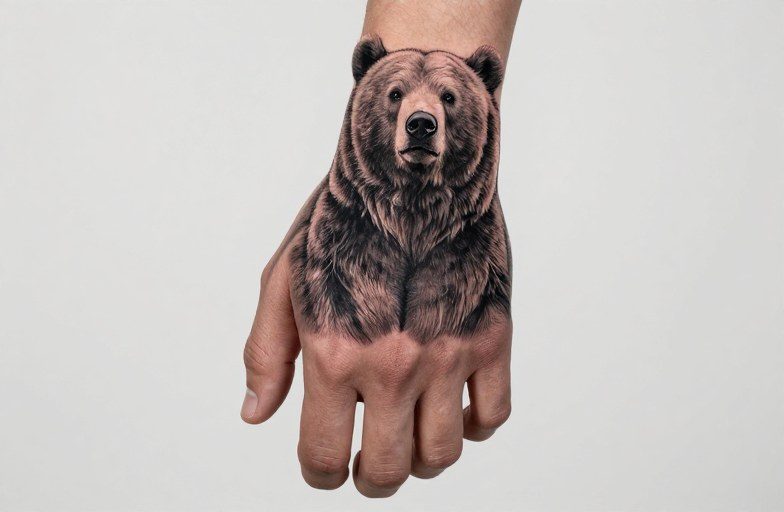
A bear hand tattoo most commonly signals raw strength, self-reliance, and a connection to primal instinct. Placed on the hand, the bear becomes impossible to ignore, a declaration that these qualities are carried into every handshake, every gesture, every day’s work. The meaning tightens around protection of family, solitary endurance, or the duality of ferocity and hibernation.
How It Ages on Skin
Hand skin turns over fast. It’s thin, constantly flexing, and takes more sun than almost anywhere else on the body. A bear tattoo here will soften faster than one on your thigh or chest. That roaring grizzly with needle-fine fur detail? In five to eight years, those lines blur together into a dark smudge unless you plan for it.
Line Work vs. Shading Longevity
Bold outlines hold. Soft shading drifts. For hand placement, prioritize thick, confident lines that define the bear’s silhouette, snout ridge, ear shape, the heavy curve of shoulder. Black-fill areas (solid paws, dark eye patches) age more gracefully than greywash gradients, which can turn muddy where the skin is thickest between knuckles. If you want a realistic bruin with fur texture, consider the top of the hand rather than the fingers, where there’s slightly more stable skin.
Related reading: bear claw tattoo meaning | bear face tattoo meaning | wolf tattoo symbolism | lion tattoo meaning
The Knuckle and Finger Reality
Finger skin is a different animal entirely. Tattoos here often need touch-ups within two years, sometimes sooner. A bear claw extending onto a finger looks striking fresh, but the ink tends to fall out along the sides where the needle can’t saturate evenly. Many artists won’t tattoo fingers at all; others will, but with the caveat that you’re buying a maintenance plan, not a one-time piece.
Symbolism and Core Meaning
Bears accumulate meaning across cultures without collapsing into a single definition. The hand placement amplifies whatever meaning you lean into, because the hand is how we touch, build, fight, and feed.
Strength and Protection
The bear as guardian is an old and widespread image. A bear on the back of the hand, where you might wear a ring, functions like a shield you can’t remove. The paw specifically, with its heavy pad and visible claws, concentrates this meaning. Some people pair it with the initials or birth dates of children, turning the bear into a literal marking of who they’d defend.
Solitude and Self-Sufficiency
Bears hibernate. They walk alone. For people who’ve spent years independent, single parents, long-distance hikers, the self-employed, this aspect resonates more than the warrior symbolism. A bear on the hand can read as quiet confidence: I carry my own weight. This meaning tends to attract quieter designs, less roaring mouth and more steady eye contact, less claw and more bulk.
The Mother Bear Archetype
Female bears defend cubs with documented ferocity against animals many times their size. This translates cleanly to hand tattoos for mothers, sometimes with two small cubs flanking a larger bear, or a single cub held in the larger bear’s paw. The hand placement matters here: it’s the hand that lifts, carries, strikes if necessary.
Common Variations and Styles
Style choice determines how readable your bear remains at hand-tattoo scale. These are the approaches that actually work.
- Traditional American: Heavy black outlines, limited color palette, stylized but immediately readable. The bear’s head in profile, maybe with a banner. Ages best of any color option.
- Blackwork silhouette: The bear as solid black shape, sometimes with negative-space claw marks or constellation lines. Striking from distance, mysterious up close. Holds up well on hands.
- Geometric and mandala: The bear’s face broken into triangles and symmetry. Had a strong trend cycle in the mid-2010s, now slightly dated, but still effective for people who want decoration over naturalism.
- Realistic black and grey: Requires exceptional artist and exceptional aftercare. The detail that makes a bear recognizable, fur direction, wet nose texture, fades fastest on hands. Consider this for the top of the hand only, not fingers.
- Minimalist line: Single continuous line forming bear profile. Elegant, but risky: one blown line and the whole image distorts. Best for inner wrist extending to hand, not the high-wear zones.
Orientation and Flow
Bear facing toward the thumb reads as approaching, aggressive, coming for you. Bear facing the pinky reads as moving away, self-contained, already leaving. Toward the wearer (palm side, if you go there) is private; away from the wearer is public declaration. Most hand placements put the bear on the dorsal side, visible to others, but some people choose the thenar eminence, the muscle at the base of the thumb, for a bear that’s visible when they gesture but hidden at rest.
Historical and Spiritual Context
The bear carries spiritual weight in several traditions, though specific religious iconography is rare in hand tattoos compared to back pieces or sleeves.
In pre-Christian European traditions, often linked to Artio the bear goddess, the animal represented cycles of death and rebirth through hibernation. Celtic warrior rituals involving bear-skin wearing are sometimes claimed, but evidence is scattered and much is reconstruction rather than solid record. Norse berserkers (“bear shirts”) are commonly associated with Odin cults, but the historical connection between this and modern tattoo choice is more romantic than documented.
Among some Native American tribes of the Pacific Northwest and Great Lakes regions, the bear holds specific clan significance and healing associations. Non-Native people should approach this with caution. Tribal-specific bear imagery can constitute cultural appropriation depending on design elements. A generic naturalistic bear avoids this; a bear with specific clan formline design does not.
Christian imagery rarely uses the bear specifically, though some medieval texts used the bear’s emergence from the den as allegory for resurrection. This is not a common tattoo motivation.
Design Tips and Pairings
What you put near the bear changes how it’s read. The hand is small; every element competes for space and attention.
Effective Pairings
- Mountains or forest line: Grounds the bear in habitat, softens the aggression. Works as a band across the knuckles or a backdrop on the back of the hand.
- Honeycomb or bees: The bear’s motivation, literal and symbolic, what drives the strength. Small bees near the wrist, bear on the hand, creates narrative flow.
- Constellations: Ursa Major and Minor, the great and little bears. Connects personal symbolism to cosmic scale. Best as fine line work that will need refresh.
- Family initials or birth flowers: Converts generic bear to specific protector. Risk: dated if relationships shift. Some artists recommend keeping these adjacent rather than integrated.
Spacing and the Other Hand
A single bear on one hand raises the question of the other. Some people mirror, wolf on left, bear on right, predator balance. Others leave the second hand bare for contrast, or plan a complementary piece (cub, forest, moon phase) that completes a theme without duplicating. Think about your hands together, shaking hands, clasped in prayer or anxiety: what do you want visible?
Color choice: green and brown look like camouflage faster than you’d expect. Red accents (mouth, claw) stay vivid but can read as aggressive in professional contexts. All black is safest for longevity and social flexibility. Blue-black bear with white highlights (polar bear suggestion, or moonlight on fur) is a specific choice that requires an artist confident in white ink on dark skin. White fades to yellowish or disappears entirely on hands.
Before You Decide
A bear hand tattoo commits you to a symbol that cannot be hidden, that will age faster than almost any other placement, and that carries enough weight that people will ask about it. The question is not just what the bear means in general, but what it means when you cannot fold your hands to conceal it, when it enters job interviews and first meetings and family dinners without your permission.
The best bear hand tattoos come from people who have lived with the symbol internally first. They did not need the tattoo to become the bear. They needed the tattoo to show what was already there. If you are still deciding what the bear means to you, place it somewhere you can see in private. The hand is for when you already know.
Frequently Asked Questions
How long does a bear hand tattoo last before needing touch-up?
Most hand tattoos need refresh work within five to eight years, with finger elements often requiring attention within two years. Bold black lines last longest; fine detail and greywash fade fastest.
What bear tattoo style ages best on hands?
Traditional American and blackwork silhouette styles hold up best. Realistic black and grey can work on the top of the hand with an exceptional artist, but fades faster than bold alternatives.
Is a bear hand tattoo culturally appropriative?
A generic naturalistic bear is generally safe. Specific tribal designs, particularly Native American formline or clan bear imagery, require belonging to that culture or explicit permission. When uncertain, stick to naturalistic or personal symbolic approaches.
Which direction should a bear hand tattoo face?
Toward the thumb reads as approaching and aggressive; toward the pinky as self-contained and moving away. Palm-side placement is private; dorsal placement is public. Consider what you want visible during handshake and gesture.
Leave a Reply