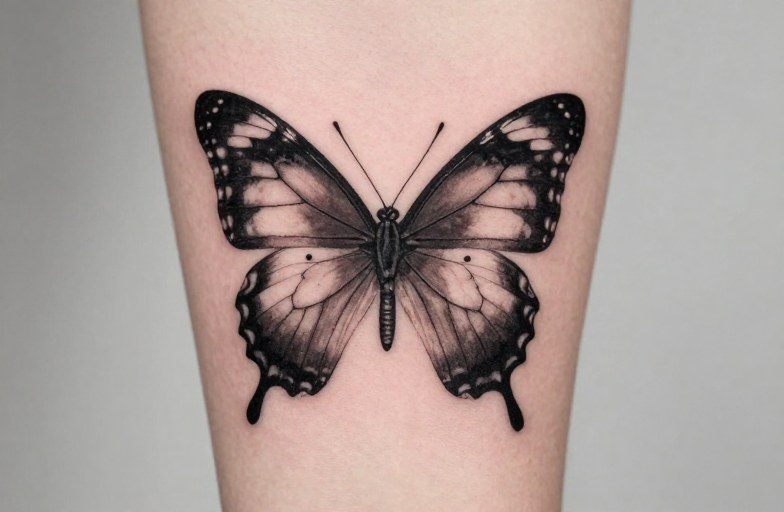
A butterfly skull tattoo fuses two powerful, opposing symbols: the butterfly as an emblem of transformation, rebirth, and fleeting beauty, and the skull as an unflinching reminder of mortality and the finite nature of life. Together, they create a visual paradox that resonates with people who have faced major life changes, survived hardship, or simply accept death as part of living fully. The meaning shifts with each person, but the core tension between life and death remains the design’s strongest pull.
Symbolism and Core Meaning
The butterfly skull works through contradiction. Butterflies live brief, spectacular lives, some species only days or weeks. Skulls strip away everything individual until only structure remains. Pairing them forces a question: what persists when the superficial falls away?
Transformation Through Loss
Many who choose this design have undergone something that fundamentally altered who they are. Recovery from addiction, surviving violence, the death of someone close, leaving a belief system or relationship. These experiences leave a kind of death in their wake. The butterfly skull marks not the loss itself but what emerged from it. The skull acknowledges what ended; the butterfly insists something else began.
Related reading: monarch butterfly tattoo meaning | butterfly with flowers tattoo | snake and butterfly tattoo | strength butterfly tattoo
Memento Mori With Softness
Traditional memento mori imagery, skulls, hourglasses, extinguished candles, can feel cold, even punitive. The butterfly introduces something the classical tradition rarely allowed: the idea that mortality itself might be beautiful, or that beauty depends on impermanence. This is not denial of death. It is a refusal to treat death as purely grim.
Color Versus Black and Grey
Your choice here dramatically shifts how the design reads and how it holds up over time.
Color Approaches
Monarch orange, blue morpho iridescence, or muted natural tones on the butterfly against a grey or bone-white skull create immediate visual hierarchy. The eye goes to life first, then registers death. Bright color works best with enough skin contrast; on darker skin tones, saturated magentas, electric blues, or deep golds pop more reliably than pale yellows or oranges. Color demands larger scale. Tiny color tattoos blur faster, and butterfly wings need clean edges to read as wings, not smudged shapes.
Black and Grey
Black and grey unifies the two elements into a single tonal world. The skull and butterfly become equally real, equally present, no one element dominates. This approach ages more forgivingly; grey wash softens uniformly, while color can patch and spot. For fine detail in wing patterns or skull texture, black and grey gives your artist more control. The mood shifts too: more contemplative, less celebratory.
- Color: higher maintenance, more contrast, reads as “life” first
- Black and grey: better longevity, unified mood, reads as integrated whole
- Single accent color, red eyes, one colored wing: compromise that draws focus without full color commitment
Common Variations and Styles
The butterfly skull hybrid appears across nearly every tattoo tradition, and each style carries different connotations.
Realistic and Neo-Traditional
Realistic renderings, photographic skull detail with anatomically correct butterfly wings, tend toward darker interpretations. The skull looks actual, the butterfly looks preserved, almost pinned. Neo-traditional work softens this with bolder outlines, stylized proportions, and decorative elements like jewels, flowers, or banners. The neo-traditional version feels more designed, less documentary; it signals choice rather than observation.
Geometric and Abstract
Some designs fracture the skull into polygonal shapes while keeping the butterfly organic, or vice versa. Others dissolve the boundary entirely, skull-shaped negative space inside butterfly wings, or wing patterns that resolve into cranial contours when viewed from distance. These versions emphasize the interdependence of the symbols rather than their contrast. They also age differently: geometric lines spread predictably, but large solid black areas can blur and muddy over time.
How It Ages on Skin
Every tattoo changes; this design has specific vulnerabilities.
Butterfly wings rely on thin lines and negative space to suggest membrane and vein structure. As ink spreads under skin, inevitable over years, these details are first to suffer. What read as delicate tracery becomes indistinct grey. Skulls fare better; their structure is bolder, more forgiving. The eye sockets, nasal cavity, and teeth remain readable even with moderate blur.
Placement matters enormously. Inner bicep, thigh, or calf offer relatively stable skin with less sun exposure. Hands, feet, and elbows see constant friction and UV, accelerating fade. Ribcage skin stretches and compresses; a butterfly skull there may distort with body changes more than on a flatter, more muscular area.
For longevity, prioritize the skull’s structural clarity and simplify wing detail to what will survive at three feet, not three inches. Ask your artist to show you healed work from five-plus years ago, not just fresh photos. A good artist will have this; hesitation is a warning sign.
Placement and Pain Considerations
The butterfly skull suits areas with enough flat or gently curved surface to let both elements read clearly. The upper arm, outer thigh, calf, and chest provide this. The design needs room for the skull’s structure and the butterfly’s wing spread to coexist without crowding.
Pain varies by placement, not by design. Bone proximity amplifies sensation: ribs, spine, collarbone, and ankle all hurt more than fleshy areas. The detail work this design often requires means longer sessions, which accumulates fatigue. If you are sensitive, consider splitting the work across two sessions, especially for color packing or extensive grey wash.
Similar and Related Symbols
The butterfly skull sits in a family of life-death juxtapositions that tattoo collectors often consider alongside it.
Direct Comparisons
The snake and skull shares the transformation theme through shedding, but reads more dangerous, more primal. The rose and skull, classic, romantic, but less dynamic; it mourns rather than transforms. The raven or crow with skull emphasizes death as watcher, death as intelligence, without the rebirth element. The moth and skull, often linked to lunar imagery and attraction to flame, carries self-destructive undertones that the butterfly typically avoids.
Adjacent Symbols Worth Knowing
Hourglasses, extinguished candles, and wilting flowers appear frequently with skulls in traditional memento mori. Adding a butterfly to any of these shifts the narrative from “time runs out” to “something emerged from the running.” Some collectors build larger compositions: skull as foundation, butterfly as focal point, with additional elements clarifying the specific transition being marked.
Religious and Spiritual Angles
The symbols carry different weight depending on background, though the tattoo itself requires no religious affiliation.
In Christian iconography, the butterfly’s resurrection symbolism is well-documented, often linked to Christ’s resurrection and the promise of life after death. The skull in this context becomes Golgotha, the place of skulls, or the memento mori tradition within Catholic art that reminds believers to prepare the soul. Combined, they can express Christian hope: death is real, but transformation follows.
Mexican Día de los Muertos imagery sometimes incorporates butterflies, as returning souls are commonly associated with monarch migrations in folk belief. A skull rendered in sugar-skull style with butterfly elements connects to this specifically, though cultural appropriation concerns arise when outsiders adopt calavera aesthetics without understanding or respect for their context.
Secular spiritual interpretations abound too: the design suits atheist existentialists who find meaning precisely in finitude, or practitioners of various witchcraft traditions who work with death deities and transformation magic. The symbols are old and flexible enough to carry personal philosophy without institutional backing.
Choosing Your Artist
This design tests an artist’s ability to balance contrast, not just technically but compositionally. Too much skull overwhelms the transformation; too much butterfly dissolves the gravity. The best versions let you feel both at once.
Look for artists with strong portfolios in your chosen style, whether realistic, neo-traditional, or geometric. Ask specifically about their experience with dual-symbol compositions. Request to see healed photos, not just fresh work. A skilled artist will discuss how they plan to preserve wing detail over time, where they will place the hardest black for skull structure, and how the design will read at a glance versus up close.
Be wary of artists who dismiss your questions about aging or who cannot explain their compositional choices. This is not a simple design to execute well, and enthusiasm without technical grounding shows.
What to Remember
The butterfly skull tattoo works because it refuses easy resolution. Life and death, beauty and decay, change and finality, these are not problems to solve but tensions to inhabit. The design succeeds when it respects both sides equally, neither prettifying mortality nor treating life as mere prelude to ending.
If you are considering this piece, know what you are marking. Not every tattoo needs a story, but this one gains weight from specificity. The skull is generic; your reason for placing a butterfly beside it is not. Work with an artist who understands how to balance the two elements visually. The best versions let you feel both at once, every time you look down.
Frequently Asked Questions
Does a butterfly skull tattoo always mean someone died?
Not at all. While it can memorialize a loss, many people choose it to mark personal transformation, recovery, or acceptance of their own mortality. The meaning depends on the wearer’s intention, not the image itself.
What is the best size for a butterfly skull tattoo?
Medium to large works best, at least palm-sized. The skull needs enough room for its structure to read clearly, and butterfly wings require space for detail that will not blur into indistinct grey. Small designs, under two inches, tend to lose the nuance that makes this combination meaningful.
Where should I place a butterfly skull tattoo?
Choose areas with stable skin and moderate sun exposure: upper arm, outer thigh, calf, or chest. Avoid high-friction spots like hands and feet, and areas that stretch significantly, such as the ribcage or stomach, unless you are prepared for potential distortion over time.
How do I choose between color and black and grey?
Consider your skin tone, maintenance willingness, and the mood you want. Color pops but fades faster and needs touch-ups; black and grey ages more gracefully and reads as more contemplative. If uncertain, a single accent color can test your preference without full commitment.
Is this design culturally appropriative?
The basic butterfly and skull symbols are not tied to any single culture. However, sugar-skull styling, specific indigenous patterns, or Day of the Dead motifs without personal or cultural connection can raise appropriation concerns. If you are drawn to calavera aesthetics, research their significance and consider whether your use respects that context.
Leave a Reply