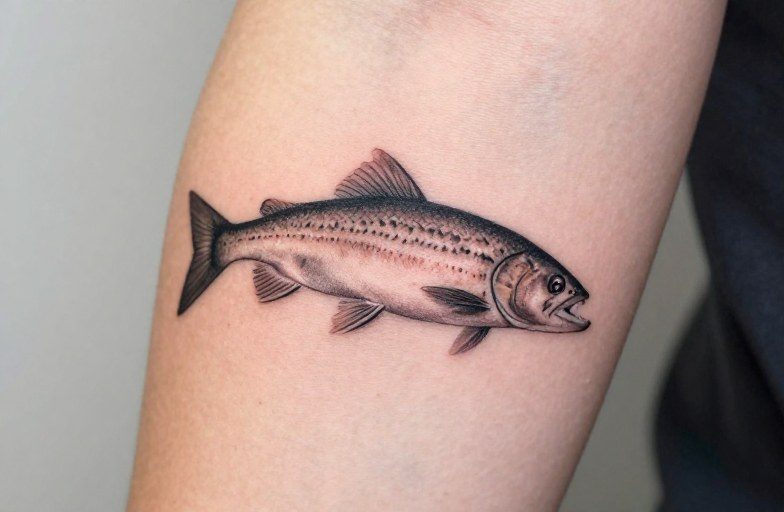
A fly fish tattoo typically signals patience, technical skill, and a deep connection to moving water and the rhythms of nature. For many who wear it, the image represents the meditative quality of fly fishing itself, the cast, the drift, the waiting, rather than the trophy catch. The symbolism sits in the method, not the outcome.
History & Cultural Roots
Fly fishing as an art form stretches back centuries, with early references often linked to Macedonian anglers using artificial flies on the Astraeus River. The practice evolved through British aristocracy in the 15th and 16th centuries, where it became codified as a gentleman’s pursuit distinct from coarse fishing. That class association lingers in the imagery: the tweed, the bamboo rod, the hand-tied fly.
From Elegance to Counterculture
By the mid-20th century, American writers like Norman Maclean reframed fly fishing as something rawer and more spiritual, Montana rivers, family trauma, the search for grace. The tattoo imagery absorbed this duality. You might see the classic Atlantic salmon fly rendered with Victorian precision, or a beat-up trout pattern that looks like it was pulled from a guide’s vest pocket. Both are valid lineages.
Indigenous and Regional Threads
Some trace Pacific Northwest fly fishing traditions to Indigenous salmon ceremonies and the deep cultural weight of first salmon rites. The tattoo imagery sometimes nods to this through integrated formline design or specific species like steelhead, though the connection is more often aesthetic than ceremonial. In New Zealand, the taupō trout fishery spawned its own visual language that occasionally surfaces in tattoo work.
How It Ages on Skin
Fly fish tattoos present specific aging challenges because of their typical components: fine wire hooks, delicate hackle fibers, thin rod shafts, and water elements. Line weight matters enormously here. A hook rendered at true scale with a single needle pass will blur into a grey blob within five to seven years on high-movement areas like the forearm or calf.
- Thin lines on hooks and flies need periodic reinforcement; plan for touch-ups
- Water ripples done with whip shading hold definition better than solid black fills
- Rod blanks, long straight lines, are prone to wobble and blowout over time
- Negative-space highlights in water “flash” tend to close up on oily skin types
Placements with stable skin, upper chest, outer thigh, upper back, preserve the fine detail longer. Hands and fingers destroy this imagery fast; the hook becomes a comma, the fly dissolves into a smear.
Who Chooses This Tattoo
The demographic is broader than the Orvis catalog suggests. Yes, you find it on retired guides and weekend warriors with drift boat stickers. But the fly fish tattoo also appears on people who have never held a rod, drawn to the symbolism of patience, of reading unseen currents, of presenting something beautiful to provoke a strike.
The Technical Purists
These collectors want anatomically correct mayfly patterns, specific hook models (the 94840, the TMC 100), accurate tippet rings. They’ll argue about whether the hackle fibers show the correct number of turns. This group tends toward smaller pieces, often on the inner forearm or ribcage, sometimes arranged as a “fly box” grid of multiple patterns.
The Atmospheric Seekers
Others want the feeling of the river at dawn: mist, rising trout, the rod bent into a parabola. These pieces run larger, often as back pieces or thigh compositions, with heavy atmospheric perspective. The fish might be barely visible, breaking the surface tension. The focus is light and water, not gear.
Mythology & Folklore
Salmon feature prominently in Celtic and Norse traditions, often associated with wisdom and transformation. The Salmon of Knowledge, which grants understanding to whoever eats it, surfaces occasionally in Irish-descended tattoo collectors’ requests. The connection to fly fishing is tenuous, ancient Celts weren’t casting dries to Atlantic salmon, but the symbolic overlap persists.
Japanese ayu fishing with cormorants, and the broader tradition of keiryu (mountain stream fishing), carries aesthetic weight that sometimes bleeds into tattoo design through water rendering techniques borrowed from irezumi. The trout itself has no fixed mythological role, which ironically makes it flexible, a blank canvas for personal projection.
The “One That Got Away” Trope
There’s a persistent narrative motif in angling culture: the impossible fish, the broken line, the story that grows. Some tattoos literalize this with a snapped tippet, a hook straightened open, a fish shadow disappearing into deep water. It’s a rare case where failure imagery carries positive weight, the pursuit validating the life, not the capture.
Design Tips & Pairings
The most successful fly fish tattoos commit to a specific visual language rather than generic “outdoor” mashups. Pairing a dry fly with a mountain skyline and a bull elk silhouette usually produces cluttered, incoherent results. Better integrations keep the focus tight.
- Single fly with botanical elements: the hackle’s origin (rooster, pheasant, peacock) rendered alongside
- Rod building sequence: cork handle, blank, guide wraps, as technical diagram
- Water line perspective: fish from below, surface tension as a horizontal divide
- Fly-tying vise and materials: a still-life of the craft itself
Script pairings tend toward fly fishing literature quotes, Maclean, Gierach, McGuane, but these age poorly unless the typography is exceptional. Better to let the image carry the literary weight.
Negative Space Strategies
Water surface can be rendered as skin tone, with the fish and fly emerging from implied negative space. This requires confident design; half-measures look like unfinished work. The technique works best on lighter skin where contrast is automatic.
Color vs Black and Grey
Color offers obvious advantages: the vermillion of a Royal Wulff hackle, the olive dun of a mayfly wing, the copper flash of a Krystal Flash streamer. But color in fly fish tattoos faces two problems. First, the reference materials (actual flies) are often small, highly detailed, and viewed in hand, scaling them up while maintaining color accuracy is difficult. Second, the bright synthetic materials used in modern flies (fluorescent pinks, UV-reactive chartreuses) look garish and dated in skin.
Black and grey excels at water, shadow, and the tonal gradations of fish scales. It ages more gracefully on the fine details that define this subject. A middle path, black and grey with selective color accents on the fly itself, often resolves the tension, drawing the eye to the human-made element while letting the natural world recede into atmospheric tone.
One practical note: the iridescent quality of real fish scales, that blue-green shift of a rainbow trout’s lateral line, is extremely difficult to render in tattoo pigment. Artists who attempt literal color matching often end up with muddy greens. Stylized interpretation usually outperforms realism here.
Final Word
The fly fish tattoo works best when it honors the specific obsession, the particular river, the remembered cast, the fly pattern tied at midnight for tomorrow’s hatch. Generic trout clip-art fails because the subject matter itself resists generic treatment. The people drawn to this image are already detail-oriented, already patient, already willing to study the hatch. The tattoo should reflect that temperament: technically precise, atmospherically specific, built to last through years of sun and water.
Frequently Asked Questions
What’s the most common placement for a fly fish tattoo?
The outer forearm and upper arm are most common for single-fly designs, while larger river scenes tend to go on the thigh or upper back. Ribcage placements work well for vertical compositions like a bent rod.
Can a fly fish tattoo work if I don’t actually fish?
Yes, but the design should lean into the symbolic elements, patience, observation, craft, rather than specific gear or river references that you’ll be asked to explain.
How much detail can realistically fit in a small fly tattoo?
At under three inches, most hackle fibers and ribbing details will blur within a few years. Simplify to major color blocks and silhouette, or accept that you’ll need periodic touch-ups.
Should I bring my actual favorite fly to the consultation?
Absolutely. A physical reference helps the artist understand proportions, materials, and what specifically matters to you. Photographs flatten the dimensionality that makes flies visually interesting.

Leave a Reply