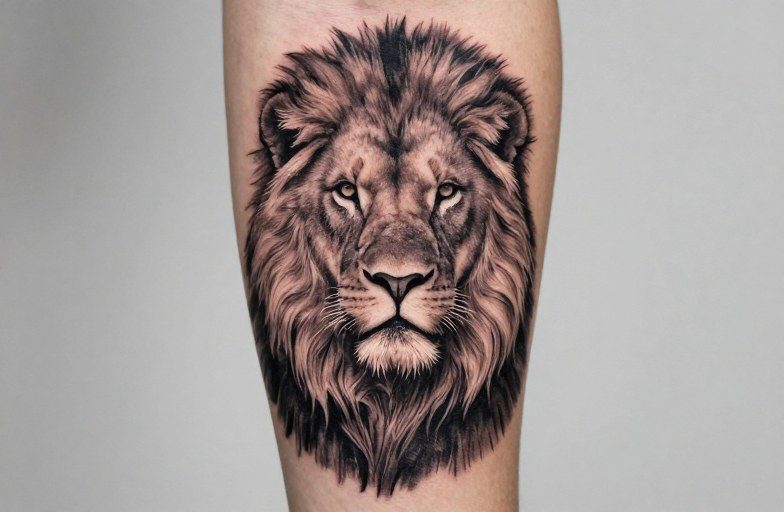
A lion tattoo most commonly signals strength, courage, and leadership, though the specific meaning shifts dramatically based on pose, style, and cultural context. A roaring male lion reads as dominance and territorial power; a lioness with cubs speaks to protection and maternal ferocity. The symbol’s flexibility is its real strength, it’s been claimed by everyone from military veterans to survivors rebuilding their lives.
Design Tips & Pairings
Placement and Scale
The chest and upper back remain the classic canvases for lion work, giving the mane room to breathe and the face its natural gravity. A full-maned portrait at 8+ inches across the chest centers the heart, literally. Thighs and outer arms work well for mid-size pieces where the jawline and eye detail carry the expression. Fingers, wrists, and behind-the-ear placements force extreme simplification, think silhouette or geometric breakdown, not realistic fur texture. Small lions often read as symbols rather than portraits, which isn’t wrong, but know the tradeoff going in.
Complementary Elements
- Crowns: Direct royal association, but easy to overdo; pair with worn, imperfect linework to avoid looking like clip art
- Clocks and hourglasses: Time, mortality, the weight of legacy, works best when the lion’s expression carries weariness, not aggression
- Roses or botanicals: Softens the masculine default; particularly effective with lioness imagery
- Geometric framing: Sacred geometry behind or around the head creates contrast between organic and structured
- Script: High risk; if you must, keep it minimal and place it as a banner or subtle background element, not floating beside the face
Line weight matters enormously here. The mane’s outer contour typically wants a heavier stroke than facial features to create depth and separation. Without that hierarchy, a lion becomes a fuzzy blob in five years.
Common Variations & Styles
Realistic and Neo-Traditional
Realistic lion portraits demand technical precision in the eye, catchlights, moisture lines, the slight asymmetry of a living creature. The best ones feel like they might blink. Neo-traditional simplifies into bold outlines and limited color palettes, trading photorealism for immediate graphic impact. Both age reasonably well if the black saturation is consistent, but realistic work shows blowout and fading sooner because of the subtle gray transitions.
Geometric and Tribal Interpretations
Geometric lions fracture the face into triangles and polygons, often with dotwork shading. The style abstracts the symbol into pure form, which can feel more timeless than literal portraiture. Tribal lion work, often linked to Polynesian and Maori traditions, carries specific cultural weight, if you’re not from those lineages, consider if you’re borrowing aesthetic or meaning, and whether the distinction matters to you. Blackwork silhouettes and single-needle fine line offer further extremes, with the latter being particularly vulnerable to aging poorly on high-movement areas.
Personal & Modern Meanings
Contemporary wearers rarely reach for “king of the jungle” literalism. The lion has become shorthand for personal battles, recovery, sobriety, standing up after failure. A sleeping lion can mean dormant strength, patience before action. A scarred or one-eyed lion speaks to survival without needing words.
Family pride shows up constantly: parents getting lion and cub pairings, siblings matching lion and lioness. The pride structure, cooperative hunting, shared territory, maps neatly onto chosen family and non-biological bonds. Some wearers specifically request lioness-only imagery to reject the default male-gendered symbolism, or to honor female strength without the crown-and-mane baggage.
Zodiac connections matter too. Leos born August-ish often claim the symbol, though the constellation’s actual astronomical timing has drifted from the astrological calendar. That disconnect rarely stops anyone, but it’s worth knowing if you’re tattooing the symbol as personal identity versus general admiration.
How It Ages on Skin
The Fur Problem
Lion tattoos age through their detail density. Fine fur texture, individual hair strands, subtle gradations around the muzzle, all of it blurs. The eye sockets, nose bridge, and jawline are your anchors; if those hold definition, the piece reads as lion even when softer details dissolve. Ask your artist how they’ll handle the transition between mane and face, because that’s where muddying happens first. Solid black in the nose and defined whites in the eye (negative space or very light gray) create contrast that survives decades.
Placement and Sun Exposure
Shoulders and outer arms take sun punishment; chest pieces under shirts hold better. The mane’s outer edges, where ink is often lightest, fade to skin tone and lose the lion’s silhouette. A slightly darker, more saturated outer contour than you think you need usually pays off. Touch-ups are common at 5-10 years for color realism, less so for bold black-and-grey with strong line structure.
Color vs Black and Grey
Golden manes in color can look extraordinary fresh, but yellow and orange pigments fade fastest and are hardest to repair. The result after ten years is often a pale, peachy ghost where fire once lived. Color also limits your artist’s ability to use black for structural depth, everything competes for attention. Black and grey lion work ages more gracefully, with the tonal range carrying expression through value shifts rather than hue. That said, a limited color palette, amber eyes only, or a single red rose against grey fur, can anchor a piece without the full maintenance burden.
Skin tone matters here. On darker skin, color saturation needs to be deeper to read; some artists specialize in this specifically. Black and grey on melanin-rich skin often develops a cooler, almost blue-black cast as it heals, which can be beautiful but should be anticipated, not fought.
Mythology & Folklore
Ancient Near East and Egypt
The lion-headed goddess Sekhmet, often linked to war and healing both, carried duality that modern wearers rarely reference directly but sometimes unconsciously echo. Mesopotamian lion imagery, gate guardians, royal hunts, established the animal as boundary-protector and legitimate-king signifier. The connection between lions and solar deities runs through multiple cultures, though the specifics vary enough that generalizing gets sloppy.
European Heraldry and Christianity
Medieval heraldry made the lion the most common heraldic beast, with posture (rampant, passant, sejant) carrying precise meaning. Saint Mark’s lion, winged and often with book, remains a specific Christian symbol distinct from generic power. Rastafarian lion imagery draws on the “Lion of Judah” lineage, blending religious and political identity in ways that non-Rasta wearers should understand before adopting.
Asian Traditions
Chinese guardian lions (foo dogs, shisa, komainu) are technically dogs in some scholarly readings, but the visual confusion with lions persists. They’re protective, placed in pairs, and carry specific symbolic objects. Japanese tattoo tradition includes lions in some older designs, though tigers dominate the big-cat category there. The distinction matters if you’re mixing cultural references in a single piece.
Final Thoughts
The lion endures because it carries weight without being locked to a single narrative. It can be imperial or intimate, aggressive or watchful, inherited or earned. The difference between a generic lion and a meaningful one usually comes down to specificity, pose, expression, what you choose to pair it with, and what you leave out. A lion with a clock and a rose says something different than a lion with a crown and banner, even if both are “lion tattoos.” The symbol’s power is in its adaptability, but that same flexibility means you need to know your own reason. The best lion work on skin looks like it belongs to exactly one person.
Frequently Asked Questions
Should I get a male lion or a lioness for my tattoo?
Male lions dominate traditional imagery and carry connotations of kingship and authority. Lionesses work better for protection, family bonds, and rejecting default masculine symbolism. The choice depends on which narrative feels personal, not which looks more impressive in a portfolio.
How big should a lion tattoo be to hold detail over time?
For realistic work with readable facial features, plan on at least palm-sized or larger. Smaller pieces need extreme simplification, geometric or silhouette approaches that sacrifice detail for longevity. The mane’s outer contour needs room to stay distinct from surrounding skin.
Do lion tattoos have to be on the chest or can they work elsewhere?
Chest and back offer natural symmetry and scale, but thighs, outer arms, and calves all work with adjusted composition. Avoid high-movement areas like ribs or stomach for detailed realism; the constant flexing distorts fine lines and accelerates aging.
Is it culturally appropriative to get a Rastafarian lion or Chinese guardian lion?
Rastafarian Lion of Judah imagery carries specific religious and political meaning tied to Ethiopian identity and resistance. Guardian lions (foo dogs) are protective symbols with established cultural rules, including proper pairing and placement. Research matters, some symbols are broadly available, others aren’t yours to claim without understanding.
Leave a Reply