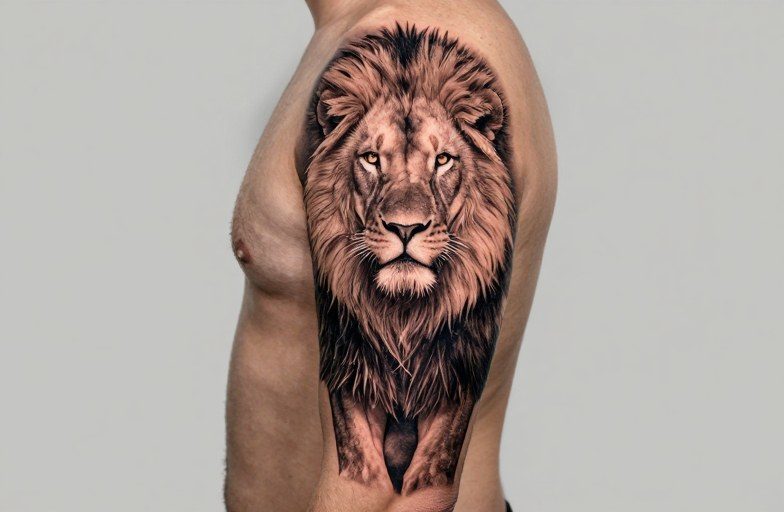
A lion nude tattoo pairs the unclothed human form with lion imagery, often a lion’s head, mane, or full body integrated with or adjacent to a nude figure. The core meaning centers on the tension between vulnerability and power: the bare body stripped of social armor, the lion representing instinct, courage, and unguarded ferocity. Together, they suggest that true strength exists without pretense, that rawness itself is a form of authority.
Symbolism & Core Meaning
The Nude Figure
The unclothed body in tattoo art carries specific weight. Without clothing, there’s no rank, no uniform, no era, just form. In this pairing, the nude figure often represents authenticity, exposure, or a return to essential self. It can suggest being seen fully, without the performance that dress and decoration provide. The lack of garments also creates visual balance: the lion’s mane becomes the ornament, the texture, the visual noise that the smooth human form lacks.
The Lion Element
Lions carry layered associations, leadership, solar energy, protective aggression, but also laziness and the burden of expectation. In this specific combination, the lion typically represents the inner force the nude figure either possesses or confronts. The integration matters: a lion’s head replacing a human’s suggests transformation or merged identity. A lion draped over a reclining nude reads as guardianship or dominance. A figure standing beside a lion implies alliance or mutual recognition.
Design Tips & Pairings
Line Work vs. Shading Approaches
This design lives or dies by how the two elements connect. Fine-line nude figures with heavy black-and-grey lion heads create jarring contrast that rarely holds together. Better approaches: match the energy, both rendered in bold traditional lines, or both in soft single-needle greywash. The mane offers natural transition space; flowing lines from hair can become the curve of a back or shoulder. For color, muted earth tones (ochre, burnt sienna, desaturated gold) bridge human skin and lion fur without cartoonish effect. Avoid bright saturated oranges unless you’re committed to a stylized, illustrative look.
Common Pairings
- Floral elements: Often roses or dried grasses, framing the nude figure and softening the lion’s aggression.
- Architectural fragments: Broken columns or partial arches, suggesting classical statuary and timelessness.
- Negative space: Using skin tone as the nude figure’s “color” while surrounding areas carry the lion in dense black.
- Skull integration: A lion’s skull held by or merged with the nude figure, adding memento mori undertones.
How It Ages on Skin
The Nude Figure’s Longevity
Skin changes make unclothed figures particularly vulnerable over time. Without clothing lines to anchor the eye, weight fluctuation and skin laxity distort the form more noticeably. Breasts, bellies, and thighs shift; what reads as graceful curve at 25 can blur to ambiguous shape at 55. The solution isn’t avoidance, it’s placement awareness and line weight. Thicker outlines on the figure’s contour maintain readability. Avoid excessive internal detail on soft tissue areas; let shadow blocks do the work rather than fine crosshatching that will muddy.
The Lion’s Aging Pattern
Lion manes age well if built with bold pattern rather than delicate hair-by-hair rendering. Dense black fills hold; wispy individual hairs become indistinguishable blurs. The face, with its clear structural landmarks (eye socket, muzzle line, jaw angle), remains recognizable longer than the mane. Plan for this: put the lion’s expressive weight in the face, let the mane be atmospheric rather than informational. On the nude figure, similarly, emphasize silhouette and major form over subtle anatomical nuance.
Personal & Modern Meanings
Contemporary wearers often reject the traditional “king of beasts” leadership reading in favor of more personal interpretations. Some use the design to mark recovery from body shame, the nude figure refusing to hide, the lion refusing to apologize. Others invert the power dynamic: a small, passive lion with a dominant nude figure, suggesting human consciousness directing animal impulse. The design has found particular resonance in non-binary and trans tattoo communities, where the unclothed form and the lion’s traditionally masculine associations create space for renegotiating gendered strength.
Modern variations sometimes replace the realistic lion with stylized or geometric versions, further abstracting the symbolism. A low-poly lion head with a classical nude torso creates deliberate temporal collision, ancient and digital, organic and constructed. These hybrid approaches work best when the contrast is intentional rather than accidental.
Best Placements
Large-Scale Options
The full back offers the most natural canvas for this pairing, allowing the lion’s mane to spread across shoulder blades while the nude figure occupies the lower back or extends vertically. The rib cage works for vertical compositions, figure seated or reclining, lion above or emerging from the torso’s curve. Thigh pieces accommodate horizontal arrangements, with the figure’s length matching the muscle’s long axis. These placements demand commitment: incomplete coverage or awkward cropping where the design meets a joint destroys the integrated effect.
Smaller Adaptations
- Upper arm: Focus on faces, lion profile merged with human profile, both in partial nude suggestion rather than full figure.
- Side of torso: Vertical strip composition, figure descending, lion ascending, meeting at the waist.
- Chest: Symmetrical approach with lion head central, nude figures as framing elements on each pectoral, risky, can read as decorative rather than meaningful.
Similar & Related Symbols
Several tattoo traditions explore comparable territory. The mermaid, human upper body, animal lower, similarly merges vulnerability and wildness, though with more explicit gendered and maritime associations. The classical centaur carries intellectual/physical split symbolism. Werewolf transformations in tattoo form often depict the painful moment of change rather than stable coexistence. Japanese namakubi (severed heads) and shishi (guardian lions) sometimes appear together, though the nude element is absent and the tone is more martial.
Closer parallels in contemporary tattooing: the bear and nude figure (more hibernation, introspection, bulk than the lion’s solar aggression), the wolf pack with solitary nude (social rather than individual strength), the snake-entwined figure (renewal and danger rather than courage and exposure). Each substitution shifts the emotional register significantly, the lion remains the most direct expression of unapologetic, visible power.
Before You Decide
This design requires comfort with both extended sessions and sustained visibility. The nude element makes it harder to conceal in professional contexts than a standalone lion. Consider whether you want the figure to be recognizably you, generically human, or idealized/classical, each choice carries different weight. The most successful versions come from artists who regularly handle both figurative work and animal portraiture; not every specialist in one crosses confidently into the other. Request to see healed photos specifically, not just fresh work. The integration point between skin and fur, between human and animal, is where technical skill proves itself over time.
Bring reference that clarifies the emotional tone you want, not just visual style. A Rubens nude with a Barbary lion reads entirely differently than a Schiele figure with a skeletal lion. Your artist needs to understand the feeling before the drawing begins.
Frequently Asked Questions
Does the nude figure in a lion tattoo have to be female?
No. Male, female, and androgynous nude figures all appear in this design. The choice depends on what body type resonates with your personal symbolism and what your artist draws with confidence.
How painful is this tattoo compared to other large pieces?
Pain varies by placement, but ribs, sternum, and inner thighs, common spots for this design, rank among the more intense areas. The back and outer thigh are more manageable for long sessions.
Can this design work in color or should it be black and grey?
Both work. Black and grey emphasizes classical, sculptural qualities. Color requires careful palette restraint to avoid a circus effect, earth tones and desaturated golds succeed where bright primaries often fail.
How do I find an artist who can execute both elements well?
Look for portfolios showing strong figurative work and strong animal rendering. Ask specifically about healed photos of both. The integration between human and animal forms is a specialized skill; don’t assume proficiency in one guarantees the other.
Leave a Reply