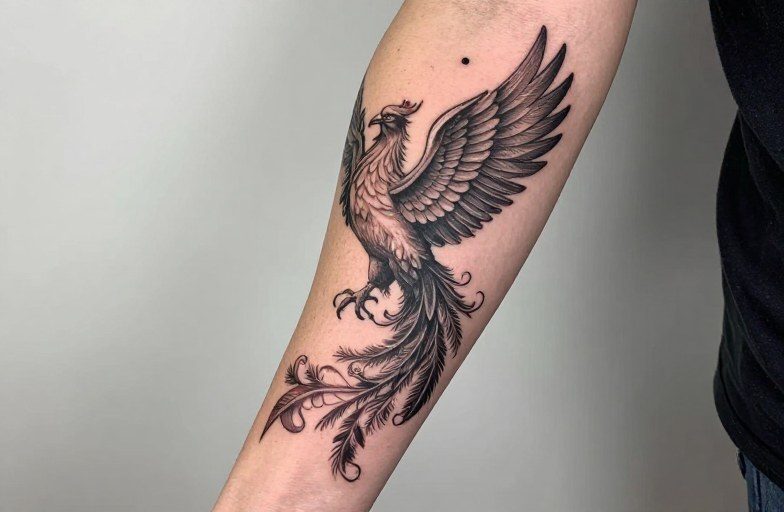
A phoenix bird tattoo on the arm means rising again after destruction, literal fire, personal loss, addiction recovery, or any life chapter that burned down and started over. The arm placement matters: it’s visible enough to serve as your own reminder, mobile enough to let the wings move with muscle and bone. Most people who choose this aren’t claiming victory; they’re marking the turning point.
Personal & Modern Meanings
What People Actually Mean By It
Rebirth is the core symbol, but the specifics vary. Someone coming out of a long illness might emphasize the rising, wings spread, head up, moving toward light. A person leaving a destructive relationship often chooses the fire itself, the moment of burning, because that was the hardest part. The phoenix doesn’t skip the destruction; it dies completely. That’s what makes the symbol honest rather than motivational-poster hollow.
Modern wearers also use it to mark identity transitions, gender, career, geography. The arm keeps it present during daily tasks, a private anchor that doesn’t require explanation. Unlike back or chest pieces, you see your own phoenix when reaching, lifting, typing. That repeated visual reinforcement is part of why the arm works for this particular symbol.
When It Gets Misread
Some viewers assume any phoenix means “I overcame something dramatic.” But plenty of people choose it for aesthetic reasons, the flowing lines, the color potential, the classical subject. Don’t assume someone’s trauma narrative. If you’re getting one, know that strangers will project their own story onto your skin. The arm’s visibility means you’re signing up for that.
How It Ages on Skin
Line Work vs. Shading Longevity
Bold black outlines hold. Fine detail in feathers does not. A phoenix lives or dies in the wing edges, those sweeping lines that read as flame or feather from across a room. Ten years out, the crisp silhouette matters more than the individual barbs you obsessed over in the stencil. Ask your artist to step back and evaluate the design from six feet before starting. If it reads as a bird in motion at that distance, it’ll age as readable art.
Color phoenixes, your oranges, crimsons, golds, shift unpredictably. Red ink is notorious for fading to pink or muddy rose. Yellow becomes skin-tone beige on lighter complexions, disappears entirely on deeper ones. Black and grey phoenixes actually age more gracefully, though they sacrifice the fire association. Consider a hybrid: black linework with limited color accents that can be refreshed later without rebuilding the whole piece.
The Arm’s Specific Challenges
- Inner bicep: softer skin, more moisture, ink spreads slightly faster here
- Outer shoulder/deltoid: sun exposure fades color; plan for touch-ups or go darker
- Forearm: constant movement and friction from desks, sleeves, equipment
- Elbow ditch: heals poorly, detail blurs, avoid intricate featherwork here
Arm skin also changes with muscle gain or loss. A phoenix designed for a lean bicep can compress and distort if that arm bulk up. Placement relative to your actual movement patterns, where the skin stretches when you flex, should guide the bird’s orientation, not just where it looks good in a static photo.
Design Tips & Pairings
Composition for the Arm’s Cylinder
The arm is round, not flat. A phoenix flying straight toward the viewer looks foreshortened and awkward within months as the skin settles. Better: profile or three-quarter view, wings following the arm’s length, tail feathers wrapping slightly toward the inner or outer edge. This uses the cylinder rather than fighting it.
Background elements need the same consideration. Circular sunbursts behind the head flatten the composition. Instead, flame trails that follow the arm’s vertical axis, or smoke wisps that wrap around toward the back of the arm, maintain dimension. The phoenix should feel like it’s moving along your limb, not pasted on top of it.
What Pairs Well (and What Doesn’t)
Complementary elements: bare branches (what burned), geometric fragments (structure rising from chaos), minimal text in a separate session if you must. Clashing elements: clocks (overused time symbolism that competes), roses (softens the fire narrative incoherently), other birds (dilutes the singular focus). One strong symbol beats three medium ones. The phoenix is already doing heavy lifting; let it.
Common Variations & Styles
Traditional American
Thick black outlines, limited color palette, the bird simplified to iconic shape. Sails well, ages well, reads immediately. The traditional approach sacrifices feather realism for longevity and clarity. Good choice if you work in visible clothing or want it recognizable from a distance.
Japanese-Influenced
Often linked to the Ho-ou, a similar mythical bird in Japanese tradition. Flowing tail feathers, wind bars, sometimes paired with paulownia leaves. Requires an artist with actual Japanese tattoo training, not just someone who owns a reference book. The compositional rules are specific, asymmetry, background integration, the relationship between positive and negative space. Done well, it’s among the most striking arm pieces possible. Done poorly, it’s a cluttered mess of mismatched elements.
Blackwork & Geometric
Feathers rendered as patterned shapes, flames as negative space, the bird emerging from constructed geometry. Heals extremely well, suits the arm’s movement, appeals to people who want the symbol without the fantasy-art aesthetic. The risk: looking like a logo rather than a living form. Vet your artist’s portfolio for actual animals in this style, not just mandalas with wings attached.
History & Cultural Roots
The phoenix myth spans multiple cultures, though specifics are often conflated. Greek sources describe a single bird that lives centuries, burns, and rises from ashes. Some trace Egyptian connections to the benu bird, associated with sun cycles and rebirth, though direct continuity is debated by scholars. Chinese fenghuang and Japanese Ho-ou represent different concepts, imperial virtue, cosmic harmony, rather than individual resurrection. The modern tattoo meaning draws most directly from the Greek narrative of personal destruction and renewal, filtered through centuries of European heraldry and later American traditional tattooing.
What matters for your arm: you’re participating in a symbol that has meant “coming back” across millennia, but your specific design choices place you in a particular lineage. Traditional American phoenixes descend from Sailor Jerry era flash sheets. Japanese-influenced pieces connect to ukiyo-e and horimono tradition. Knowing which lineage you’re entering helps you evaluate whether an artist’s approach is authentic or appropriative.
Best Placements
Upper Arm & Shoulder
The classic canvas. Enough flat area for a full wingspan, easy to cover with short sleeves, visible in tank tops or swimwear. The shoulder cap lets the head face outward, the tail trail down the outer bicep. Muscle definition here can enhance the form, pec attachment becomes the bird’s chest, deltoid curve suggests wing arch. Downside: hard to see yourself without mirrors.
Forearm
Maximum visibility, maximum conversation. A forearm phoenix faces you daily, which suits the reminder function. But it’s also exposed to sun, abrasion, and professional judgment depending on your field. The smaller canvas forces simplification, good for bold traditional, challenging for detailed realism. Consider whether you want the bird ascending (toward elbow, tail toward wrist) or descending (head toward hand, more aggressive posture).
Full Sleeve Integration
Not a placement but a strategy. A phoenix can anchor a sleeve’s narrative: rising from lower-arm destruction (skulls, ruins, dark imagery) to upper-arm light (sun, sky, clean geometry). Requires planning the full composition before starting. Most failed phoenix sleeves result from adding the bird to an existing collection without considering flow. If you’re building toward this, start with the phoenix or commit to a full redesign.
What to Remember
The phoenix on your arm will outlast the specific reason you got it. Choose a design that works as pure image, not just as illustration of a story. The fire symbolism is durable; your personal narrative will shift, compress, become complicated by new experience. A bird that reads as powerful abstract form will serve you longer than one that requires footnotes.
Prioritize the silhouette over the detail. Prioritize the artist’s healed portfolio over their fresh Instagram. Prioritize placement that fits your actual body in motion over placement that photographed well on someone else. The rebirth symbol only works if the tattoo itself survives, physically on your skin, visually over decades, personally as something you still want to carry.
Frequently Asked Questions
Does a phoenix arm tattoo have to be colorful to look like fire?
No. Black and grey phoenixes with strong contrast and strategic negative space can read as flame through value shifts rather than hue. Color adds immediate association but isn’t required for the symbol to work.
How painful is the inner bicep for a phoenix tattoo?
The inner bicep rates high on most pain scales, thin skin, nerve proximity, and the muscle’s edge create a sharp sensation. It’s manageable in sessions under three hours, but plan breaks for larger pieces.
Can a phoenix cover up an existing arm tattoo?
Often yes, depending on the old tattoo’s darkness and size. Phoenixes require large flowing shapes that can incorporate or obscure previous work. Black old tattoos may need laser fading first; consult an artist who specializes in cover-ups.
Should the phoenix face toward or away from my hand?
Toward the hand generally reads as forward movement, away as looking back. There’s no wrong choice, but consider your daily view, forearm pieces facing you let you see the bird’s eye; outward-facing pieces show it to others first.
Leave a Reply