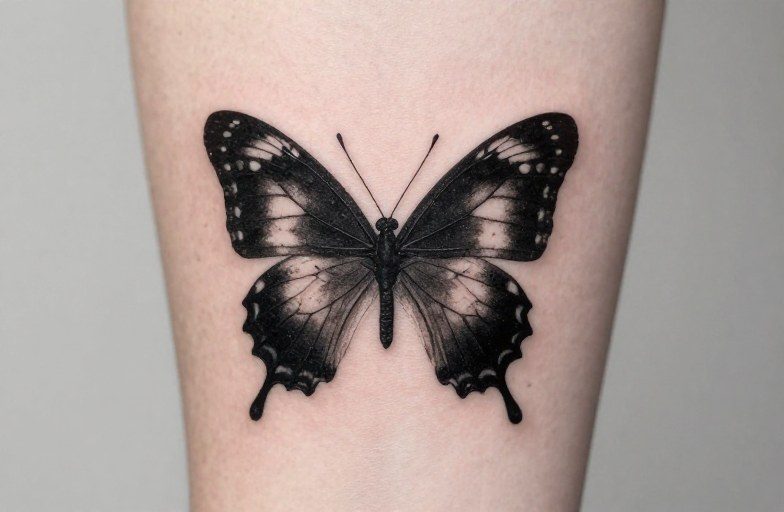
A black butterfly tattoo most commonly signals transformation born from difficulty, death, grief, or profound life upheaval that reshapes rather than destroys. Unlike bright monarchs or watercolor pieces, the stripped-down palette removes sentimentality and leaves something harder, more honest. The meaning tightens around survival, memorial, or a deliberate rejection of pretty-for-pretty’s-sake tattoo culture.
What Sits Nearby: Related Symbols
Butterflies occupy crowded symbolic territory. Understanding what neighbors a black butterfly helps clarify what you are actually asking for.
Moths and Skull Moths
Moths share the lepidopteran form but carry different freight: attraction to flame, nocturnal existence, fatality. A deaths-head hawkmoth, with its skull-patterned thorax, pushes into gothic territory that a black butterfly approaches but does not fully enter. Moth tattoos read more fatalistic; black butterflies keep some rebirth optimism intact, only muted. Line weight matters here. Thick black outlines with limited shading feel more moth-adjacent, while softer grey-wash black butterflies hold closer to traditional butterfly territory. If you are drawn to the black butterfly but want heavier energy, ask your artist about skull moth references and see where the conversation lands.
Ravens and Crows
Corvids occupy similar symbolic space: black, death-associated, intelligent. Ravens lean messier, more mythic, more solitary. A black butterfly offers a structural delicacy that a raven rejects, even under identical color restriction. Placement changes this. A black butterfly behind the ear or on the wrist keeps a lighter reading; across the upper back or thigh, it starts competing with raven energy. Consider whether you want the insect’s fragility or the bird’s heft. You cannot have both in equal measure.
Plain Black Ink Silhouettes
Abstract black shapes, solid butterflies with no internal detail, function as almost pure symbol. The recognizable outline does the work; interior texture becomes irrelevant. These age exceptionally well because no fine lines exist to blur, but they sacrifice the organic quality that makes butterflies compelling. They read closer to a logo than a living thing. This is a valid choice, but know you are choosing symbol over naturalism.
How Black Butterflies Age on Skin
Black butterfly tattoos age differently than their colorful counterparts, and not always worse. The factors are specific and worth understanding before you commit.
Line-Heavy vs. Grey-Wash Approaches
Heavy black outlines with minimal interior shading hold their shape for decades. The silhouette remains readable even as skin texture changes. Grey-wash and soft black shading, the kind that gives wings dimension, faces faster degradation. Those subtle gradients rely on tiny dot patterns and diluted black that disperse more readily than saturated lines. After ten years, a softly shaded black butterfly can look muddy where a bold-outline version still reads clean from across a room. Ask your artist to show you healed work from five-plus years ago, not just fresh photos. Most cannot, which tells you something.
Placement Realities
- Inner forearm: high visibility, moderate sun exposure, fine for bold black work
- Ribs: stretching with torso, soft shading blurs faster here than almost anywhere
- Ankle/foot: sun exposure and friction destroy detail; solid black recommended
- Upper back/shoulder blade: protected, stable, ideal for either approach
- Behind the ear: small scale demands simplicity; intricate grey-wash becomes soup within five years
White highlights, sometimes added to black butterflies for dimension, typically vanish first. They yellow or disappear entirely, leaving the design flatter than if they had never been included. A skilled artist knows this and either commits to pure black or uses white with full transparency about its lifespan. If an artist promises white will “pop” long-term, find someone else.
Touch-Ups and Fading Patterns
Black does not stay black forever. It cools toward blue-grey, particularly in areas with thinner application or lower needle saturation. The edges of wings, where ink density drops, show this first. Plan for a touch-up at eight to fifteen years, sooner if you tan heavily or use skincare acids near the area. Laser removal of black is more straightforward than color, a practical consideration if you are young or uncertain about lifelong commitment.
History and Folklore
Butterfly-blackening appears across cultures, though specific “black butterfly” mythology remains thinner than generic butterfly lore. What follows is documented association, not invented tradition.
European Threads
In Irish tradition, butterflies are often linked to souls, and black butterflies specifically were sometimes viewed as restless dead seeking resolution. Some trace this to the belief that a black butterfly hovering near a home foretold death. The connection is regional and not universal across Celtic practice; county-level variation matters more than national generalization. You cannot claim “Irish heritage” as automatic justification for this symbol without knowing which county, which century, which specific oral tradition.
Central American Associations
Central American and Mexican practice sometimes links black butterflies to the recently deceased, particularly during Día de los Muertos observances. This is not a standardized symbol; it appears more in specific communities and families than in broad cultural practice. The overlap with monarch migration, orange and black, not purely black, complicates clean attribution. If you are not from these communities, tread carefully. The symbol is not forbidden, but claiming it as your own without relationship to the living culture is hollow.
Philippine and Pacific Contexts
Philippine folklore sometimes associates black butterflies with visiting spirits, particularly ancestral ones. The meaning shifts by island and language group; Tagalog-speaking areas differ from Visayan regions. There is no unified “Filipino” reading. As with the Irish material, specificity matters. Ask your grandmother, not Google, if this connection is genuine to your family.
What unifies these threads: black butterflies carry death-adjacent energy that colored butterflies typically do not. Not necessarily negative, but weightier. The tattoo inherits this gravity whether you know the folklore or not. You do not get to opt out of the cultural weight by claiming ignorance.
Why People Choose This Design
Certain patterns emerge in placement and style choices, though no single demographic owns the design. These are shop-floor observations, not rules.
Memorial Context
Black butterflies function as grief markers without the explicitness of dates, names, or religious imagery. You know; observers might not. This privacy appeals to people processing loss who reject public performance of mourning. Rib placement, hidden, personal, painful to receive, dominates this category. The pain of receiving the tattoo becomes, for some, part of the processing. I have watched clients choose this and later describe it as necessary. I have watched others regret the location and wish they had chosen somewhere less agonizing. There is no correct choice, only your own tolerance and meaning.
Aesthetic Rebellion
Against the current flood of hyper-realistic color butterflies, black variants read as refusal. They reject the decorative, the cheerful, the immediately legible. This choice often accompanies broader blackwork or black-and-grey portfolios rather than standing alone. The person building a cohesive aesthetic selects black butterflies; the person wanting a single pretty piece typically does not. Neither position is superior. Know which one you inhabit.
Gender and Placement Patterns
Observable trends, not rules: women more often choose black butterflies in delicate placements with fine linework; men more often scale larger, with heavier black fill. The most interesting black butterflies break these patterns. Heavy black butterflies on small feminine frames, whisper-thin grey-wash on masculine bodies. The tension between expected delicacy and chosen starkness creates the visual interest. If you want to be interesting, consider defying the expectation your body suggests.
Color vs. Black and Grey
The choice to remove color is not neutral. It transforms meaning.
What You Lose and Gain
Colored butterflies, especially monarchs, carry established symbolic loads: migration, perseverance, specific cultural pride, Mexican heritage notably. Black removal severs these associations. What remains is more universal but less specific: transformation generally, not transformation-through-Mexico specifically. Black and grey allows focus on form: wing structure, negative space, the architecture of the insect. Color competes for attention; black demands you look at shape. Artists with strong background in engraving or illustration often prefer black butterflies for exactly this reason. Their line confidence shows without chromatic distraction.
Practical Considerations
Black heals more predictably than color. Red can blow out; yellow disappears; blue shifts. Black stays black, mostly. The exceptions, blue-black healing, grey-wash unevenness, are more correctable than color disasters. For first tattoos or for people with known healing difficulties, black offers lower risk. Cost and time: pure black often requires fewer sessions than equivalent color work. Not always; intricate black realism can exceed simple color, but generally. This matters less than meaning, but it is not irrelevant. Budget reality shapes what you can sustain.
Spiritual and Religious Angles
Christian tradition lacks specific black butterfly theology, but general butterfly resurrection symbolism adapts easily. The black variant suits Christian perspectives that emphasize suffering preceding transformation, Lenten spirituality, Good Friday before Easter. Some churches use butterfly imagery in funeral contexts; black versions fit naturally here without requiring doctrinal innovation.
Buddhist and Hindu frameworks, with their existing butterfly-as-soul metaphors, accommodate black variants through the same lens of reincarnation and impermanence. The black does not contradict; it intensifies the acknowledgment of death’s necessity for rebirth.
Contemporary pagan and witchcraft practices sometimes assign black butterflies to specific deities: Hecate, Persephone, the Morrigan, though this is modern syncretism rather than ancient continuity. The associations feel organic to practitioners even where historical grounding is thin. Tattoo choices in this context often accompany other symbols: keys, pomegranates, crossroads imagery. If this is your path, the black butterfly likely chose you through personal practice, not through reading this article.
Secular spiritual use, meditation on impermanence without doctrinal framework, is equally valid. The black butterfly works as a private reminder of what you have survived, not what you believe.
What to Remember
A black butterfly tattoo is not a safer choice than color, only a different one. It carries weight you may not intend, folklore you may not know, and aging characteristics that demand specific aftercare and eventual maintenance. The meaning you assign matters less than the meaning the symbol already holds in collective memory. You are entering a conversation, not starting one.
Choose your artist for healed blackwork, not fresh portfolio shots. Ask about their grey-wash experience if you want softness; ask about their bold-line consistency if you want longevity. Do not accept white highlights without understanding their temporary nature. Do not place intricate grey-wash where sun and friction concentrate. Do not claim cultural heritage you have not lived.
The black butterfly rewards honesty. It looks best on skin that has actually weathered something, not skin performing resilience for an audience. Know your own history before you ask this symbol to speak it.
Frequently Asked Questions
Does a black butterfly tattoo always mean someone died?
No. While memorial use is common, the symbol also marks survival, transformation through difficulty, or aesthetic preference for stark blackwork. The meaning you assign is personal, though the symbol carries death-adjacent cultural weight regardless of your intent.
Will a black butterfly tattoo fade to green or blue?
Black ink often cools toward blue-grey over time, especially in thinly saturated areas. This is normal and correctable with touch-ups. Proper aftercare and sun protection slow the shift but do not prevent it indefinitely.
Is a black butterfly tattoo less painful than color?
The color itself does not affect pain. Needle technique does. Heavy black fill requires more saturation passes than light color packing, which can mean more time under the needle. Placement matters far more than pigment choice for pain levels.
Can I add color to a black butterfly tattoo later?
Technically yes, but practically difficult. Saturated black blocks most color application. If you think you might want color eventually, design for that possibility from the start with planned negative space or lighter black application.