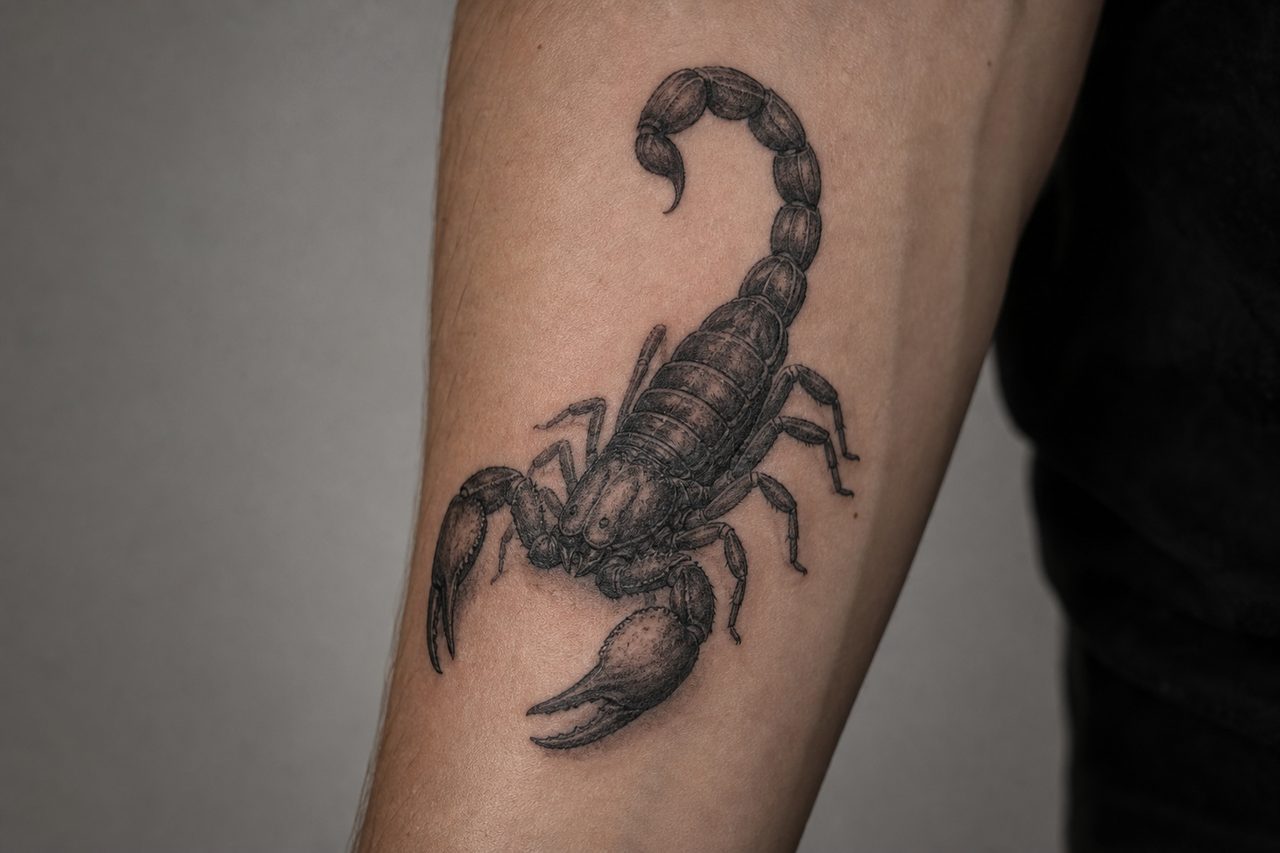
A scorpion tattoo most commonly signals protection, resilience, and the willingness to strike when cornered. The symbolism stretches across desert cultures, military insignia, and modern street tattooing alike. Beyond meaning, the scorpion’s anatomy makes it a technically demanding design that ages in specific ways depending on placement and style choices.
Religious & Spiritual Angles
Scorpion imagery surfaces in several spiritual traditions, though its role varies dramatically between them.
Desert Faiths and Protective Ritual
In ancient Near Eastern practice, scorpion amulets served as apotropaic devices, objects meant to turn harm away. Some Bedouin groups historically carried scorpion motifs as talismans against the actual creatures, a sympathetic magic approach where the symbol commands what it depicts. This protective function carries forward in tattoo form, particularly among people with roots in arid regions where scorpion encounters are lived reality rather than abstract danger.
Christian and Gnostic Text
The Gospel of Luke contains the passage about authority to tread on serpents and scorpions, often interpreted as spiritual dominion over evil. Certain Gnostic texts used the scorpion as a complex symbol of both earthly danger and the power to transcend it. Tattoo wearers drawing on this tradition usually emphasize the triumph aspect, the creature underfoot rather than the threat itself. Designs here often incorporate script or crosses, with the scorpion positioned lower in the composition to suggest subjugation.
Mythology & Folklore
Scorpion myths tend to cluster around transformation, vengeance, and cosmic consequence.
Greek and Roman Sources
The constellation Scorpio originates in the myth of Orion, the hunter who boasted he would kill every animal on earth. Gaia sent the scorpion to stop him; both were placed in the sky as constellations, never visible together. This narrative of hubris punished by a small, overlooked creature gives scorpion tattoos a underdog resonance that appeals to people who identify with quiet, disproportionate power. The scorpion wins not through size but through patience and precision.
Native American and Mexican Lore
Some Southwestern tribes feature scorpion in cautionary tales about respecting boundaries, desert creatures who strike only when threatened. In Mexican folk practice, the scorpion connects to Santa Muerte imagery and narco-culture aesthetics, though this association is often reductively applied by outsiders. The actual folk tradition is more nuanced, treating the scorpion as a creature of necessary defense rather than gratuitous aggression.
Similar & Related Symbols
Scorpion designs rarely stand completely alone; they cluster with specific companion imagery that modifies or intensifies the meaning.
- Spider: Both are venomous arachnids, but where spider tattoos lean toward patience and web-building strategy, scorpion emphasizes direct confrontation and survival in harsh conditions.
- Snake: The serpent and scorpion share desert symbolism and biblical reference, but snakes carry more explicit rebirth connotations through shedding. Paired together, they suggest comprehensive danger, striking from above and below.
- Skull: A scorpion emerging from or perched on a skull narrows the meaning toward mortality, poison, and the specific aesthetic of 1980s-90s biker and metal tattooing. This combination has become almost a genre unto itself.
- Rose: The thorned plant and the venomous creature create a balance-of-beauty-and-danger composition. Here the scorpion typically represents the defensive aspect, the rose the vulnerable or attractive one.
- Scorpion with flames: Common in Southern California Chicano tattooing, this pairing draws on the creature’s desert habitat while adding intensity and movement to the design.
How It Ages on Skin
The scorpion’s anatomy presents specific technical challenges that affect how it looks at five, ten, and twenty years.
Line Weight and Detail Loss
Scorpion tails curve, legs splay at thin angles, and pincers require negative space to read as distinct from the body. Fine lines in these areas, especially the multiple leg segments and the tail’s stinger tip, tend to blur and close up over time. A scorpion with legs drawn at hairline thickness may become a dark blob on the lower leg or forearm where circulation and movement accelerate aging. The safest approach uses varied line weights: heavier outlines on the body and tail segments, with strategic simplification of leg joints rather than attempting full anatomical accuracy.
Placement Realities
Hands and feet, popular for scorpion placement, are among the fastest-fading locations due to skin density and friction. A scorpion on the top of the hand will likely need substantial touch-up within five years. The upper arm outer bicep and calf back hold detail better. Ribs and sternum work for larger compositions but stretch with breathing and weight fluctuation, distorting the symmetrical body plan that makes scorpions visually recognizable. For smaller designs, the flat planes of the shoulder blade or thigh provide the most stable long-term canvas.
Shading and Color Behavior
Black-and-grey scorpion tattoos with soft shading age more gracefully than solid black tribal-style designs, which tend to heal with inconsistent saturation and develop a “stamped” look. Red accent on the stinger or as a background element is common, but reds are among the least stable pigments, often fading to a dull pink or orange. If you want color that lasts, the body of the scorpion should remain primarily black with perhaps minimal yellow or gold highlights that can fade without destroying the design’s readability.
Common Variations & Styles
Scorpion tattoos have accumulated distinct stylistic traditions that carry their own connotations.
Traditional and Neo-Traditional
American traditional scorpion tattoos feature bold black outlines, limited color palette (red, yellow, black, green), and simplified forms that emphasize the curved tail and prominent stinger. The legs are often reduced to three or four visible pairs rather than the full anatomical count. This style prioritizes immediate readability over realism. Neo-traditional work keeps the bold outlines but adds more illustrative detail, jewel tones, and decorative elements like ornamental florals or Art Nouveau framing.
Realism and Biomechanical
Photorealistic scorpion tattoos require significant space to execute, the exoskeleton’s texture, the segmentation, the translucency of certain species’ bodies all demand room and a skilled hand. These work best at palm-size or larger. Biomechanical scorpion designs, often associated with H.R. Giger’s influence, replace organic segments with mechanical pistons, gears, and metal plating. This style peaked in the 1990s and early 2000s but maintains a dedicated following among collectors of dark surrealism.
Tribal and Geometric Interpretations
Polynesian-influenced tribal scorpion tattoos use the creature’s form as a vehicle for traditional patterning, though this requires genuine understanding of the source culture to avoid appropriation. More commonly, geometric scorpion designs break the body into triangles, hexagons, and dotwork patterns, creating a contemporary aesthetic that reads as both technical and symbolic. These tend to age well because the simplified forms withstand blur better than fine detail.
Personal & Modern Meanings
Contemporary wearers assign scorpion tattoos meanings that sometimes diverge from traditional symbolism.
Zodiac and Identity Claims
Scorpio sun-sign tattoos are among the most common astrological placements, though the symbol’s intensity appeals to people who identify with the sign’s cultural reputation, emotional depth, loyalty, vindictiveness, regardless of actual birth date. Some wearers specifically request the scorpion to mark a powerful period, drawing on the creature’s association with molting and renewal. The tattoo becomes a timestamp rather than a permanent personality claim.
Subcultural and Regional Markers
In specific contexts, the scorpion functions as regional pride, Arizona desert rat identity, Baja California surf culture, certain Texas prison traditions where the scorpion indicated a specific status or conviction type. Military units, particularly those with desert deployment history, have adopted scorpion insignia that sometimes migrates to skin. These meanings are context-dependent and can shift dramatically based on who is wearing the design and where they are seen.
The Takeaway
A scorpion tattoo carries weight because the creature itself is unmistakable, there is no mistaking it for a passive or decorative choice. The symbolism of protection, precision, and survival under harsh conditions is durable and cross-culturally legible. For actual execution, prioritize bold lines over delicate detail, consider placement carefully for longevity, and choose a style that matches how you want the meaning to read: traditional for straightforward toughness, realistic for awe, geometric for contemporary distance. The scorpion does not need embellishment to land; its form alone carries sufficient threat and beauty to justify permanent ink.
Frequently Asked Questions
Does a scorpion tattoo always mean someone is dangerous or aggressive?
Not necessarily. Many people choose it for protective symbolism, warding off harm rather than projecting it. The meaning depends heavily on context, companion imagery, and the wearer’s own intent. A scorpion with a rose reads differently than one with a skull or military insignia.
What’s the best size for a scorpion tattoo that won’t blur badly?
At minimum, palm-sized or slightly larger if you want leg detail and tail segmentation to remain distinct. Smaller than two inches, and the legs and stinger become vulnerable to ink spread and merge together over time.
Why do so many scorpion tattoos look similar regardless of artist?
The creature’s anatomy constrains design choices. The curved tail and pincers are immediately recognizable, so radical abstraction risks losing the scorpion identity entirely. Most variation happens in style execution, traditional, realistic, geometric, rather than fundamental composition.
Is the scorpion specifically a prison or gang tattoo?
It has been used in some correctional and regional contexts, but it’s far too widespread across military, zodiac, and general protective symbolism to assume any single meaning. Location, style, and accompanying imagery provide better clues than the creature alone.