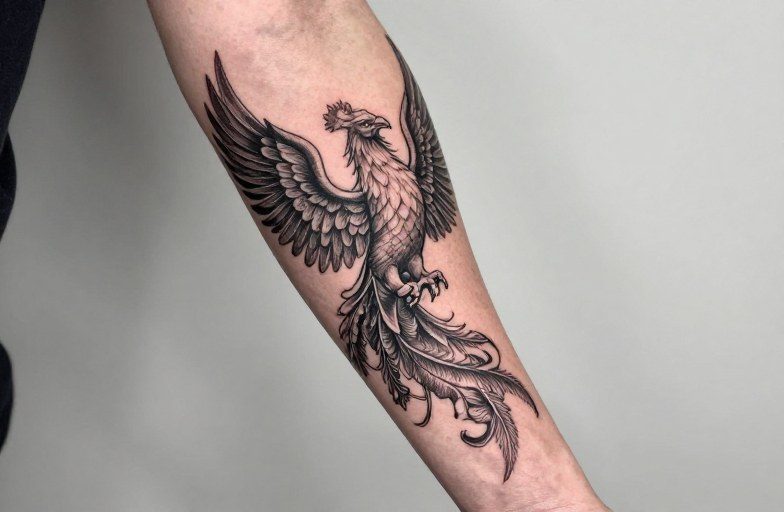
A phoenix arm tattoo carries one of the most widely understood symbols in tattooing: rebirth through fire. The bird ignites, collapses to ash, and returns to life. On the arm, this imagery becomes visible, kinetic, and deeply personal. The placement matters as much as the symbol itself.
Symbolism and Core Meaning
Fire as Transformation
The phoenix does not merely survive destruction. It requires it. The flames are not punishment; they are the mechanism of renewal. This distinction separates the phoenix from generic strength tattoos. Someone choosing this symbol often marks a specific ending: a divorce, an addiction’s aftermath, a career collapse, a health crisis. The ashes are not abstract metaphor. They are the actual wreckage of a former life.
The arm placement amplifies this meaning through visibility. Unlike a back piece hidden under clothing, the arm tattoo confronts you daily. It becomes a deliberate reminder of where you have been and what survived. The motion of the arm, reaching, working, gesturing, gives the bird a sense of perpetual animation.
Color Versus Black and Grey
Color phoenix tattoos traditionally emphasize the flames: crimson, orange, and gold bleeding into each other. These pieces demand more skin. The color saturation needs room to breathe; a three-inch flame patch on a forearm often muddles into a bruise-like blob within five years. Black and grey phoenixes rely on contrast, feather texture, and negative space. They age more forgivingly on arms that see regular sun exposure. The symbolic weight remains identical; the visual strategy differs.
- Full sleeve phoenixes allow narrative sequencing: destruction at the wrist, flight ascending toward the shoulder
- Forearm placements focus on the emergence, the bird breaking from ash, wings still half-folded
- Upper arm and bicep pieces emphasize power and containment, the bird coiled before expansion
Mythology and Folklore
Greek and Roman Sources
Herodotus described the phoenix in his Histories, though he admitted to secondhand reporting. Early accounts typically gave the bird a lifespan of five hundred years. Roman imperial symbolism later adopted the phoenix for emperors who claimed divine renewal of the state. Some imperial coinage featured the bird, though scholars debate which reigns first popularized this imagery. The connection between personal immortality and political continuity remained consistent across these adaptations.
Eastern Parallels
Chinese mythology offers the Fenghuang, often paired with the dragon in wedding symbolism. Unlike the solitary Western phoenix, the Fenghuang represents union and harmony. Japanese Hō-ō imagery shares the fire-bird’s regenerative associations but frequently appears in temple architecture rather than body art. Tattoo clients sometimes conflate these traditions; a knowledgeable artist distinguishes whether you want Greco-Roman solitary rebirth or East Asian paired cosmology.
The Egyptian bennu bird, often linked to the phoenix through Greek interpretation, carried solar and creation associations. Its cry supposedly began the cycle of time. These layered origins mean the phoenix arm tattoo rarely carries a single mythological program. Wearers often combine elements without knowing the friction between traditions.
Who Chooses This Tattoo
Recovery and Survival
Demographic patterns exist, though any generalization dissolves on contact with individual motivation. The phoenix arm tattoo appears frequently among people in recovery communities, visible enough to serve as accountability, personal enough to avoid preachiness. Military veterans sometimes select it after discharge, marking civilian identity construction rather than combat trauma specifically. Cancer survivors form another substantial group, though many prefer more explicit medical symbolism.
Age and Gender Shifts
Age distribution skews toward first tattoos in the twenty-five to forty range. The phoenix demands enough skin commitment to discourage impulsive placement. Younger clients occasionally request small wrist phoenixes; these often require cover-ups within years as the detail collapses. The arm’s muscle movement also distorts miniature designs.
Gender presentation in phoenix arm tattoos has shifted. Traditional American tattooing coded the phoenix as feminine through the late twentieth century. Contemporary placement and styling have largely dissolved this. Bold black linework, aggressive feather geometry, and integrated biomechanical elements attract clients across gender expressions.
Religious and Spiritual Angles
Christian Adaptation
Early Christian writers, notably Clement of Rome and Tertullian, explicitly claimed the phoenix as resurrection symbolism. The bird’s self-immolation and return mapped onto Christ’s death and resurrection. Medieval bestiaries preserved this interpretation. Modern Christian wearers sometimes incorporate crosses, ichthys symbols, or scriptural references into phoenix arm designs. The theological coherence varies; some churches reject the imagery as pagan syncretism.
Contemporary Spiritual Eclecticism
Many contemporary phoenix arm tattoos operate outside institutional religion. Clients who describe themselves as spiritual but not religious often describe the bird as representing their journey or their transformation without doctrinal specificity. The arm’s visibility supports this function: the tattoo becomes a self-directed sacred object, not a community affiliation marker. Some combine phoenixes with chakras, mandalas, or astrological elements in ways that would confuse any single tradition’s practitioners.
History and Cultural Roots
Tattooing Lineage
The phoenix as tattoo motif entered Western practice through multiple channels. Sailor Jerry’s flash sheets included phoenix designs, though less prominently than eagles or pin-ups. The 1970s Japanese tattoo influence brought larger, more dynamic phoenix compositions to American awareness. Don Ed Hardy’s work in particular synthesized Japanese Hō-ō structure with American color sensibility.
The 1990s and 2000s saw phoenix arm tattoos surge in popularity through celebrity visibility. Exact attribution proves difficult; tattoo journalism rarely documented precise dates, but the design became a standard shop request. This saturation produced backlash among some tattooers, who associated the phoenix with uninformed client requests. Contemporary quality varies enormously: masterful Japanese-influenced full sleeves coexist with traced reference disasters.
Arm Placement Specifically
The arm’s tattoo history matters for placement. Traditional American arm tattooing developed around military and maritime contexts: eagles, anchors, pin-ups. The phoenix entered this visual vocabulary as a later addition, carrying different symbolic weight than the patriotic or sentimental standard motifs.
Similar and Related Symbols
Clients considering phoenix arm tattoos sometimes evaluate alternatives. Understanding the distinctions clarifies choice.
- Ouroboros: Cyclical return without destruction. The snake eating its tail emphasizes continuity; the phoenix emphasizes rupture and reconstruction. Better for gradual evolution rather than crisis recovery.
- Koi dragon transformation: Japanese tradition where koi become dragons through effort and endurance. More process-oriented than the phoenix’s instantaneous combustion. Often better for long-term goal achievement.
- Butterfly or metamorphosis: Gentler transformation imagery. Less suited to clients who experienced violent or catastrophic change. The arm placement would feel almost ironic given the butterfly’s delicacy.
- Rising sun: New beginnings without the death prerequisite. Lighter symbolic load, less narrative density.
- Three crows or ravens: Odin’s messengers, associated with death and knowledge. Darker, more ambiguous. Less universally legible to casual viewers.
The phoenix maintains unique position through its requirement of total destruction. No other common tattoo symbol insists on annihilation as prerequisite. This severity attracts some clients and repels others.
Technical Considerations
Design and Placement
The phoenix arm tattoo succeeds or fails through technical execution more than symbolic selection. The bird’s wings demand flowing lines that follow arm musculature. Poorly placed, the wing tips stab awkwardly at wrist or shoulder joint. Flame elements need sufficient contrast; light orange on light skin often ages to indistinguishable blur within a decade. The eye of the phoenix, frequently rendered too small, becomes a blackened dot after healing.
Long-term Thinking
Consider the long arc. An arm tattoo visible at twenty-five remains visible at fifty-five. The rebirth you commemorate at one life stage may feel distant or even embarrassing at another. This is not an argument against getting the tattoo. It is an argument for choosing imagery broad enough to accommodate future reinterpretation. The phoenix works partly because its myth is already about change: the bird you are today differs from the bird you were, and both differ from the bird you will become.
Artist Selection
Not every artist who can execute a clean eagle or rose can handle phoenix composition. The bird’s asymmetry in flight, the gradient demands of flame, the feather layering that must read correctly from multiple angles: these require specific experience. Ask to see healed photos, not fresh work. A bright red phoenix on day one often becomes a pink smear by year three. The artist who understands this will design accordingly, sacrificing initial pop for longevity.
What to Remember
The phoenix arm tattoo endures because its meaning is both universal and privately adaptable. Everyone understands rebirth; only you know the specific fire you walked through. The arm placement makes this duality possible: public enough to declare survival, personal enough to withhold the full story.
Choose your artist with patience. Choose your design with the understanding that you will change, and the tattoo must change with you. The phoenix is not a static emblem. It is a promise that destruction and renewal are not opposites but phases of the same continuous motion. On your arm, in motion, that promise becomes visible every time you reach for something new.
Frequently Asked Questions
Does a phoenix arm tattoo always mean rebirth?
Rebirth is the most common association, but individual meaning varies widely. Some clients choose it for aesthetic reasons, others for religious resurrection symbolism, others for specific personal transitions. The universal recognition of the myth allows private interpretation without requiring explanation.
How much does a phoenix arm tattoo typically cost?
Forearm pieces generally range from several hundred to over a thousand dollars depending on complexity and artist reputation. Full sleeves require multiple sessions and significantly more investment. The phoenix specifically demands technical skill in flame and feather rendering, so experienced artists command appropriate rates.
Will a color phoenix tattoo fade quickly on my arm?
Arms receive substantial sun exposure, which accelerates fading of reds, oranges, and yellows. Quality application and consistent sun protection extend vibrancy, but black and grey will always outlast color. Discuss aging expectations with your artist before choosing palette.

Leave a Reply