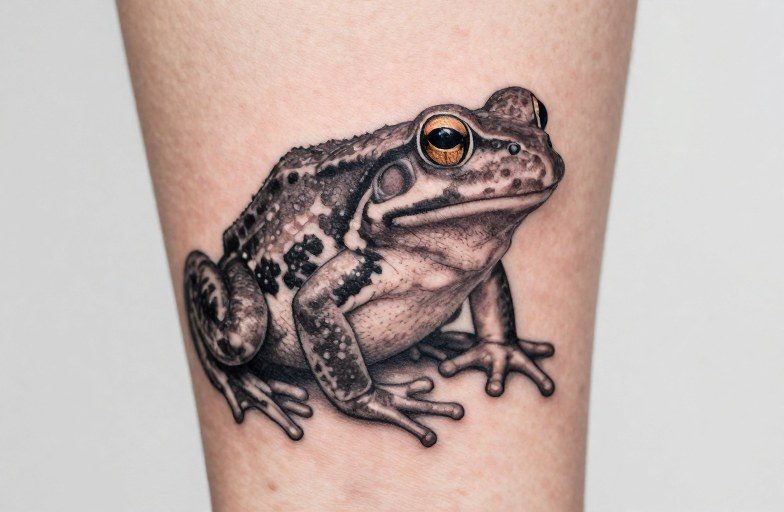
Frog tattoos most commonly represent transformation, fertility, and adaptability. The creature’s life cycle, from aquatic tadpole to land-dwelling adult, makes it a natural emblem of personal change and growth. Depending on the cultural context and specific design choices, a frog can also signal good luck, financial prosperity, or spiritual cleansing.
Symbolism & Core Meaning
The frog carries layered meanings that shift based on how it’s rendered and where it’s placed. Understanding these core symbols helps you choose a design that actually resonates rather than picking something generic.
Transformation and Rebirth
The most universal frog symbol is metamorphosis. Tadpoles lose tails, grow legs, and develop lungs, a visible, dramatic change that mirrors major life transitions. People often choose this imagery after career shifts, recovery from hardship, gender transitions, or spiritual awakenings. A design showing the full cycle (tadpole to frog) emphasizes process over destination; a single adult frog suggests arrival at a new stage.
Fertility and Abundance
Frogs lay thousands of eggs and thrive in wet, lush environments, so they’ve long been tied to fertility and agricultural abundance. In this context, the tattoo can honor parenthood, creative fertility, or a connection to nature’s cycles. Pairing a frog with lotus flowers, water lilies, or moon imagery reinforces this reading without needing explicit text.
Adaptability and Survival
Frogs absorb oxygen through skin, survive freezing, and thrive across six continents. As tattoo symbolism, this speaks to resilience, bouncing back, finding a way, flourishing in unlikely conditions. A frog mid-leap captures this energy; a frog half-submerged in water emphasizes the ability to exist between worlds.
Religious & Spiritual Angles
Spiritual traditions have assigned specific significance to frogs for millennia, though interpretations vary dramatically.
Christian Symbolism
In medieval European art, frogs sometimes appeared as symbols of sin or plague, most famously the Exodus narrative of frogs swarming Egypt. However, the creature also represented resurrection due to its hibernation and apparent “rebirth” each spring. A frog tattoo with Christian resonance might include subtle cross elements, or conversely, might deliberately reclaim the creature from negative associations.
Buddhist and Hindu Connections
In some East Asian Buddhist contexts, frogs are associated with spiritual awakening and the dissolution of ego, the “frog” being a creature that must let go of its aquatic identity to become something new. In certain Hindu traditions, frogs are linked to Varuna, deity of water and cosmic order, and their croaking forecasts monsoon rains essential for survival. Mandala backgrounds or Sanskrit integration can nod to these connections.
Mythology & Folklore
Mythological frogs carry specific narrative weight that can anchor a tattoo in story rather than vague positivity.
Japanese Kaeru and Prosperity
The Japanese word for frog, kaeru, sounds like the word for “return”, making frogs talismans for safe travel, returning money, and the return of good fortune. Maneki-neko-style frogs holding coins, or frogs with travelers’ items (straw sandals, walking sticks), specifically invoke this meaning. This is distinct from general “good luck”; it’s about things and people coming back to you.
Native American and Mesoamerican Traditions
Several Indigenous North American cultures feature frogs as rain-bringers and healers. The Aztec deity Tlaloc, associated with rain and fertility, wore frog imagery. Some Pacific Northwest coast peoples depict frogs as transformers and spirit helpers. These specific cultural attributions are often linked to particular artistic styles, formline design for Northwest Coast references, for instance, and should be approached with respect for their origins rather than casual appropriation.
European Witchcraft and Folk Magic
Frogs and toads populated European folk magic as ingredients and familiars, though this symbolism often blurs frog and toad together. A frog with a witch’s hat or cauldron leans into playful Halloween aesthetic; a more historically grounded approach might reference medieval woodcut styles. The distinction matters: toads carry more venomous, earthy, “dark” associations, while frogs stay more watery and liminal.
Common Variations & Styles
How you render the frog changes its impact significantly. These are the most effective approaches seen in actual tattoo work.
Realistic and Neo-Traditional
Realistic tree frogs (red-eyed, poison dart, green tree frog) showcase incredible color and texture opportunities, translucent skin, jewel-toned markings, delicate toe pads. These age reasonably well if kept large enough for detail, but the fine linework in toe webbing and eye striations can blur over time. Neo-traditional approaches simplify these forms into bold outlines with limited but saturated color palettes, trading some accuracy for longevity and graphic punch.
Minimalist and Line Work
Single-line frogs, geometric abstractions, and tiny silhouettes work for discreet placements, behind the ear, inner wrist, ankle. The challenge: frogs have distinctive proportions (long hind legs, compact body, specific head shape) that can become unrecognizable if oversimplified. A successful minimalist frog usually preserves the silhouette of crouched legs ready to spring. These designs age well due to simplicity but require precise initial execution.
Japanese Irezumi and Water Themes
Traditional Japanese frog tattoos often appear as standalone subjects or as part of larger water scenes with koi, waves, and lotus. The style demands specific expertise, correct scale patterns, particular color gradients, background integration. A frog in this context reads as part of a broader aesthetic system rather than an isolated symbol. The water backgrounds also provide practical benefit: blue and black backgrounds hold color better over decades than exposed skin with isolated color subjects.
Design Tips & Pairings
Specific combinations sharpen the frog’s meaning and improve the tattoo’s visual coherence.
- Water and lily pads: Ground the frog in its habitat; the lily pad adds a platform or “stage” that compositions well on flat areas like shoulders, thighs, or upper backs.
- Skulls or hourglasses: Creates mortality contrast, life/death, time/transformation. Works best in American traditional or neo-traditional styles.
- Coins or gold: Directly references the Japanese kaeru prosperity meaning; also fills space for larger compositions.
- Moon phases: Connects to cyclical change, nocturnal activity, feminine energy. Effective wrapping around limbs or as background elements.
- Snakes or dragons: Both share transformation symbolism; pairing them creates narrative tension or complementary power.
Placement affects readability. Frogs crouch, leap, and cling, poses that need space to read correctly. A leaping frog needs horizontal room (outer forearm, calf, side ribcage). A clinging frog works vertically (upper arm, side of torso, ankle). Circular compositions (frog on lily pad) suit shoulders, knees, or chest centers.
Who Chooses This Tattoo
There’s no single demographic, but certain patterns emerge. People undergoing visible life transitions, graduations, divorces, sobriety milestones, relocations, often gravitate toward frog imagery specifically for its metamorphosis association. Environmentalists and biologists sometimes choose scientifically accurate species renderings as identity markers. People with Japanese heritage or connection may select kaeru-specific designs.
The frog also appeals to those who want nature imagery without the ubiquity of wolves, bears, or birds. It’s recognizable but not overdone, specific but not aggressively masculine or feminine. That middle ground makes it versatile across gender expression and age groups.
Key Takeaways
Frog tattoo symbolism centers on transformation, but branches into prosperity, resilience, spiritual transition, and cultural narrative depending on design choices. The most successful pieces match specific symbolic intent to appropriate style and cultural context, Japanese prosperity frogs need different handling than personal metamorphosis frogs. Prioritize clean, readable design over cramming every possible symbol in; a frog that clearly reads as a frog, in a pose that suits its placement, communicates more than an overcrowded composition. Work with an artist who understands the style you’re pursuing, whether that’s scientific realism, bold neo-traditional, or refined minimalism. And remember: the life cycle reference only works if the tattoo itself ages well, simpler, bolder, and slightly larger than you might initially think.
Frequently Asked Questions
Do frog tattoos have different meanings than toad tattoos?
Yes. Toads carry earthier, more venomous associations in folklore, witchcraft ingredients, warts, dry land survival. Frogs stay more aquatic, liminal, and tied to rain and transformation. Visually they’re distinct too: toads have dry, warty skin and shorter legs; frogs have smooth, moist skin and longer jumping legs.
Which frog species works best for realistic color tattoos?
Red-eyed tree frogs and poison dart frogs offer the most striking natural color for tattoo work, bold reds, blues, and yellows against green. However, these colors fade faster than black and grey. Expect touch-ups every 5-8 years to maintain saturation, and protect the tattoo from sun exposure.
Is a frog tattoo culturally appropriative if I’m not Japanese?
Generic frog imagery isn’t tied to any single culture. However, specific Japanese kaeru designs, particularly those with specific coin types, straw sandals, or particular stylistic conventions, do carry cultural specificity. If you’re drawn to those specific elements, research thoroughly and consider whether your connection justifies the imagery, or work with a Japanese-trained artist who can guide appropriate use.
How well do detailed frog tattoos age over time?
Fine detail in toe webbing, eye striations, and translucent skin effects tends to blur and merge over 10-15 years. Bold-outline neo-traditional or simplified approaches age more gracefully. If you want realistic detail, commit to larger size (at least palm-sized) and plan for periodic maintenance.


Leave a Reply