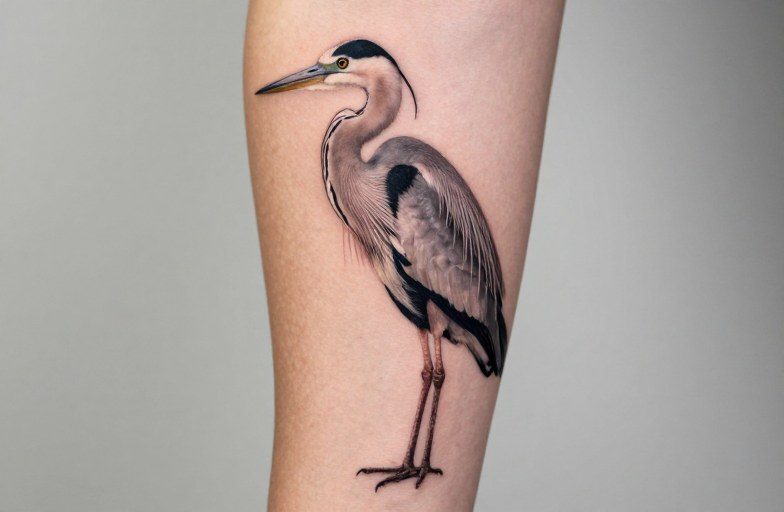
The heron carries a specific set of associations that make it distinct from other water birds. People gravitate toward this image for its connotations of stillness, self-reliance, and the ability to stand alone without loneliness. Unlike the showy peacock or aggressive eagle, the heron represents a quieter, more contemplative strength, waiting motionless for the right moment, then striking with precision.
Symbolism & Core Meaning
At its foundation, the heron is a hunting bird that survives through patience rather than speed or force. This biological reality shapes its symbolic weight across cultures. The bird stands in shallow water for hours, utterly still, then moves with explosive efficiency. That contrast, motionlessness versus sudden action, gives the tattoo layered meaning.
Independence and Self-Sufficiency
Herons are largely solitary. They don’t flock, don’t hunt in groups, and don’t depend on social structures for survival. A heron tattoo often marks someone who values autonomy, who works best alone, or who has learned to trust their own timing over external pressure. The image suits people who’ve left restrictive situations, unhealthy relationships, rigid workplaces, family expectations, and found stability in self-direction.
Patience as Active Strategy
The heron’s stillness isn’t passivity. Muscle tension, alertness, readiness, all remain high during the wait. This distinction matters for the tattoo’s meaning. It represents not resignation but disciplined preparation. Someone recovering from injury, building a slow-burning career, or navigating prolonged uncertainty might choose this symbol to mark their commitment to the long game.
History & Cultural Roots
Associations with the heron appear across several traditions, though specifics vary significantly.
Native American and Indigenous Connections
Among various Plains and coastal tribes, the heron often linked to good judgment and deliberate action. Some traditions connected the bird to fishing success and prosperity. The long legs and neck made it a natural symbol for bridging worlds, water and air, earth and sky. Certain creation stories featured the heron as a helper during flood narratives, carrying messages or guiding survivors to dry land.
Japanese and East Asian Symbolism
In Japanese art, the heron (sagi) appears frequently in ukiyo-e prints and ink paintings, often paired with willows or set against winter landscapes. The bird commonly associated with purity, elegance, and the changing seasons. Chinese traditions sometimes connected herons to longevity and the passage into a respected elder status. These associations carried into tattoo culture through the popularity of Japanese-inspired Western designs since the mid-20th century.
Egyptian and Mediterranean Links
The heron often linked to the Egyptian deity Bennu, a solar-associated bird connected to creation and rebirth. Greek sources sometimes confused herons with cranes, but both birds carried similar symbolic freight in Mediterranean antiquity: watchfulness, boundary-crossing, and the liminal spaces between elements.
Color vs Black and Grey
The choice between color and monochrome significantly affects how a heron tattoo reads and how it holds up.
Black and Grey Realism
Most heron tattoos execute in black and grey, and for sound practical reasons. The bird’s natural coloration, slate blues, soft greys, white plumes, translates well into monochrome shading. The long neck and legs provide excellent opportunities for smooth greywash gradients that show technical skill. Black and grey ages more predictably on most skin tones, with less risk of the muddying that can affect blues and purples over time. The somber palette also reinforces the heron’s associations with stillness and introspection.
Color Approaches
When color appears, it typically emphasizes specific elements:
- Soft blue-grey for the body, referencing the great blue heron’s actual plumage
- Orange or yellow accents at the beak or eye, drawing focus to the bird’s intent gaze
- Water rendered in teals and greens, setting off the heron’s cooler tones
- Seasonal foliage, red maples, snow-laden pines, green reeds, to place the bird in a specific environment
Color demands more maintenance. The lighter blues and soft greys that match actual heron feathers are particularly prone to fading and blurring. Expect touch-ups every 5-8 years if you want color to remain crisp.
How It Ages on Skin
Heron designs present specific aging challenges due to the bird’s anatomy.
The long, thin legs are notorious for spreading. Lines that read as elegant at year one can become wobbly or thickened by year ten, especially on areas with frequent movement or friction. The lower leg, ankle, and foot are particularly risky placements for detailed leg rendering. Thicker line weight helps, as does simplifying the lower extremities into bolder shapes rather than fine detail.
The neck, by contrast, ages relatively well. Its S-curve provides natural flow that accommodates skin movement, and the broader surfaces hold shading better than extremities. Chest and upper back placements preserve neck detail longer than forearms or calves.
Beak and eye detail require careful consideration. Small, intricate work around the face, tiny eye highlights, delicate mandible separation, often blurs into indistinct grey within a decade. Slightly exaggerated scale in these areas, or a move toward more stylized rather than strictly realistic rendering, extends readability.
Who Chooses This Tattoo
Certain life circumstances and personality types consistently drawn to this imagery.
Professional Contexts
The heron lacks the aggressive or rebellious connotations of predators, skulls, or traditional flash imagery. This makes it viable for people in conservative fields, medicine, law, education, finance, who want meaningful body art that won’t raise eyebrows in professional settings. The bird’s quiet dignity reads as tasteful rather than provocative.
Life Transition Markers
People marking specific transitions often select herons: leaving a long-term relationship, recovering from burnout, completing extended education, or surviving illness. The bird’s association with solitary endurance resonates with periods of necessary isolation. Unlike phoenix imagery, which emphasizes dramatic rebirth, the heron suits quieter, more protracted transformations.
Similar & Related Symbols
Several alternatives occupy adjacent symbolic territory, and understanding the distinctions helps clarify whether the heron truly fits.
- Crane: More explicitly associated with longevity and good fortune in East Asian contexts; more social, often depicted in pairs; the heron carries more solitary, self-reliant energy
- Egret: Nearly identical visually but carries stronger associations with purity and, in some Southern US contexts, regional identity; less universal symbolic recognition
- Flamingo: Playful, social, decorative; the heron’s opposite in temperament and symbolic weight
- Owl: Wisdom through knowledge and nocturnal mystery; the heron represents wisdom through patience and observation
- Phoenix: Cyclical destruction and rebirth; the heron emphasizes sustained endurance without the drama of burning
Some designs combine herons with lotus flowers (purity emerging from murky water), willow branches (flexibility, grief), or moon imagery (nocturnal hunting, cycles). These combinations should serve the core meaning rather than cluttering the composition.
The Takeaway
The heron tattoo works best when its specific qualities, solitude, patience, self-sufficiency, quiet precision, genuinely match the wearer’s values or current life chapter. It is not a default “nature tattoo” for people who like birds. The image demands a certain commitment to its understated ethos. Poorly executed, it becomes merely decorative; well-executed and well-chosen, it carries weight for decades without requiring explanation. Consider placement carefully for longevity, be realistic about color maintenance, and trust the symbol’s inherent dignity rather than overloading it with additional elements that dilute its particular character.
Frequently Asked Questions
Does a heron tattoo work for small designs, or does it need to be large?
The heron’s long proportions generally favor medium to larger sizes. Small herons often lose leg detail and neck elegance, becoming generic bird shapes. Minimum recommended size is about 4-5 inches in height for the full body to preserve recognizable anatomy.
What’s the best placement for a heron tattoo?
The vertical S-curve of a standing heron suits the side of the torso, outer thigh, or upper arm. Flying herons work well across shoulders or upper back. Avoid ankle and wrist if you want leg detail to remain crisp long-term.
How much does a heron tattoo typically cost?
A detailed heron in black and grey from an experienced artist generally runs $400-800 for palm-sized work, $800-1,500 for larger pieces with background elements. Color adds 20-30% to time and cost. Highly realistic or Japanese-influenced styles command premium rates.
Can a heron tattoo be easily covered up later if I change my mind?
The long neck and legs create challenging cover-up geometry. Black and grey designs are easier to modify than color. The bird’s generally light tonal values (much skin showing through) can work in your favor for cover-ups, but the distinctive silhouette is hard to fully disguise without going much larger.

Leave a Reply