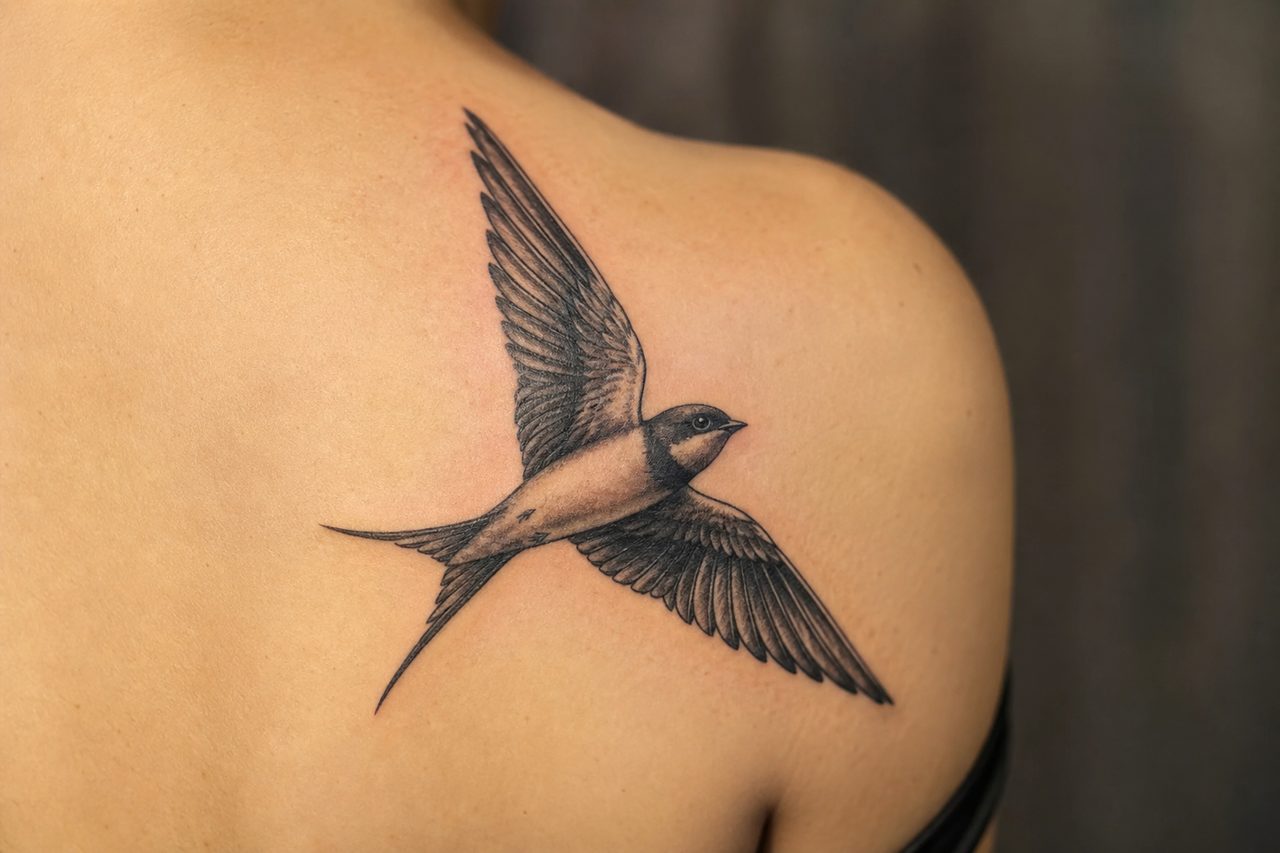
A swallow bird tattoo most commonly represents safe return home, loyalty, and distance traveled. Two swallows traditionally marked 10,000 nautical miles for sailors; today, the design carries themes of love, freedom, and finding your way back to what matters. The bird’s real-world behavior, migrating vast distances yet returning to the same nesting spot year after year, gives the symbol its staying power across centuries of skin.
Symbolism & Core Meaning
The Sailor’s Original Code
Before electric navigation, sailors watched swallows for landfall. The birds stay close to shore, so spotting one meant dry ground ahead. Tattooing a swallow on each side of the chest became a visual logbook: one bird for 5,000 miles, a second for 10,000. This wasn’t decorative bragging, it was a language other sailors read instantly. The chest placement kept the birds near the heart, tying the symbol to life itself.
The meaning hardened into tradition because swallows actually return to the same nest. A sailor who made it home could reasonably expect to do so again. The tattoo became a protective token, almost talismanic, though that aspect grew more through repetition than any formal ritual.
Love, Fidelity, and Homecoming
Swallows mate for life in observable behavior, and that biological fact fed the tattoo’s romantic layer. Partners sometimes got matching swallows before separations, military deployments, long work trips, immigration. The bird promises return and fidelity without needing words. This meaning holds especially strong in European and Latin American traditional scenes where the design never fully lost its working-class roots.
- Single swallow: personal milestone, solo journey, or waiting for someone’s return
- Two swallows facing each other: partnership, reunion, mutual commitment
- Swallow in flight: forward momentum, leaving something behind
- Swallow at rest: arrival, contentment, home found
Common Variations & Styles
Traditional American and Neo-Traditional
The classic swallow wears bold black outlines, a red or blue chest patch, and forked tail feathers spread wide. Sailor Jerry’s flash sheets cemented this look, small enough for hands, necks, or chest panels, readable from across a bar. Neo-traditional builds on that skeleton with more color gradients, ornamental backgrounds, or slightly exaggerated proportions. Both styles age well because the heavy lines hold against sun and time.
Blackwork, Fine Line, and Minimalist
Blackwork swallows strip away color for silhouette or dotwork shading, often reading more abstract. Fine line versions trend smaller and more delicate, behind the ear, along the collarbone, or as part of a larger composition. The risk here is real: thin lines in a bird’s wing feathers blur faster than bold traditional work. A skilled artist compensates with slightly heavier line weight in the body and simplified detail in the tail forks.
Watercolor backgrounds behind a solid black swallow create contrast without fighting the symbol’s readability. Geometric framing, circles, triangles, or compass roses, adds structure to otherwise floating designs.
Religious & Spiritual Angles
Christian iconography sometimes links swallows to the resurrection or the soul’s flight to heaven, though this connection is looser than the naval tradition. The bird’s spring return made it a natural symbol of Christ’s rising in medieval European art, and that echo occasionally surfaces in tattoo requests, often with crosses, scrolls, or script integrated into the design.
In broader spiritual readings, the swallow’s migration mirrors life’s cycles: departure, transformation, return. Some trace this to Greek stories of the swallow’s connection to Procne and Philomela, though that’s more literary than devotional. Modern wearers often pick up the bird simply as a marker of personal rebirth or survived hardship, with no specific religious intent.
Similar & Related Symbols
Swallows vs. Sparrows
The mix-up persists because both are small, brownish birds in old flash art. Sparrows carry different baggage, often linked to memory, undying love, or sometimes darker sailor codes about death at sea. Swallows have the forked tail, brighter chest, and cleaner association with safe return. If you’re researching designs, check the tail shape: split and pointed means swallow, notched or square means sparrow.
Swallows vs. Swifts and Martins
Swifts and martins share the aerial lifestyle and similar body shapes, but tattoo tradition almost never uses them. The swallow’s specific nesting loyalty and visible coloration made it the chosen symbol. Artists sometimes blend traits for aesthetic reasons, but the tattoo world’s visual shorthand stays with Hirundo rustica and its relatives.
Related designs that pair well: compass roses (direction and return), anchors (stability after journey), banners with names or dates (specific commitment), ship wheels (control through distance), and hearts (love made explicit).
Design Tips & Pairings
Placement and Scale
Traditional placement favors the chest, hands, and throat, visible, symmetrical, socially significant in old sailor culture. Modern wearers expand to shoulders, ribs, and ankles without diluting the meaning. The chest still reads strongest for the classic “home to the heart” message. Hands and fingers demand simpler shapes because the skin there sheds and ages faster; a swallow on a hand needs thicker lines and less fine detail than one on a shoulder blade.
Two swallows work symmetrically on chest, shoulders, or knees. Single birds suit asymmetrical placements, one side of the neck, a rib panel, or trailing behind another design element.
Color Choices and Aging
Traditional red and blue chest patches fade to softer versions but remain readable. All-black swallows hold longer but can look muddy if the shading isn’t balanced. White highlights on wings add dimension but often disappear into skin tone within five to ten years. Yellow beaks and eye rings stay bright longest because the pigment sits in small, concentrated areas.
- Pair with roses for love and beauty layered onto the travel theme
- Pair with daggers for protection during dangerous journeys
- Pair with clocks or hourglasses for time spent apart or time running
- Pair with maps or coordinates for specific locations tied to the meaning
Personal & Modern Meanings
Today’s swallow rarely connects to actual nautical miles. Instead, people mark immigration, coming out, surviving illness, or returning to sobriety. The core idea, going far, changing, coming back to yourself or your people, stays intact while the specifics multiply. A swallow might memorialize a parent who always came home from sea, or celebrate a relationship that survived long-distance.
The tattoo also functions as a promise to oneself: leaving a hometown, building a life, intending to return not as escape but as completion. This layers cleanly over the old sailor code without requiring any maritime background. The symbol’s flexibility is its strength, not its weakness.
Some wearers choose swallows for purely aesthetic reasons, the shape fits body contours, the wings fill space dynamically, the traditional style matches other planned work. Meaning can accumulate after the fact, which is common with tattoos chosen first for how they look on skin.
What to Remember
The swallow’s meaning starts in physical reality: a bird that crosses oceans and finds its way to the same nest. That grounded origin keeps it from floating into pure abstraction. If you’re considering this design, know whether you want the traditional visual language (bold lines, chest or hands, symmetrical pairs) or a modern interpretation that borrows the symbol without the style.
Line weight matters more than most small bird tattoos because the forked tail and pointed wings need crisp edges to read correctly. Choose an artist who understands traditional flash structure even if you’re going contemporary, those proportions are solved problems. And be clear with yourself whether the tattoo marks something already completed (a return made) or something ongoing (a commitment to try). Both work; confusion between them is what leads to regret.
Frequently Asked Questions
What’s the difference between a swallow and a sparrow tattoo?
Swallows have forked tails and brighter chest coloring, and they symbolize safe return and miles traveled. Sparrows have notched or square tails and carry different meanings, often memory, love, or sometimes death at sea. Check the tail shape in your design reference.
Do swallow tattoos have to be done in traditional style?
No. While bold traditional American style is the classic look, blackwork, fine line, watercolor, and geometric interpretations all work. The symbol transfers across styles, though heavy lines age better for long-term readability.
Where should I place a swallow tattoo for the strongest meaning?
Chest placement keeps the traditional “home to the heart” reading. Hands and throat carry old sailor visibility. Shoulders, ribs, and ankles work well for modern interpretations without weakening the core symbolism.
Can a single swallow tattoo work, or does it need to be a pair?
Single swallows work fine and often mark personal solo journeys or waiting for someone. Pairs traditionally signaled 10,000 miles or mutual commitment. The number changes the emphasis but not the fundamental symbol.