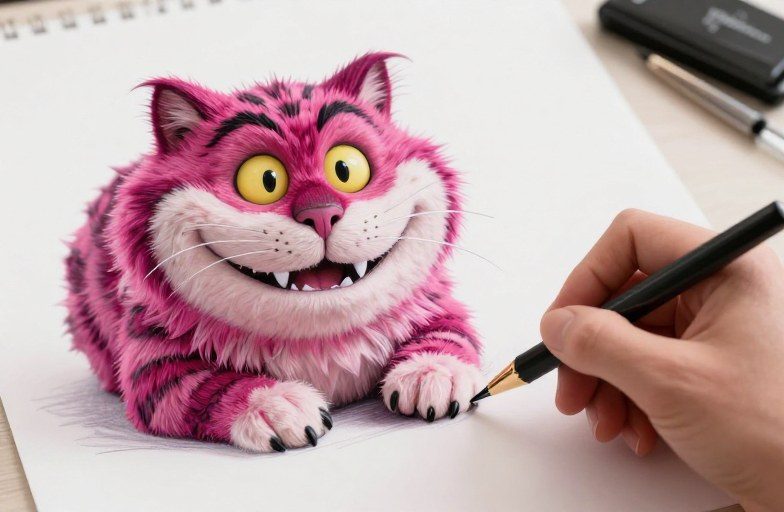
Drawing a Cheshire Cat for tattoo application means designing something that reads instantly at a glance but rewards closer inspection. The character’s core trick is the grin surviving without the cat, so your drawing needs to solve how the eyes, teeth, and negative space interact when the body dissolves or fades into the surrounding skin. This guide covers how to build that design from sketch to stencil-ready art, with practical considerations for how it will sit on actual bodies and age under real conditions.
Tips From the Chair
The best Cheshire Cat tattoos succeed because the artist solved three problems on paper first: silhouette recognition, the uncanny expression, and how much detail will survive at the intended size. Disney’s version and Carroll’s original text offer different starting points, the former gives you rounded, approachable shapes; the latter lets you push into stranger proportions and asymmetry.
Linework vs. Shading Strategy
A grin-heavy design lives or dies by its line weight. The mouth needs heavier outlines than the surrounding fur to keep it from bleeding together as the tattoo ages. Striped cats demand consistency: if your stripes taper, they need to taper predictably, or the pattern looks like a mistake rather than a choice. For the disappearing-body effect, consider building the tail and limbs as negative-space outlines rather than fully rendered forms, less ink means less blur over time, and the visual trick reads cleaner.
- Outline the grin at 0.35, 0.5mm heavier than other facial features
- Keep stripes at least 3mm apart at final size to prevent merge
- Use whip-shading or stipple for the fade-to-nothing body sections; solid black pools and blurs faster
- Eyes: one slightly larger pupil creates the unhinged quality without cartoon exaggeration
Expression Without the Full Face
The classic floating-grin composition removes most reference points. Draw the teeth as individual shapes with gaps between them, merged tooth masses look like a solid white band after healing. The curve of the mouth should rise higher on one side. Test your sketch at arm’s length; if the expression reads as friendly rather than unsettling, push the asymmetry further.
Pain & Comfort
Placement changes the experience more than design complexity does. The Cheshire Cat’s detailed face and stripes mean longer sessions with the needle in constant motion, which accumulates faster than broken-up work with pauses.
High-Detail Zones to Consider
Ribs and sternum flex with breathing, making long linework sessions genuinely difficult to sit through. The outer upper arm or calf offer stable surfaces where you can hold position without constant adjustment. If the design includes the full disappearing body wrapping a limb, the inner bicep and back of knee become involved, both spots swell noticeably and make fine detail harder to execute precisely.
- Thigh (outer or front): generous flat space, moderate sensation, easy to draw large
- Forearm: visible, but frequent movement during healing can affect stripe crispness
- Shoulder cap: good for the grin-only composition, limited real estate for full-body designs
The Direct Answer
Start with the grin as your anchor point. Draw a wide crescent with the upper curve longer than the lower, this creates the upward-tilted smirk. Block in sixteen to twenty teeth as individual rounded rectangles, not points; sharp teeth age poorly and look unintentionally aggressive. The eyes sit above and outside the grin ends, larger than natural cat proportions, with pupils that ignore a shared focal point. Ears come last, drawn as triangles with slightly notched tips, positioned so their inner points aim toward the grin center.
For the disappearing effect, stop the body outline deliberately. Draw stripes that become incomplete strokes, fading to nothing at consistent heights rather than random lengths. The tail can resolve into a single curved line with a question-mark hook. This isn’t laziness, it’s the visual logic of the character, and incomplete lines age better than fully rendered forms that then blur.
What to Expect Step by Step
Design to Stencil
Your drawing transfers to stencil through a thermal or hand-traced process. Fine fur texture and subtle stipple rarely survive this transfer, so separate your drawing into two layers: the bold structural lines that become stencil, and the texture notes you’ll freehand during the session. The grin outline, eye shapes, and major stripe paths must be stencil-perfect; everything else you can rebuild from reference.
During the Session
Linework runs first, usually ninety minutes to three hours depending on scale. The grin gets the most passes, artists often run it twice to ensure saturation. Stripes follow, then any solid black fill. Color, if used, goes last: purples and teals for the Disney reference, or sickly yellow-green for the original Tenniel illustration feel. A floating-grin-only piece might finish in a single session; full body with environmental elements typically needs two.
- Day of: expect redness and plasma weeping for several hours
- Days 2, 4: surface tightening, possible light scabbing on solid black areas
- Week 2: peeling begins from the edges inward; stripes may look patchy temporarily
- Month 2, 3: settled color, true line weight visible, touch-up window opens
Cost Factors
Black-and-grey grin-only designs start around $400, $600 at reputable shops in mid-sized US cities. Full color with environmental elements, trees, mushrooms, the “we’re all mad here” text, run $800, $1,500 and up. The price climbs with scale, not just complexity; a palm-sized precise grin takes more concentration than a spread-out composition with breathing room between elements.
Artist specialty matters. Someone who regularly does illustrative or neo-traditional work will quote higher than a street-shop generalist, but the line confidence shows in the final grin symmetry. Book consultations with artists whose healed work you can see, fresh tattoos look sharp on everyone; five-year-old grins reveal who understood spacing.
Healing Timeline
The Cheshire Cat’s heavy reliance on white and light colors (for teeth, eye highlights, the moonlit quality of many compositions) makes aftercare particularly consequential. White ink sits shallow and drops out easily if scabs are disturbed. Stripes with adjacent black and skin-tone negative space will look distorted during healing; resist the urge to judge the symmetry until month three.
Protecting the Grin’s Read
Keep the tattoo out of direct sun for the first month; UV degrades the purples and teals common to this design faster than black. Once healed, SPF 30+ whenever it’s exposed, the grin needs contrast to function, and faded purple reads as grey, not mysterious. Moisturize regularly; dry skin makes the stripes look cracked and uneven regardless of the actual tattoo quality.
- Swimming pools and hot tubs: avoid for three weeks minimum
- Tight clothing over the area: skip for ten days to prevent stripe distortion from pressure
- Touch-ups: plan for one, especially on the white teeth and any stipple-shaded fade areas
Final Word
Drawing a Cheshire Cat that works as a tattoo means embracing incompleteness as a feature, not a fallback. The character’s entire identity rests on partial information, grin without cat, eyes without context, so your drawing should lean into that rather than fighting it. Build from the grin outward, test your expression at distance, and draw stripes that know when to stop. The best versions feel like they might vanish if you look directly at them, which is exactly the point.
Frequently Asked Questions
How big should a Cheshire Cat tattoo be to keep the details crisp?
The grin alone needs at least palm-sized width to keep individual teeth readable long-term. Full-body designs with stripes should run no smaller than six inches in their longest dimension, or the black stripes risk merging as the ink settles and spreads slightly over years.
Can a Cheshire Cat tattoo work in all black and grey?
Absolutely, and it often ages better. The grin reads through contrast rather than color, so solid black stripes against greywash fur with white teeth holds its impact for longer than color-dependent designs that rely on purple or teal saturation.
Why do the teeth in my healed Cheshire Cat look like one solid blob?
Teeth need deliberate gaps between them in the original drawing, and those gaps must be skin-tone negative space, not just un-inked areas that fill in with shading. If the artist ran greywash too close to the white ink, or if the teeth were drawn touching, healing merges them into a band.
Is the floating grin or full-body Cheshire Cat harder to sit for?
The floating grin is quicker but demands perfect placement, there’s no surrounding detail to distract from slight asymmetry. Full-body designs take longer and involve more needle time, but they’re more forgiving of minor imperfections because the eye travels across more elements.
Related Tattoo Guides
- How to Train Your Dragon Tattoo: A Practical Guide
- Explore more
Leave a Reply