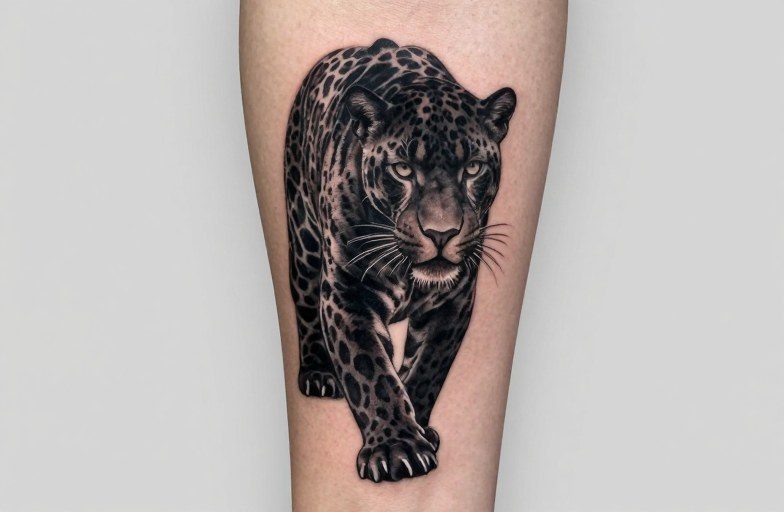
A black jaguar tattoo typically symbolizes dominion over darkness, unseen power, and the ability to move through shadow with lethal precision. Unlike its spotted counterpart, the melanistic jaguar carries added associations with the unknown, the subconscious, and spiritual guardianship across several cultures. The meaning shifts noticeably based on design choices, an open-mouthed predator reads as aggression and protection, while a half-shadowed face suggests mystery and inner exploration.
History & Cultural Roots
Mesoamerican Foundations
The jaguar held supreme status in Olmec, Maya, and Aztec societies. Tezcatlipoca, the Aztec god of night and sorcery, was often linked to the jaguar, and warriors of elite jaguar orders wore the animal’s pelts into battle. Black jaguars specifically, rare in nature, were seen as conduits between the living world and the underworld. Temple carvings at sites like Chichén Itzá show were-jaguars, human-feline hybrids suggesting transformation and shamanic power. For a tattoo drawing from this lineage, the imagery carries weight: you’re invoking something older than national borders, something that once represented divine authority.
Amazonian and Contemporary Indigenous Perspectives
Across the Amazon basin, the jaguar, onça-preta when black, functions as a forest guardian and apex predator whose presence indicates ecosystem health. Some traditions view the black jaguar as a spirit that moves between visible and invisible worlds, able to see what humans cannot. This isn’t universal; specific meanings vary between Tupi-Guarani, Quechua, and other communities. What holds broadly is the animal’s association with mastery and perception beyond ordinary sight. Tattoos drawing from this well often emphasize the eyes, large and reflective, catching light that isn’t there.
How It Ages on Skin
Black Ink Longevity
Jaguar tattoos rely heavily on solid black fill and negative space, which ages better than most color work. The black pigment in modern inks, carbon-based or iron oxide, tends to hold crisp edges for years, though all black softens slightly as it settles into the dermis. A well-executed black jaguar silhouette can remain readable for fifteen to twenty years with minimal touch-up. The risk lies in overworking: too much solid black packed too densely can heal with patchy saturation or raised scarring, especially on thinner skin.
Placement Realities
Large black areas behave differently by body zone. On the outer thigh or upper arm, solid black stays relatively stable. On ribs, sternum, or inner bicep, areas with frequent movement and thinner fat layers, the same design may blur faster and heal with more irritation. The jaguar’s characteristic rosette patterns (visible even in melanistic individuals under certain light) require fine line work that doesn’t hold well on fingers, feet, or anywhere with high friction. If you want the face detailed enough to read from ten feet, plan for at least palm-sized real estate, ideally larger.
Who Chooses This Tattoo
The demographic spans wider than you’d expect. Military and law enforcement often gravitate toward the black jaguar as a symbol of calculated force, power deployed selectively rather than constantly displayed. People recovering from significant life transitions sometimes choose it to mark a period of operating in uncertainty, moving through darkness without losing direction. Artists and musicians occasionally use it as a nod to shadow integration, the Jungian concept of acknowledging rather than suppressing one’s darker capacities. The common thread isn’t profession or background; it’s an identification with potency that doesn’t need to announce itself. Someone who needs you to know how dangerous they are usually picks a roaring tiger or lion. The jaguar, particularly black, appeals to those comfortable with being underestimated.
Similar & Related Symbols
Overlapping Predators
The black panther, technically the same species, since melanistic jaguars and leopards are both called black panthers, carries similar stealth symbolism but loses the specific Mesoamerican weight. The puma or mountain lion, by contrast, represents solitary patience rather than explosive ambush. Wolves emphasize pack loyalty; the jaguar stands alone. In tattooing, these distinctions matter compositionally too. A wolf howling at negative space reads as longing. A jaguar crouched in shadow reads as coiled capability.
Non-Animal Counterparts
Serpents share the jaguar’s underworld associations in Mesoamerican iconography, particularly the feathered serpent Quetzalcoatl as counterbalance to Tezcatlipoca’s jaguar aspect. Skulls, hourglasses, and nocturnal imagery, moons, stars, deep forest, pair naturally with black jaguar designs without becoming cluttered. The key is maintaining the animal’s visual dominance; too many surrounding symbols turn the jaguar into decoration rather than focal point.
Personal & Modern Meanings
Contemporary wearers often layer personal significance onto traditional foundations. Some use the black jaguar to mark survival of depression or addiction, periods of functioning while internally navigating darkness. Others identify with the animal’s ecological role: necessary predation, maintaining balance rather than seeking chaos. The tattoo functions as private marker rather than broadcast message, which suits the jaguar’s actual behavior. In the wild, black jaguars hunt at dawn and dusk, edges of light, using riverine corridors invisible to most observers. That quality, present but not obvious, translates well to people who’ve learned that visibility isn’t always advantage.
Design Tips & Pairings
Stylistic Approaches
Realistic black jaguar portraits demand strong reference photography and an artist experienced in animal fur texture. The challenge: pure black fur offers no natural highlight, so artists must create dimension through subtle gray-wash transitions and strategic negative space suggesting underlying muscle structure. Neo-traditional or illustrative approaches solve this by using stylized rosette patterns, deep greens or purples blended into black, or geometric framing that provides contrast. Japanese-inspired designs sometimes render the jaguar in sumi-e brushstroke style, emphasizing movement over detail.
Complementary Elements
- Jungle foliage: ferns, philodendron, or ceiba tree roots ground the animal in habitat without competing visually
- Obsidian or volcanic glass: references Mesoamerican material culture and adds reflective contrast to matte black ink
- Geometric mandala or meander patterns: frame the jaguar without overwhelming it; best placed behind or below, not overlapping the face
- Text in Nahuatl, Yucatec Maya, or Portuguese: adds cultural specificity, but verify spelling and meaning with native speakers, not internet sources
Scale matters enormously. A jaguar’s power is physical, muscular, not merely symbolic. Wrist-sized versions lose this entirely. The minimum for a recognizable head is roughly four inches in the longest dimension; full body in dynamic pose needs eight to twelve inches to avoid muddling. Chest pieces and back pieces work well; the animal’s horizontal spine aligns with natural body contours.
Key Takeaways
The black jaguar tattoo carries genuine cultural depth without requiring the wearer to claim any specific heritage, respect for the symbol’s origins matters more than bloodline. It ages well technically due to reliance on black ink, but demands adequate size and thoughtful placement to maintain readability. The meaning clusters around power exercised with restraint, navigation of darkness literal or psychological, and solitary self-sufficiency. Design-wise, prioritize the animal’s physical presence; decorative elements should support, not dilute. And finally, the tattoo works best for those who don’t need others to immediately understand what it represents. The jaguar never explains itself. It simply is, visible or not, and that quality might be the most accurate meaning of all.
Frequently Asked Questions
What’s the difference between a black jaguar and black panther tattoo?
Black panther is a catch-all term for any melanistic big cat, jaguar or leopard. A black jaguar tattoo specifically references the Americas, Mesoamerican mythology, and stockier, more muscular build. If you want Latin American cultural resonance, specify jaguar.
Do black jaguar tattoos work on darker skin tones?
Absolutely. Black ink on melanin-rich skin heals with a blue-black cast that can actually enhance the nocturnal, shadow-dwelling quality of the design. The key is an artist experienced with your specific skin tone who knows how to pack black for saturation without overworking.
How much should I expect to pay for a quality black jaguar piece?
A palm-sized detailed black jaguar runs roughly $400-800 USD in most metropolitan areas; larger pieces with background elements can reach $1,500-3,000. The solid black work requires time and precision, bargain hunting here usually shows in patchy healing.
Is it cultural appropriation to get a Mesoamerican-style jaguar tattoo?
The jaguar appears across many indigenous traditions, not a single closed culture. Respect matters: avoid sacred motifs you haven’t researched, don’t claim indigenous identity you don’t hold, and consider whether your design trivializes religious symbolism. When uncertain, consult with artists from relevant communities.


Leave a Reply