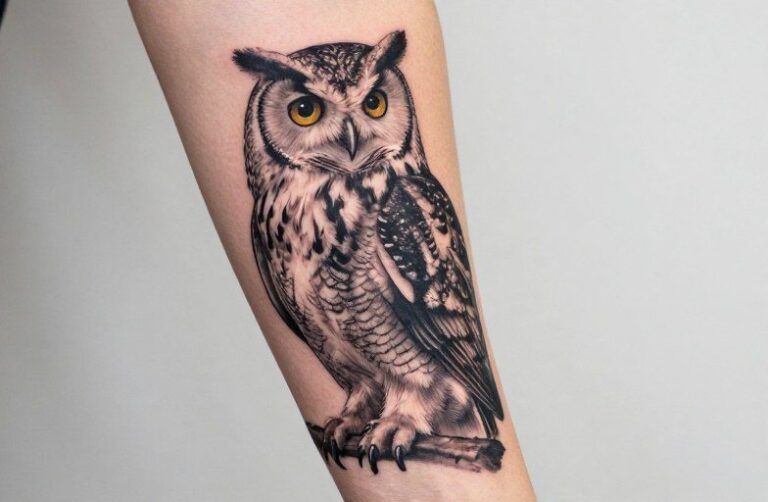
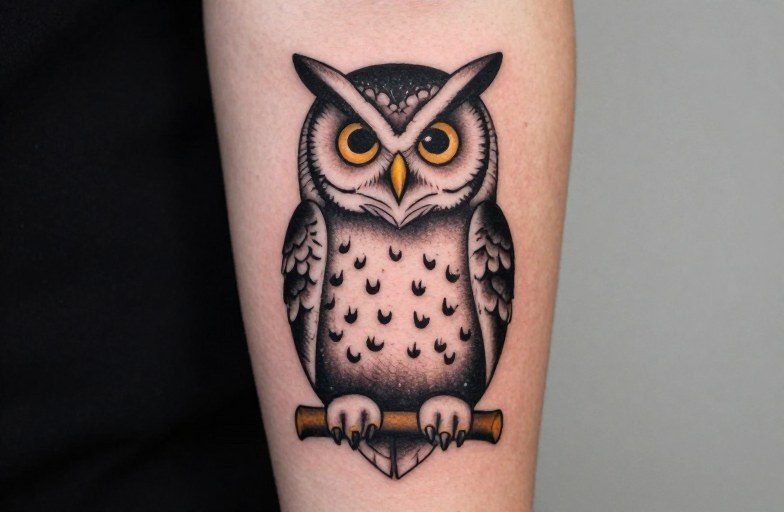
A traditional owl tattoo follows the rules of classic American tattooing: thick black outlines, limited but saturated color palette, flat shading without smooth gradients, and an instantly readable silhouette. The owl itself is rendered with stylized feathers, oversized eyes, and a fierce or watchful expression, often perched on a branch, clutching a banner, or surrounded by roses, skulls, or clocks. The style demands clarity from across a room, not photorealistic detail.
How It Ages
What Holds Up
The traditional owl’s heavy black outline is its armor against time. Those thick borders trap ink densely and slow the spread that blurs finer work. The large eye shapes, usually circles with bold pupils, stay legible for decades because there’s no delicate linework to collapse. Solid color fields, applied properly, fade evenly rather than patchily. A well-executed traditional owl on a forearm or outer thigh can look recognizably the same after fifteen years.
What Softens First
- Thin white highlights painted over black often disappear within 2-5 years as the immune system carries away that surface ink.
- Yellow and orange pigments fade faster than red, green, and black, so beaks and talons may need refresh sooner.
- Inner bicep and chest placements, areas with more friction and moisture, show age quicker than outer arms or calves.
- Feather details done with single-needle lines rather than bold striping blur into indistinct texture.
Placement matters enormously. A traditional owl on the top of the foot or inside the wrist faces constant abrasion and sun exposure; the same design on a shoulder cap or outer forearm ages gracefully.
Choosing the Right Artist
Portfolio Red Flags
Not every artist who does “traditional” actually understands the discipline. Look for portfolios where owls, or similar birds of prey, show consistent weight in their outlines. The feathers should read as geometric patterns, not soft textures. Color should sit flat and uniform, not airbrushed or gradient-heavy. If every owl in their book looks different in style, they’re likely borrowing reference rather than working from internalized knowledge.
Questions Worth Asking
- “Do you draw your own owls, or work from flash?” Either is valid, but custom work should still feel authentically traditional.
- “How do you handle the eye shape?” The answer should involve discussion of negative space and pupil placement, not just “I wing it.”
- “What’s your preferred color brand for yellows?” A specific answer suggests genuine technical concern for longevity.
Shops with actual flash walls, printed sheets of classic designs, often breed artists who respect the tradition more than studios that only do custom work in every style.
Linework & Technique
The Outline as Foundation
Traditional owl tattoos rely on a 7-14 round liner for the main contours, sometimes followed by a 5-7 for interior details. The outline isn’t a sketch to be filled in; it’s the structural skeleton. A proper traditional owl outline should look complete and balanced before any color touches skin. The “whip shading” technique, pulling the needle quickly to create tapered gradients, gives feathers their depth without the smooth blends of neo-traditional or realism.
Feather Pattern Specifics
- Chest feathers: overlapping scallop shapes, often filled with parallel lines or solid black.
- Wing flight feathers: long, bold stripes with distinct separation, not fuzzy edges.
- Ear tufts: stylized into sharp or rounded geometric forms, never wispy.
- Facial disc: concentric circles or radiating lines framing the eyes, a key identifying feature.
The best traditional owl tattoos simplify anatomy into pattern. The bird should look like an owl immediately, but also like a tattoo first.
Color vs Black and Grey
Classic Color Approach
The traditional color owl uses a restricted palette: warm brown or black for body feathers, bright yellow or orange for eyes and beak, red for accents or surrounding roses, green for leaves or background fills. Skin tone serves as the lightest “color.” This limitation is intentional, it forces contrast and readability. A traditional owl drowning in ten colors loses its graphic punch.
Black and Grey Adaptation
Black and grey traditional owls work beautifully but require even more discipline. Without color to separate elements, the artist must rely on stark value contrast: deep blacks for eye pupils and shadowed feather layers, light grey washes for highlights, and pure skin for the brightest points. The risk is muddiness; without the anchor of saturated color, poorly planned grey tones merge into indistinct grey masses. A strong black and grey traditional owl often uses more negative space and heavier black accents than its color counterpart.
Healed black and grey can also shift unpredictably as different grey washes settle. What looks like a clean three-tone separation fresh may compress to two tones after healing.
Aftercare Notes
The First Two Weeks
Traditional owl tattoos with heavy saturation need consistent moisture without drowning. Thick color fields and solid blacks are prone to scabbing if allowed to dry out, and scabs pull ink with them when they lift. A thin layer of fragrance-free lotion, applied whenever the skin feels tight, works better than gooping on ointment. The large eye shapes, often filled with dense yellow or white, are particularly vulnerable to patchy healing if picked or scratched.
Long-Term Preservation
- Sunscreen on exposed placements; UV degrades all pigments but yellows and reds most visibly.
- Avoid prolonged soaking during the first month, no baths, hot tubs, or swimming.
- Loose clothing over fresh work; friction on detailed feather edges can lift healing skin.
- Moisturize regularly after healing; dry skin makes even crisp lines look duller.
Touch-ups are normal and expected, especially for color traditional work. Plan for one session at 6-12 months if the artist offers it included.
Modern Variations
Neo-Traditional Expansion
Neo-traditional owls keep the bold outline but introduce softer shading, more naturalistic anatomy, and expanded color palettes, teals, purples, muted earth tones. The eyes gain dimension with multiple color layers rather than flat circles. This hybrid appeals when you want the owl’s symbolic weight with more decorative complexity. The tradeoff: faster aging and less distance readability.
Japanese Influence
Some artists blend traditional American structure with Japanese owl depictions, more rounded body forms, maple leaves or wind bars as background, and softer color transitions in the feathers. The outline stays bold, but the interior treatment borrows from irezumi. This works best at larger scales where the hybrid elements have room to breathe.
Minimal Stripping
A newer trend reduces the traditional owl to its essential silhouette: the distinctive eye shape, ear tufts, and beak profile, with almost no interior detail. These function as small tattoos, finger pieces, or components in larger assemblies. They age exceptionally well but require an artist with genuine understanding of what makes an owl recognizable at its simplest.
The Takeaway
A traditional owl tattoo succeeds when it honors the style’s constraints: bold outline, flat color, readable form, and symbolic directness. The owl carries associations, wisdom, death, nocturnal vigilance, that the traditional format renders accessible and permanent. Choose an artist whose portfolio proves they can handle the discipline, not just the imagery. Place it where the skin sees less abuse. Accept that yellow beaks and white highlights will need attention sooner than black feathers. The traditional owl isn’t a trend to ride; it’s a specific visual language with its own grammar, and fluency takes both study and respect.
Frequently Asked Questions
Do traditional owl tattoos always need to include a skull or clock?
No. Those are common companion elements in classic flash, but a traditional owl stands alone perfectly. Some people prefer roses, banners with names, or the bird by itself. The style matters more than the surrounding symbols.
How big should a traditional owl tattoo be to hold its detail?
For full readable detail including facial disc and feather striping, plan on at least palm-sized. Smaller than that, and the artist must simplify aggressively, still possible, but it becomes a different tattoo with less interior information.
Why do traditional owl eyes look so different from real owl eyes?
The oversized, forward-facing circular eyes are a stylized convention that increases readability and emotional impact. Real owls have more lateral eye placement and complex iris patterns, but the traditional format sacrifices accuracy for instant recognition and graphic punch.
Is a traditional owl tattoo more painful than other traditional designs?
Pain depends on placement, not subject. An owl on the ribs hurts more than an owl on the outer forearm, same as any tattoo. The dense color packing in large eye and body fills can feel like more continuous pressure than line-only work, but it’s manageable in standard placements.