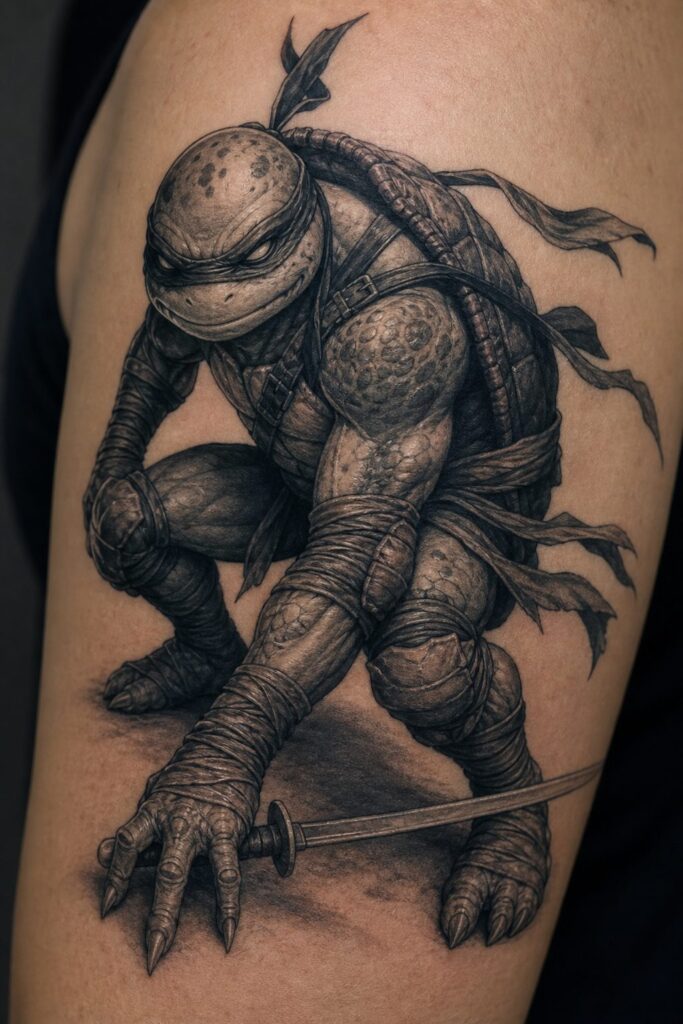
A ninja turtle tattoo signals allegiance to found family, the humor of not taking yourself too seriously, and the stubborn resilience of underdogs. Most people who get one grew up with the 1987 cartoon or the 1990 film, but the staying power comes from what those four brothers represent: skill developed in isolation, loyalty tested by conflict, and personality as armor.
Similar & Related Symbols
Other tattoos occupy the same emotional territory. A three-headed dragon or group of koi swimming upstream carries similar weight around perseverance and collective struggle. The yin-yang echoes the turtles’ balance of opposing forces, Raphael’s aggression against Donatello’s calm, Michelangelo’s play against Leonardo’s duty.
Pop Culture Siblings
Group dynamics from other franchises get similar treatment. Hogwarts house crests, Voltron lions, or Power Ranger colors all serve the same function: identifying yourself by tribe and temperament. The turtles edge ahead for longevity because the source material has been rebooted across four decades, so the reference stays alive without becoming frozen in one era.
Actual Ninja Imagery
Historical shinobi symbols, shuriken, kusarigama, masked figures in keikogi, share DNA but land differently. The real-deal ninja tattoo reads as martial arts dedication or Japanese heritage. The turtle version is self-aware, almost defiantly silly. That contrast is the point. You’re not pretending to be a shadow warrior; you’re claiming the right to be dangerous and ridiculous at once.
Design Tips & Pairings
Placement shapes how the tattoo reads. A single turtle head or mask color works as a small bicep or calf piece, readable from six feet away. Full-body turtle poses need thigh, back, or outer forearm real estate, anywhere the shell’s curve and the weapon’s line can breathe.
Composition That Works
- Single mask: Clean, immediate, color-coded. Purple for Donatello, red for Raphael, blue for Leonardo, orange for Michelangelo. The mask color does all the identification work.
- Four-up grouping: Best across the upper back or around a thigh. Stagger the heights so weapons don’t tangle. Keep each turtle’s silhouette distinct, Leo with swords raised reads differently than Mikey with nunchaku spinning.
- Action pose vs. portrait: Action needs more space and benefits from dynamic background (sewer brick, city skyline, pizza box edge). Portrait style, face and shoulders only, holds up better at small sizes and ages cleaner.
What Pairs Well
Pizza slices are the obvious companion, but consider sewer grate patterns, Japanese cloud motifs, or 1990s comic book halftone dots as background texture. A rat silhouette (Splinter) or foot clan symbol adds narrative without cluttering. Avoid cramming all four brothers plus Splinter plus Shredder plus the Technodrome into one piece, choose your focal point and let negative space do work.
Color vs Black and Grey
The mask colors are the entire shorthand system. In color, a purple mask instantly signals Donatello; in black and grey, you lose that instant read unless the design compensates with weapon or body language clarity.
When Color Wins
Color suits new-school styling, comic-book linework, or any piece where the nostalgic punch matters. The green of turtle skin and the specific orange-red-purple-blue of the masks are burned into visual memory from childhood. Color also ages better on lighter skin tones where saturation holds, and on areas with less sun exposure (upper arm under short sleeves, torso, thigh).
When Black and Grey Works
Black and grey excels for realistic rendering, a turtle as actual animal, not cartoon, with ninja gear rendered in photorealistic texture. It also suits smaller pieces where color would muddy, and darker skin tones where black ink contrast reads sharper than color. The trade-off: you need stronger composition to communicate which turtle is which, since color can’t do that labor.
How It Ages on Skin
Green ink, especially the brighter yellow-greens common in turtle tattoos, is notorious for fading toward blue-grey over time. The specific pigment chemistry shifts, yellow components break down faster than blue. Plan for this: either accept the cool-tone drift or budget for touch-ups every 5-8 years.
Line weight matters enormously. The cartoon’s thin black outlines, if replicated exactly at small size, spread and blur within 3-5 years. Tattoo lines need to be slightly heavier than the source image suggests, particularly around the eyes and mouth where expression lives. A 2-inch turtle face on an ankle will be a green blob in a decade. A 4-inch version on a forearm, with 0.5mm minimum line weight, stays readable.
Shell detail is the first thing to go. The hexagonal pattern that reads so clearly fresh becomes visual noise as skin texture changes. Simplify the shell pattern from the start, fewer, larger segments rather than intricate geometry.
Common Variations & Styles
The 1987 cartoon look, with rounded snouts and bright primaries, dominates but isn’t the only option. The 1990 live-action film suits, rubbery, textured, more menacing, translate to realistic or neo-traditional treatments. The 2012 Nickelodeon CGI redesign, with slimmer builds and anime-influenced eyes, works for illustrative or anime-style tattooing.
Dark or Horror Twists
Some go zombie turtle, rotted flesh, exposed shell cracks, weapons rusted. Others do samurai armor versions, treating the turtle as actual feudal Japanese warrior. These work best when committed fully; a half-measure horror turtle just looks like a bad rendering. The “Turtle in a Suit” meme style (formal wear, cigarette, noir lighting) has emerged as a specific sub-genre, usually black and grey, usually upper arm.
Minimalist Approaches
Just the mask, just the weapon silhouette, or just the initial letter in the correct color, a blue “L” for Leonardo, an orange “M” for Michelangelo. These read as insider signals, recognizable to those who know, abstract to others. The risk is genericism: a colored letter tattoo needs additional context (placement, surrounding elements) to avoid looking like a sports team logo.
Mythology & Folklore
The Teenage Mutant Ninja Turtles were born from a satirical comic in 1984, a parody of Frank Miller’s dark, serious Daredevil run. The origin story, turtles exposed to mutagenic ooze, trained by a rat in ninjutsu, was deliberately absurd. That parody origin is often linked to the Japanese myth of the kappa, river-dwelling turtle-like creatures known for martial arts skill and mischief, though the creators have cited direct inspiration from a doodle of a turtle with nunchaku.
The four-to-one dynamic (four students, one master) mirrors martial arts training structures across multiple traditions, commonly associated with Chinese and Japanese fighting schools. The turtles’ names, Renaissance artists chosen as a joke by the creators, have no traditional symbolic weight, but the accidental result is a collision of European humanism and Japanese combat discipline that the tattoo can play up or ignore.
Some trace the turtle’s broader symbolic resonance to North American Indigenous traditions, where the turtle carries the world on its back, or to Chinese cosmology, where the Black Tortoise (Xuanwu) guards the north. These associations aren’t inherent to the ninja turtle image, but people sometimes layer them in consciously, choosing the turtle for multiple overlapping reasons.
What to Remember
The ninja turtle tattoo works because it’s specific. It names a particular childhood, a particular attitude toward loyalty and conflict, a particular comfort with being silly and serious in the same breath. The design choices, color or not, which brother, which era’s styling, are how you make that general signal personal.
Get the line weight right for longevity. Accept that green shifts. Know that the mask color is doing symbolic labor you can’t easily replace. And recognize that this is one of the few tattoos where smiling at your own arm is the entire point, not every piece needs to be grave to be meaningful.
Frequently Asked Questions
Which Ninja Turtle should I choose if I want to represent a specific trait?
Leonardo for leadership and duty, Raphael for passion and defiance, Donatello for intelligence and calm problem-solving, Michelangelo for joy and adaptability. Most people pick the one they identified with as a kid, not the one they think they should be.
Will a Ninja Turtle tattoo look unprofessional as I get older?
The cartoon style reads as playful, but placement matters more than subject. A small mask on the forearm is easier to cover than a full sleeve. The tattoo’s tone, nostalgic, not juvenile, depends on execution quality and your comfort with it.
How much does a full-color Ninja Turtle sleeve typically cost?
Sleeves run into multiple sessions regardless of subject. A four-turtle composition with background elements usually needs 15-25 hours minimum. Pricing varies enormously by region and artist tier, so consult specific shops rather than estimating broadly.
Can I mix different art styles from different TMNT eras in one tattoo?
Mixing 1987 cartoon faces with 2014 film bodies creates visual dissonance. If you want multiple eras represented, separate them spatially, different arms, or foreground versus background, or commit to one unified style interpreted by your artist.
Leave a Reply