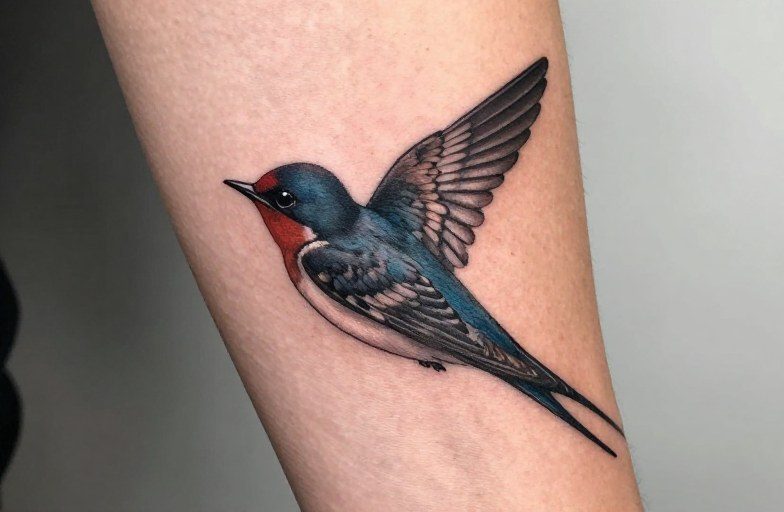
The swallow tattoo meant, for sailors, that you had survived enough open ocean to earn your way home. The bird stays close to land, so spotting one meant solid ground ahead. That practical signal hardened into something more permanent: a mark of distance traveled, a promise to return, and a quiet hope that if you didn’t make it, the bird would guide you onward.
Where the Tradition Started
The nautical swallow is often linked to British and American naval practice in the 18th and 19th centuries, though exact documentation is sparse. Tattoo historians note that by the early 1900s, the design was common enough among sailors to be recognizable shorthand. The bird’s value was immediate and visible: unlike a ship’s log, a swallow on your chest couldn’t be disputed.
The Mileage Claim
You will hear that one swallow meant 5,000 nautical miles, two meant 10,000. This is widely repeated in tattoo folklore and may reflect actual practice, but no naval regulation codified it. What matters is that the tattoo functioned as a credential. A sailor with swallows had been somewhere and returned. The chest placement kept this credential visible: above the heart, wings angled upward, a declaration rather than a secret.
Safe Return and Fidelity
Swallows return to the same nesting sites year after year. Sailors tattooed the bird as a promise to come back to partners, parents, or a particular port. The design also carried protective weight: folk belief held that if a sailor drowned, the swallow would carry the soul to rest. Whether sailors literally believed this or found comfort in the gesture is harder to know. The tattoo served those waiting on shore too, something to touch while the ship was out of sight.
- Distance traveled and survived
- Promise of return to home or partner
- Protection for the voyage
- Comfort for those left waiting
- Hope during prolonged hardship
How the Design Wears Over Time
The swallow’s simple shape is part of its longevity as a tattoo. A bird in flight, forked tail, pointed wings: the silhouette reads even when details soften. But how you execute it determines whether it lasts five years or twenty.
Traditional American Style
Bold black outlines, saturated red or blue chest panels, the tail fanned wide. The classic sits high on the pectorals, wings sweeping upward. This style ages well because the heavy line work resists blurring, and the limited palette, red, blue, black, yellow, avoids the muddy blending that kills softer designs. The traditional swallow is stripped of fine feather detail that would become unreadable anyway. What looks like simplicity is actually restraint.
Realistic and Neo-Traditional
Realistic swallows trade bold outlines for individual feather barbs, graduated breast shading, anatomically accurate tail proportions. These need space: four inches or more, or the detail collapses into grey mush. Neo-traditional keeps the strong outline but adds ornamental elements, jewel tones, or decorative backgrounds. Both approaches demand more skin and more patience in the chair. The question is whether you want a tattoo that reads clearly from across the room or one that rewards close inspection.
Color or Black and Grey
Color changes how the tattoo announces itself and how it fades.
Traditional color swallows use opaque red and blue packed solid into the wings. Dense pigment, well-saturated, often outlasts subtle black and grey work that relies on gradation. The trade-off is stylistic inflexibility: color reads as vintage, nautical, deliberate. You are making a historical reference whether you intend to or not.
Black and grey suits contemporary placements: behind the ear, on the wrist, integrated into larger sleeves. Without color, attention shifts to line quality and negative space. A single-needle black swallow on the forearm feels lighter, more modern, less explicitly maritime. Over decades, black and grey softens into the skin more naturally than color, though it can fade to a blue-grey haze if the black was not saturated deeply enough.
Skin tone matters. Color pops differently on pale skin versus melanin-rich skin; a competent artist adjusts pigment opacity rather than applying the same formula everywhere. Black and grey is more forgiving across skin tones but still requires adjusted contrast. Ask your artist to show you healed work on skin similar to yours, not just fresh photos.
Placement and Composition
The chest pair, one swallow on each pectoral, maintains the symmetrical sailor tradition and frames the torso effectively. But single swallows work almost anywhere: collarbones, ribs, hands, behind the ear. The bird’s diagonal flight path follows natural muscle lines, so it moves with your body rather than fighting against it.
What Pairs Well
Swallows sit naturally with maritime imagery: ships, anchors, compasses, roses. The anchor-and-swallow combination is common enough to feel traditional, specific enough to avoid genericity. Roses add softness against the bird’s sharp geometry. Clocks or banners with names or dates personalize without drifting into clip-art territory.
The risk is overcrowding. The swallow’s strength is its readable silhouette. Bury it in filigree and it becomes decorative noise. Negative space lets the design breathe and keeps it legible from a distance.
Size and Longevity
Small swallows, under two inches, lose detail fast. The forked tail blurs into a stub; the eye becomes an indistinct dot. For longevity, three to four inches minimum on the chest, slightly smaller for fine-line work on arms or legs where the design is not competing with chest hair or sun exposure. Line weight should vary: thick outlines on the wings and body, finer lines for feather texture that can fade gracefully rather than turning to uniform grey.
Religious and Spiritual Readings
The swallow appears in Christian iconography, often linked to the Incarnation and the coming of spring. Resurrection imagery overlaps with the sailor’s hope of return. Some medieval art shows swallows nesting near the Virgin Mary, symbolizing domestic fidelity and protection over the home.
More broadly, the swallow’s migration mirrors human patterns: departure, trial, return, renewal. In 19th-century folk art, the bird’s refusal to stay caged made it a minor symbol of freedom, though this meaning is less fixed than the nautical tradition. For tattoo purposes, the spiritual resonance is usually personal rather than doctrinal: a sense of being watched over, of cycles completing, of faith in return.
Some wearers reject the religious layer entirely, wanting purely maritime heritage. Others lean into it with crosses, halos, or biblical banners. The tattoo’s history is broad enough to hold both approaches without forcing a choice.
What It Means Now
Most people wearing swallow tattoos today have never logged nautical miles. The meaning has stretched to cover any significant journey: emigration, recovery, military deployment, career change. The pattern is consistent: leaving, enduring, returning changed.
Contemporary Placements
The swallow has moved beyond its masculine naval origins. Women often place it on the hip, ribcage, or shoulder blade with softer styling. Couples get matching swallows as commitment marks, referencing the bird’s mating fidelity without the sailor context. Memorial swallows carry initials or dates, the safe-return promise inverted into hope of reunion after death.
Subcultural Staying Power
The swallow persists in punk and rockabilly circles for its working-class tattoo heritage, worn as anti-pretension. In fine-line minimalist trends, it gets stripped to a single continuous outline, almost abstract. Both approaches work because the underlying shape is so recognizable. Like a skull or a rose, it survives stylization without becoming unidentifiable.
Modern wearers often choose the swallow for its visual clarity rather than explicit meaning. That is valid. A tattoo does not need a paragraph of symbolism to justify its place on skin. The swallow’s particular strength is that it carries weight whether you explain it or not.
The Bottom Line
The swallow nautical tattoo endures because it balances specific history with open-ended personal meaning. It marks experience without demanding explanation, honors tradition without being imprisoned by it. Whether you choose saturated traditional color on your chest or a fine-line black bird on your wrist, the core remains: movement, return, survival.
Pick an artist who understands line weight and how it ages. Place it where your body moves naturally with the design. Let the bird do what it has always done: signal that you have been somewhere, and you made it back.